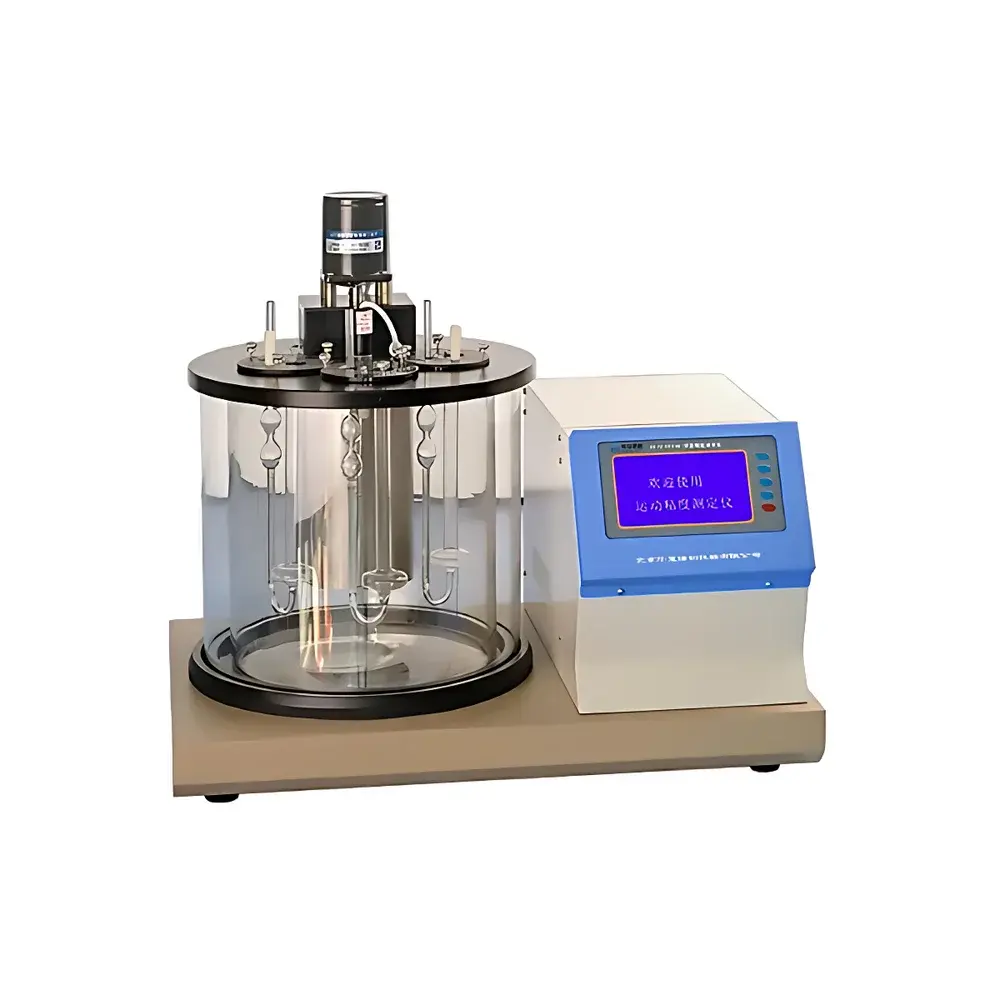
HX-VIS1000 Kinematic Viscosity Tester by Spectra Invent
| Brand | Spectra Invent |
|---|---|
| Origin | Beijing, China |
| Manufacturer Type | Authorized Distributor |
| Country of Origin | China |
| Model | HX-VIS1000 |
| Compliance Standard | GB/T 265 |
| Power Supply | AC 220 V ±10%, 50 Hz |
| Operating Temperature | 5–40 °C |
| Relative Humidity | ≤85% |
| Dimensions (W×D×H) | 545 × 370 × 500 mm |
| Weight | 18.4 kg |
Overview
The HX-VIS1000 Kinematic Viscosity Tester is a precision laboratory instrument engineered for the accurate determination of kinematic viscosity in liquid petroleum products, including lubricating oils, transformer oils, hydraulic fluids, and fuel oils. Kinematic viscosity—defined as the ratio of dynamic viscosity to density at a specified temperature—is a fundamental rheological property governed by Newtonian flow behavior under gravitational driving force. This instrument implements the capillary viscometry principle per GB/T 265 (equivalent to ISO 3104 and ASTM D445), wherein a calibrated Ubbelohde-type or Cannon-Fenske (Ostwald) capillary tube is used to measure the efflux time of a fixed volume of sample under gravity. The measured time is converted to kinematic viscosity (mm²/s, equivalent to centistokes, cSt) using tube-specific calibration constants and standardized temperature control (±0.01 °C stability). Designed for routine QC/QA laboratories in refineries, power generation facilities, and third-party testing centers, the HX-VIS1000 delivers high reproducibility across repeat measurements and supports traceable calibration protocols aligned with ISO/IEC 17025 requirements.
Key Features
- Integrated constant-temperature bath with PID-controlled heating and refrigeration modules, maintaining bath stability within ±0.01 °C over the operational range (typically 20 °C to 100 °C, configurable per standard method)
- Dual-capillary support: Pre-installed Ubbelohde-style viscometer tube compliant with GB/T 265; optional interchangeable tubes available for extended viscosity ranges (e.g., low-viscosity fuels or high-viscosity bitumens)
- Automated efflux timing system with optical sensor detection and microsecond-resolution stopwatch logic, eliminating operator-dependent parallax error
- Modular bath design enabling rapid thermal equilibration and uniform temperature distribution across multiple test positions
- Robust stainless-steel housing with corrosion-resistant internal components suitable for long-term exposure to hydrocarbon solvents and cleaning agents
- Compliance-ready architecture: Supports manual or semi-automated data logging compatible with GLP/GMP documentation workflows
Sample Compatibility & Compliance
The HX-VIS1000 is validated for use with transparent, homogeneous liquid petroleum derivatives meeting the clarity and volatility criteria outlined in GB/T 265 and ISO 3104. Compatible samples include mineral-based and synthetic lubricants, diesel fuel, jet fuel (Jet A-1), insulating oils, and light distillates. Non-applicable samples include opaque suspensions, emulsions, highly viscous residues (>100,000 mm²/s), or thermally unstable fluids requiring inert-atmosphere handling. All test procedures adhere strictly to national and international regulatory frameworks: GB/T 265 (China), ASTM D445 (U.S.), ISO 3104 (global), and IP 71 (UK). Instrument qualification includes documented installation qualification (IQ), operational qualification (OQ), and performance verification against NIST-traceable reference oils (e.g., Cannon Standard Reference Oils).
Software & Data Management
While the base HX-VIS1000 operates in standalone mode with analog/digital readout and manual calculation, an optional USB-enabled data interface allows integration with Spectra Invent’s VisCal™ desktop software (v3.2+). VisCal™ provides automated viscosity computation, statistical reporting (mean, SD, RSD), calibration curve management, and audit-trail-enabled user access logs. Export formats include CSV, PDF, and XML for LIMS compatibility. Software functionality conforms to FDA 21 CFR Part 11 requirements when deployed with electronic signature modules and role-based user permissions—supporting regulated environments subject to pharmaceutical-grade QA oversight or ISO 17025 accreditation audits.
Applications
- Quality control of turbine and transformer oils in power generation plants per IEC 60296 and DL/T 429.6
- Viscosity grading of engine oils (SAE J300) and gear oils during formulation and batch release
- Monitoring oxidative degradation in in-service lubricants via trending of kinematic viscosity drift
- Specification compliance testing for aviation fuels (ASTM D1655 Annex A1) and marine distillates (ISO 8217)
- R&D screening of bio-based lubricants and alternative fuel blends where shear-independent viscosity behavior is critical
- Supporting predictive maintenance programs through correlation of viscosity changes with equipment wear patterns
FAQ
What standards does the HX-VIS1000 comply with?
The instrument fully supports GB/T 265, ISO 3104, ASTM D445, and IP 71 methodologies, with hardware and procedural validation aligned to each standard’s bath geometry, temperature tolerance, and timing accuracy requirements.
Can it be used for non-petroleum liquids such as glycols or silicone oils?
Yes—provided the sample is Newtonian, optically clear, and falls within the measurable efflux time window (typically 200–600 seconds per GB/T 265); however, calibration constants must be verified using certified reference materials specific to the fluid class.
Is temperature calibration traceable to national standards?
Yes. Bath temperature sensors are supplied with individual calibration certificates traceable to CNAS-accredited laboratories (equivalent to NIST or PTB), and users may perform periodic verification using certified platinum resistance thermometers (PRTs).
Does the system support multi-sample throughput?
The standard configuration accommodates one viscometer tube; optional multi-bath or parallel-tube configurations are available for high-volume labs, subject to custom engineering and validation.
How is maintenance performed on the capillary system?
Capillary tubes are removable and cleanable using standardized solvent rinses (e.g., toluene, xylene) followed by nitrogen purge; routine inspection for bore integrity and meniscus formation is recommended per ISO 4787 guidelines.