
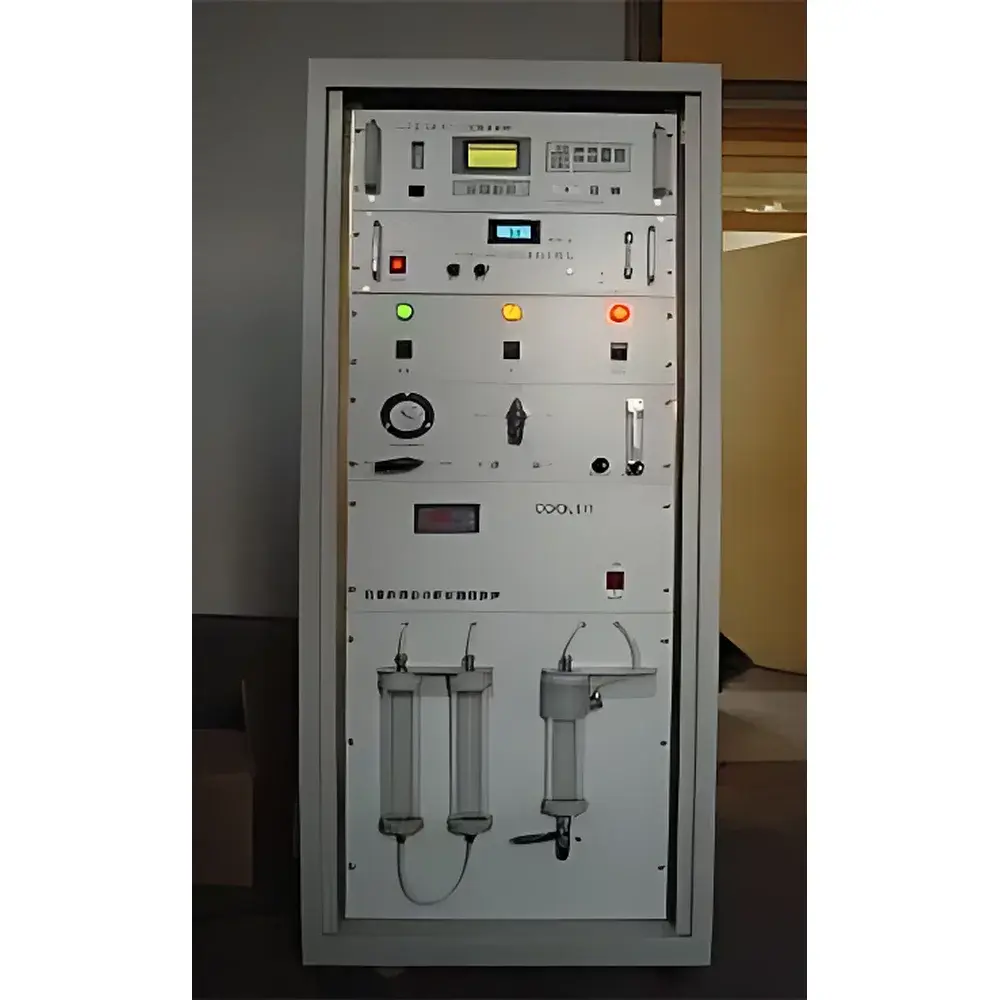
HY-3000 Continuous Emission Monitoring System (CEMS) for Municipal Solid Waste Incineration Flue Gas
| Origin | Beijing, China |
|---|---|
| Manufacturer Type | Authorized Distributor |
| Model | HY-3000 |
| Instrument Type | Continuous Emission Monitoring System (CEMS) |
| Measurement Repeatability | <1% |
| Response Time | 30 s |
| Measured Gases | CO, CO₂, CH₄, O₂ |
Overview
The HY-3000 Continuous Emission Monitoring System (CEMS) is an industrial-grade, extractive-type flue gas analysis platform engineered for regulatory-compliant, real-time monitoring of combustion emissions from municipal solid waste (MSW) incineration facilities. Designed in accordance with the fundamental principles of non-dispersive infrared (NDIR) spectroscopy for CO, CO₂, and CH₄, and electrochemical or paramagnetic detection for O₂, the system delivers stable, interference-resistant quantification under high-dust, high-moisture, and thermally variable stack conditions typical of waste-to-energy plants. Its architecture adheres to the functional requirements outlined in EN 15267-3 (performance certification of CEMS), ISO 14956 (air quality — evaluation of air quality measurement results), and supports alignment with national emission standards such as China’s GB 18485–2014 (Emission Standard for Pollution Control of Municipal Solid Waste Incineration) and EU Directive 2010/75/EU (Industrial Emissions Directive, IED). The HY-3000 operates as a certified CEMS solution—not a portable or spot-check instrument—intended for permanent installation, continuous data logging, and integration into plant-wide environmental management systems.
Key Features
- Multi-Gas Simultaneous Detection: Integrated NDIR optical cells for CO (0–10,000 ppm), CO₂ (0–25 vol%), CH₄ (0–5,000 ppm), and dual-sensor O₂ module (0–25 vol%) enable concurrent, cross-interference-compensated analysis without manual switching or calibration cycling.
- Robust Extractive Sampling Train: Heated sample probe (180 °C), PTFE-lined sampling line, condensate removal via chiller or permeation dryer, and particulate filtration down to 0.3 µm ensure representative gas delivery while minimizing acid condensate formation and filter clogging.
- High Repeatability Performance: Achieves measurement repeatability better than ±1% of full scale across all channels under steady-state stack conditions—validated per ISO 5725-2 guidelines for precision assessment.
- Rapid Dynamic Response: Total system response time (T₉₀) ≤30 seconds from inlet to validated digital output, meeting minimum performance criteria for process feedback and alarm triggering in incineration control loops.
- Modular Hardware Architecture: Rack-mounted analyzer unit with hot-swappable sensor modules, redundant power supply, and configurable analog (4–20 mA) and digital (RS485/Modbus RTU, optional Ethernet/IP) outputs for seamless SCADA and DCS integration.
- Environmental Resilience: IP54-rated enclosure; operating ambient temperature range: −10 °C to +50 °C; designed for deployment in unconditioned equipment shelters adjacent to boiler houses or flue ducts.
Sample Compatibility & Compliance
The HY-3000 is validated for use with flue gases generated from grate-fired, fluidized-bed, and rotary kiln MSW incinerators. It accommodates gas matrices containing up to 20% water vapor (saturated), ≤50 mg/Nm³ total suspended particulates (after primary filtration), and trace halogen acids (HCl, HF) when used with corrosion-resistant sampling components. While not intrinsically certified for Zone 1 hazardous areas, it may be installed in classified zones when deployed with appropriate purge or pressurization systems compliant with IEC 60079-2. Data reporting meets mandatory requirements for Chinese provincial ecological environment departments—including 1-minute averaged values, 1-hour rolling averages, and daily mass emission totals—as well as audit-ready electronic logs traceable to UTC timestamps. System validation follows QAL2 (Quality Assurance Level 2) procedures per EN 14181, supporting annual recertification and third-party verification.
Software & Data Management
Built-in embedded Linux OS runs dedicated CEMS firmware with local HMI (7″ resistive touchscreen) for configuration, diagnostics, and real-time trend visualization. All measurements are timestamped with millisecond resolution and stored internally for ≥30 days (circular buffer). Data export is supported via USB, SD card, or network transfer in CSV and XML formats compliant with China’s HJ 75–2017 and HJ 76–2017 technical specifications for CEMS. Optional cloud gateway enables TLS-encrypted transmission to provincial environmental monitoring platforms (e.g., National Pollutant Discharge Permit Management Information Platform). Audit trail functionality records all user actions—including calibration events, parameter changes, and maintenance logs—with immutable digital signatures satisfying GLP-aligned record retention policies. Remote access is available via secure SSH or VNC with role-based permissions (operator, engineer, auditor).
Applications
- Continuous compliance monitoring of CO (incomplete combustion indicator) and O₂ (combustion efficiency proxy) in MSW incinerator stacks per GB 18485 limits.
- CH₄ quantification during low-load or start-up phases to support greenhouse gas (GHG) inventory reporting under national carbon accounting frameworks.
- CO₂ concentration trending for thermal efficiency optimization and heat recovery system diagnostics.
- Integration with lime injection or SCR control systems via 4–20 mA feedback loops for dynamic reagent dosing.
- Supporting environmental impact assessments (EIAs), permit renewal applications, and annual environmental reports required by local MEE bureaus.
FAQ
Does the HY-3000 meet U.S. EPA PS-11 or PS-15 equivalency requirements?
No—the HY-3000 is designed and certified for compliance with Chinese national standards (GB, HJ) and EU EN standards. It has not undergone U.S. EPA Performance Specification testing or been listed on the EPA CEMS Certification List.
Can the system measure SO₂ or NOₓ?
Not natively—the base HY-3000 configuration includes only CO, CO₂, CH₄, and O₂. Optional add-on modules for UV-DOAS-based SO₂/NO/NO₂ detection are available under separate model variants (e.g., HY-3000-SN), subject to additional QAL1 certification.
What maintenance intervals are recommended?
Filter replacement every 7 days under typical MSW conditions; NDIR optical cell cleaning every 90 days; O₂ sensor replacement annually or after 18 months of continuous operation; full system QAL2 verification every 6 months.
Is remote calibration supported?
Yes—zero/span calibration can be initiated remotely via Modbus command or web interface, provided certified calibration gases (NIST-traceable) are connected to the auto-calibration manifold.
How is data integrity ensured during power interruption?
The unit features a 30-minute battery-backed RTC and non-volatile flash memory; all active measurements and event logs are preserved across blackouts and cold restarts without loss.
Related Products







