
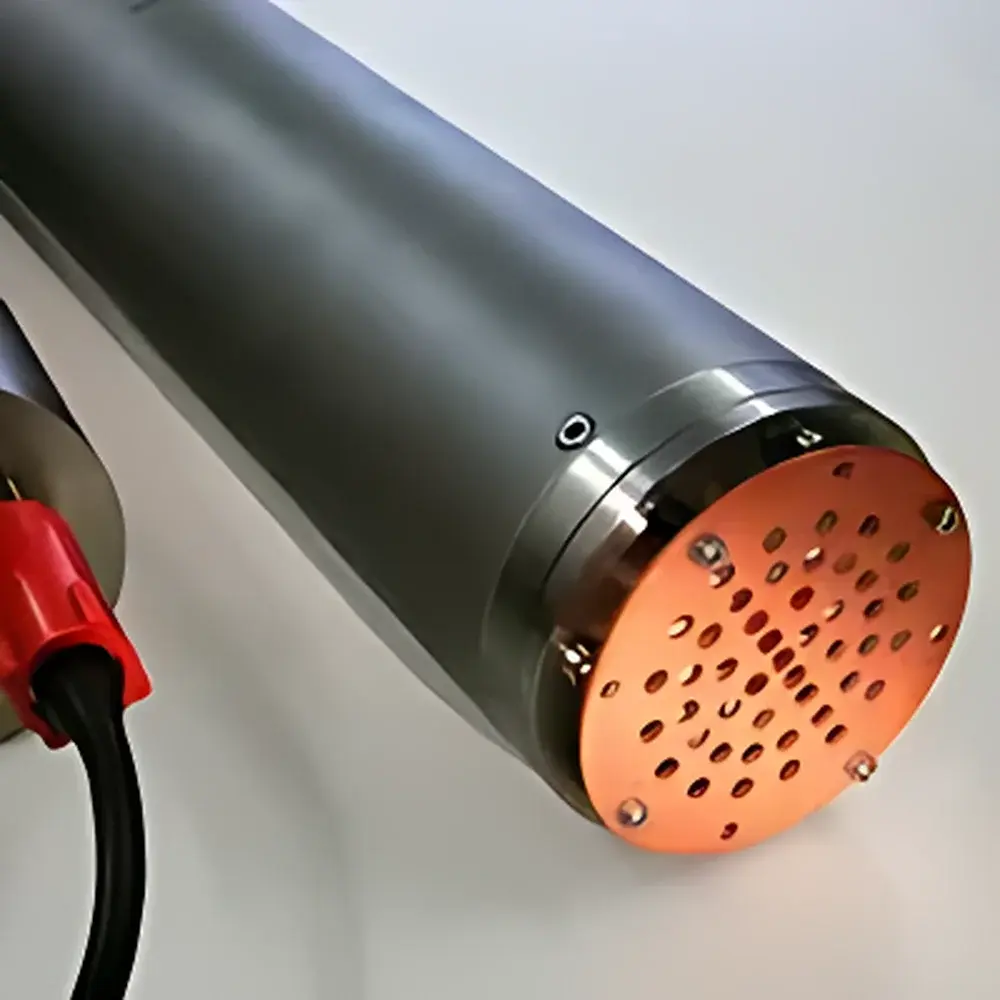
HYDRO-CO2 Submersible In Situ Carbon Dioxide Sensor
| Origin | Germany |
|---|---|
| Manufacturer Type | Authorized Distributor |
| Origin Category | Imported |
| Model | HYDRO-CO2 |
| Pricing | Upon Request |
Overview
The HYDRO-CO2 is a high-precision, submersible in situ carbon dioxide (CO₂) sensor engineered for long-term, real-time monitoring of aqueous CO₂ partial pressure (pCO₂) in marine and freshwater environments. It operates on the principle of non-dispersive infrared (NDIR) spectroscopy: dissolved CO₂ diffuses across a patented silicone membrane into an optical measurement chamber, where it selectively absorbs infrared radiation at 4.26 µm. A photodetector quantifies the attenuation of this wavelength, enabling calculation of pCO₂ with trace-level sensitivity. Unlike extractive or headspace-based systems, the HYDRO-CO2 performs direct, membrane-mediated equilibration—eliminating sampling artifacts, flow dependence, and calibration drift associated with pumped systems. Its robust titanium housing and pressure-compensated optical path ensure metrological stability across extreme hydrostatic conditions, making it a reference-grade instrument for ocean carbon cycle research, air–sea CO₂ flux quantification, and biogeochemical time-series observatories.
Key Features
- Patented silicone membrane design optimized for diffusion kinetics and pressure resilience—available in three thicknesses (2 mm, 4 mm, 10 mm) matched to operational depth classes (≤2000 m, ≤4000 m, ≤6000 m)
- Titanium alloy (Grade 5, Ti-6Al-4V) pressure housing rated for full-ocean-depth deployment; corrosion-resistant, non-magnetic, and compatible with AUV/ROV integration
- True in situ measurement: no fluid pumping, no reagents, no consumables—enabling unattended operation for >12 months
- Auto-zeroing capability via internal reference channel and software-controlled zero-point verification; supports field recalibration using certified gas standards or buffer solutions
- Configurable analog outputs (0–5 V, 0–10 V, 4–20 mA) and digital interfaces including RS-232, RS-485 (binary), ASCII, and NMEA-0183 protocols
- Optional integrated SmartDI data logger with 2 GB flash memory, onboard timestamping, and GLP-compliant audit trail generation
Sample Compatibility & Compliance
The HYDRO-CO₂ is validated for use in seawater (salinity 0–40 PSU), brackish water, and freshwater systems—including estuarine, benthic, pelagic, and cryospheric (under-ice) environments. Its silicone membrane exhibits minimal interference from H₂S, CH₄, SO₂, and volatile organic compounds, while remaining impermeable to water vapor and liquid-phase ions. The sensor complies with ISO 17025-accredited calibration practices and supports traceability to NIST-traceable CO₂ standards. For regulatory or QA/QC applications, its output metadata structure aligns with FAIR data principles and meets minimum requirements for submission to international repositories such as SOCAT (Surface Ocean CO₂ Atlas) and ICOS (Integrated Carbon Observation System). All firmware and data handling routines are designed to support 21 CFR Part 11 compliance when deployed with SmartDI’s secure logging module.
Software & Data Management
Sensor configuration, real-time diagnostics, and data retrieval are managed via HydroSoft—a cross-platform application supporting Windows, macOS, and Linux. HydroSoft enables remote parameter adjustment (e.g., averaging interval, output scaling, zero offset), firmware updates, and spectral validation reports. When paired with SmartDI, raw detector signals and environmental metadata (temperature, pressure, timestamps) are stored with CRC-32 error checking and optional AES-128 encryption. Export formats include CSV, NetCDF4 (CF-compliant), and MATLAB-compatible .mat files. Integration with OceanPack+ mobile platforms provides synchronized CO₂/CH₄ flux computation using dual-gas covariance algorithms, while ROS (Robot Operating System) drivers facilitate plug-and-play deployment on AUVs such as REMUS or Seaglider.
Applications
- Air–sea CO₂ flux estimation in open-ocean moorings (e.g., PAPA, BATS, SOCCOM arrays)
- Benthic chamber studies measuring sediment–water exchange and ecosystem respiration
- Time-series monitoring of coastal acidification and hypoxia-driven CO₂ dynamics
- Calibration and validation of satellite-derived sea surface pCO₂ products (e.g., from OCO-2, GOSAT, or future CO2M missions)
- Integration into autonomous observatory networks (e.g., EMSO, ESONET) for climate-relevant biogeochemical parameterization
- Under-ice measurements in polar regions to assess winter outgassing and seasonal carbon budgets
FAQ
What is the difference between the “Shorty” and “Long John” configurations?
The “Shorty” version (380 mm length) uses a shorter optical path and thinner membrane for rapid response (T₆₆ ≈ 30 s) in shallow-water or high-temporal-resolution applications. The “Long John” (550 mm) features an extended pathlength and thicker membrane for enhanced signal-to-noise ratio and improved precision (<±1% of reading) at low pCO₂ levels—ideal for oligotrophic gyres or deep-ocean profiling.
Can the HYDRO-CO₂ be used in turbid or biofouling-prone waters?
Yes—the titanium housing includes optional antifouling coatings (e.g., copper-nickel alloy plating or silicone-based foul-release layers), and the membrane surface can be fitted with replaceable protective caps. Field deployments exceeding 6 months in eutrophic estuaries have demonstrated <5% signal drift without cleaning.
Is temperature compensation automatic and traceable?
Yes—integrated Pt1000 thermistor and pressure transducer provide simultaneous thermal and hydrostatic correction per the Weiss (1974) and Millero et al. (2006) equations. Calibration certificates document temperature coefficient uncertainty (±0.015 °C⁻¹) and pressure sensitivity (±0.002 %/MPa).
How is zero-point stability verified during long-term deployment?
The sensor performs periodic internal zero checks using a sealed nitrogen reference cavity. Users may also schedule external zero events via command-triggered flush cycles with certified zero gas or pH-buffered seawater—data logs record all zero events with operator ID and UTC timestamp.
Does the system support bidirectional communication for closed-loop control?
Yes—RS-485 Modbus RTU interface allows host systems to read sensor status, adjust integration time, initiate diagnostics, and trigger zero/calibration sequences—enabling integration into adaptive sampling networks and smart buoy control architectures.







