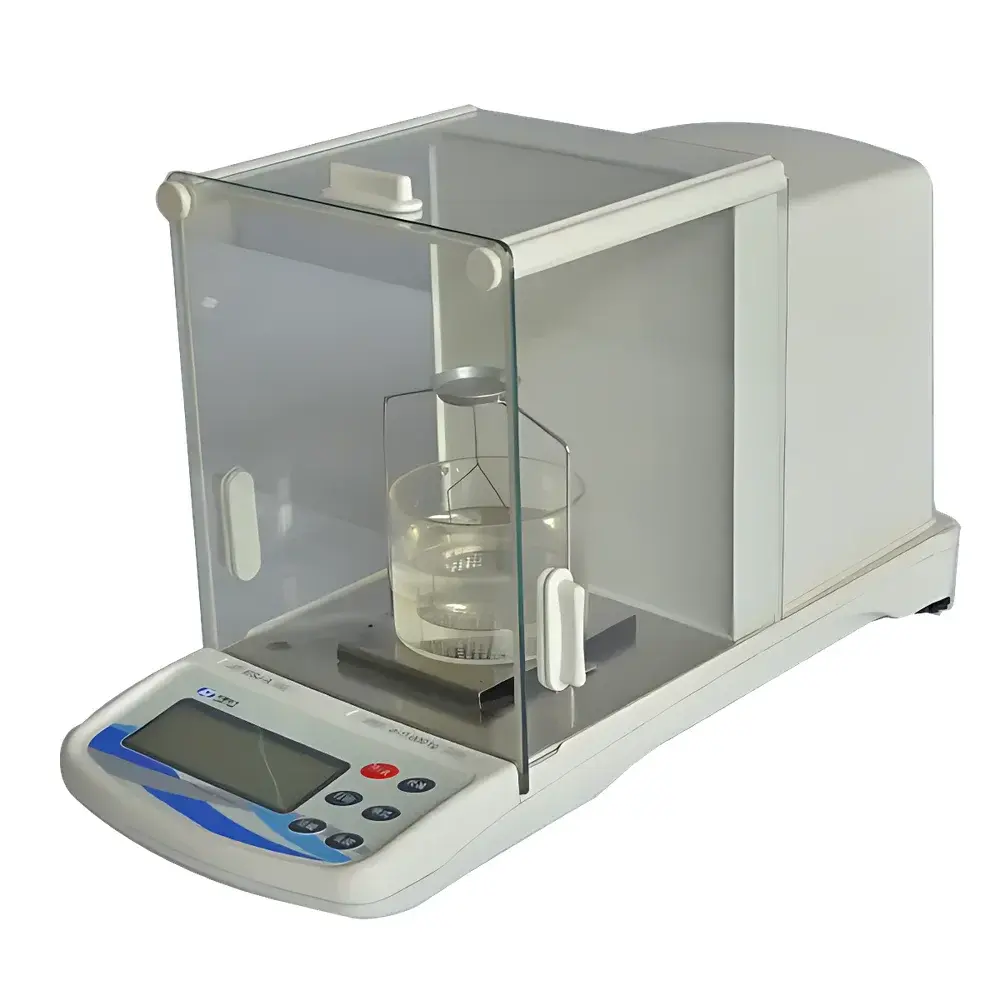
Hydrostatic Balance and Solid Density Tester ESJ220-4A
| Brand | Jihepu (Jinan Hepu) |
|---|---|
| Origin | Shandong, China |
| Manufacturer Type | Authorized Distributor |
| Country of Origin | China |
| Model | ESJ220-4A |
| Instrument Type | Hydrostatic Density Balance |
| Maximum Capacity | 220 g |
| Readability | 0.1 g |
| Repeatability | ±0.1 g |
| Calibration | Internal Automatic Calibration |
| Measurement Range | 200–500 g (with auxiliary sinker system) |
| Density Resolution | 0.001 g/cm³ (calculated) |
Overview
The Jihepu ESJ220-4A Hydrostatic Balance and Solid Density Tester is an engineered precision instrument designed for the accurate determination of density, volume, and specific gravity of solid materials using the principle of hydrostatic weighing—based on Archimedes’ buoyancy law. Unlike conventional analytical balances, this system integrates a dual-mode weighing mechanism: one for air-weight measurement and another for submerged-weight measurement in a standardized liquid medium (typically distilled water at controlled temperature). The device calculates true volumetric displacement by comparing mass differences under defined environmental conditions, enabling traceable density results compliant with ISO 1183-1, ASTM D792, and GB/T 1033.1 standards. Its robust mechanical architecture supports stable operation in QC laboratories, material science departments, and polymer testing facilities where reproducible physical property characterization is essential.
Key Features
- Dual-position weighing platform with dedicated suspension hook and submersion cradle for precise hydrostatic load transfer
- Internal automatic calibration system with built-in reference mass, eliminating manual calibration drift between measurements
- High-stability electromagnetic force restoration sensor delivering consistent readability of 0.1 g across the full 220 g capacity range
- Integrated temperature-compensated density calculation engine—accepts user-input water temperature (15–30 °C) to correct for fluid density variation per ISO 3696
- Stainless steel sample pan and corrosion-resistant sinker assembly compatible with aqueous and low-viscosity organic immersion media
- Front-panel LED display with real-time toggling between air weight, submerged weight, density (g/cm³), and specific gravity (dimensionless)
Sample Compatibility & Compliance
The ESJ220-4A accommodates solid specimens ranging from granular powders (encapsulated in wire mesh baskets) to irregularly shaped machined parts, provided they are non-porous or sealed against liquid ingress. Samples must be fully submersible and exhibit no surface adsorption or chemical reactivity with water or standard calibration fluids. It meets fundamental metrological requirements for Class II balance applications per OIML R76-1 and supports GLP documentation workflows through manual result logging. While not equipped with digital audit trail or 21 CFR Part 11-compliant electronic signatures, its deterministic measurement protocol ensures full traceability when paired with laboratory notebooks and validated SOPs aligned with ISO/IEC 17025.
Software & Data Management
This model operates as a standalone benchtop instrument without embedded PC connectivity or proprietary software. All calculations—including density (ρ = mair / [(mair − msub) / ρfluid])—are executed onboard using fixed-point arithmetic to minimize rounding error. Results are displayed numerically and may be manually recorded into LIMS or Excel-based QA databases. For labs requiring automated reporting, optional RS-232 serial output (available via third-party interface module) enables ASCII-formatted data streaming to external terminals or legacy lab systems. No firmware updates or cloud synchronization are supported; calibration parameters remain immutable post-factory configuration.
Applications
- Density verification of thermoplastics (e.g., PP, ABS, PET) per ASTM D1505 for incoming raw material inspection
- Quality control of sintered metal components in powder metallurgy production lines
- Porosity assessment of ceramic green bodies prior to firing cycles
- Educational demonstration of buoyancy principles and mass-volume relationships in university physics labs
- Batch-to-batch consistency checks for rubber compounds and elastomer formulations
- Supporting ISO 1133 melt flow index corrections where specimen density influences volumetric flow rate derivation
FAQ
What types of solids can be measured with the ESJ220-4A?
Non-porous, non-hygroscopic, and chemically inert solids—such as metals, plastics, glass, and ceramics—that do not absorb water or degrade upon brief immersion.
Is temperature control of the immersion fluid required?
Yes. Accurate density calculation requires input of the actual water temperature during measurement; built-in correction tables reference IAPWS-95 water density values from 15 °C to 30 °C.
Can the instrument measure liquids or powders directly?
No. It is configured exclusively for solid density via hydrostatic displacement. Powders require containment in a calibrated pycnometer basket; liquids necessitate a different methodology (e.g., pycnometry or oscillating U-tube densitometry).
How is repeatability verified?
Repeatability of ±0.1 g is confirmed per JIS B 7721 using three consecutive weighings of a certified 100 g stainless steel test weight under identical environmental conditions.
Does the balance support external calibration with traceable weights?
While internal auto-calibration is primary, the unit accepts external calibration using Class M2 or better weights via the dedicated calibration mode—documented per ISO 9001 clause 7.1.5.