
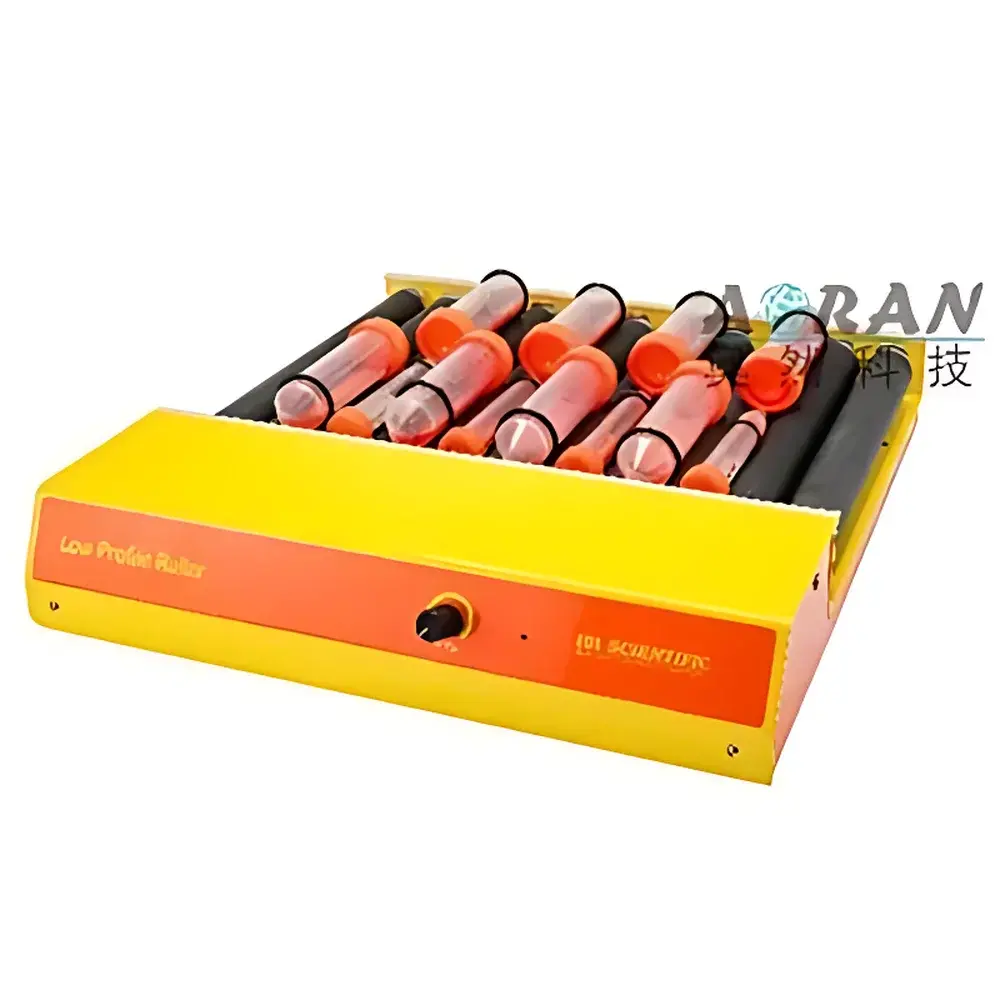
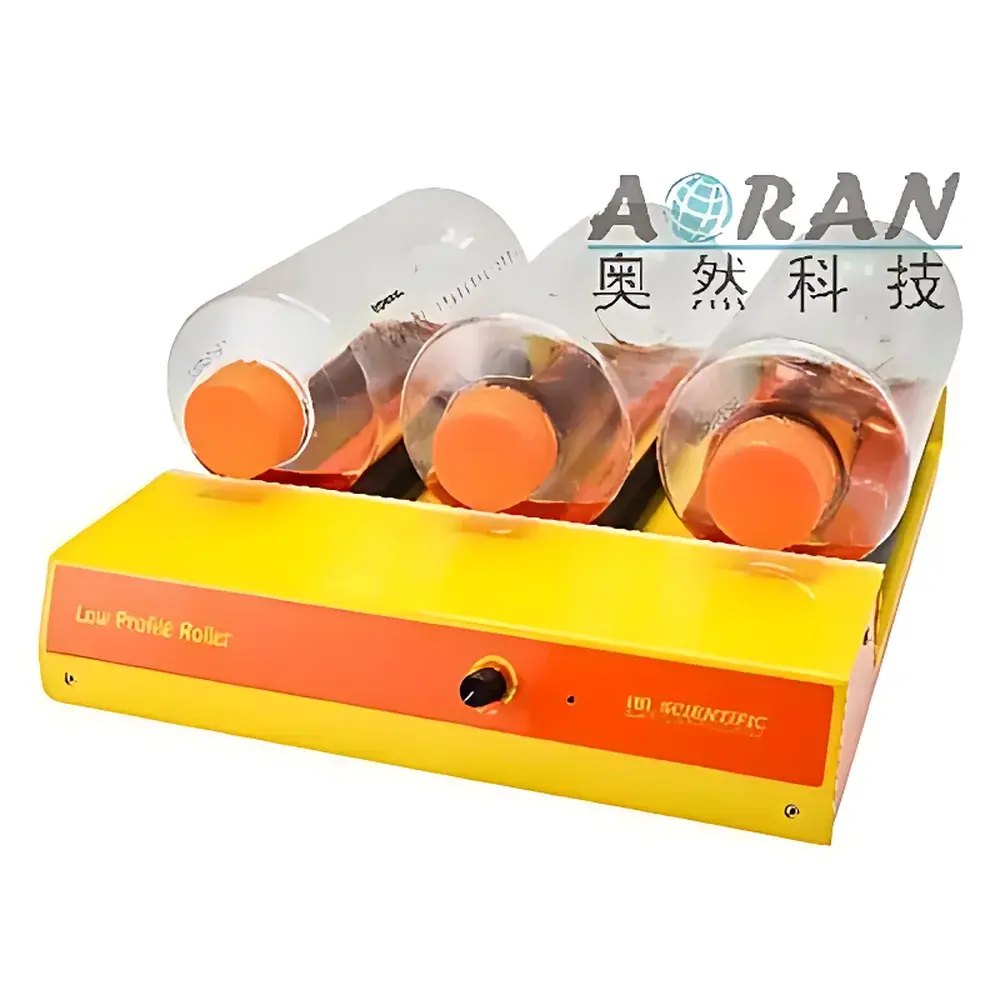
IBI Low Profile Roller Drum Cell Culture Mixer
| Brand | IBI Scientific |
|---|---|
| Origin | USA |
| Model | Low Profile Roller |
| Weight | 10.5 lbs (4.76 kg) |
| Speed Range | 2–38 rpm |
| Roller Capacity | 3 × 850 cm² culture bottles or up to 18 × 15–50 mL tubes (with optional roller kit) |
| Operating Temperature Range | 0–65 °C |
| Standard Rollers | 6 pcs (Ø28 mm × 250 mm) |
| Optional Expansion | +5 rollers for high-density small-vessel loading |
Overview
The IBI Low Profile Roller Drum Cell Culture Mixer is an engineered solution for gentle, continuous agitation of adherent and suspension cell cultures in cylindrical vessels—primarily roller bottles and conical centrifuge tubes. Designed around the principle of controlled rotational motion, this mixer maintains laminar fluid dynamics across vessel surfaces to promote uniform nutrient distribution, gas exchange, and cell monolayer integrity without shear-induced damage. Its low-profile architecture enables seamless integration into standard CO₂ incubators (including compact and stackable models), biosafety cabinets, and cold rooms—addressing a critical spatial constraint faced by modern cell culture laboratories. Unlike orbital shakers or rocking platforms, the roller drum configuration provides consistent, unidirectional rotation that minimizes bubble formation and sedimentation while supporting scalable expansion from research-scale flasks to production-grade roller bottles.
Key Features
- Adjustable speed control (2–38 rpm) with digital display and calibrated potentiometer for repeatable setpoint accuracy ±0.5 rpm.
- Low-profile chassis (height < 4.5 inches) optimized for placement under incubator shelves or within confined containment workspaces.
- Standard configuration includes six precision-machined stainless-steel rollers (Ø28 mm × 250 mm), each independently mounted on corrosion-resistant polymer bushings to ensure smooth, low-noise operation over extended duty cycles.
- Expandable roller array: accepts up to five additional rollers (sold separately), enabling simultaneous rotation of up to 18 × 15–50 mL conical tubes or microcentrifuge tubes—ideal for high-throughput primary cell isolation or bioprocess sampling protocols.
- Thermally stable construction supports uninterrupted operation across ambient temperatures from 0 °C (refrigerated storage conditions) to 65 °C (e.g., warm-room applications or accelerated stability studies).
- UL-listed power supply with grounded 3-prong cord; meets IEC 61010-1 safety requirements for laboratory electrical equipment.
Sample Compatibility & Compliance
The mixer accommodates standard tissue culture roller bottles (e.g., Corning 175 cm², 850 cm², and Nunc 1000 cm² formats) as well as polypropylene or polycarbonate conical tubes (15 mL, 50 mL) and glass or plastic test tubes (10–25 mm diameter). All contact surfaces are inert to common sterilants (70% ethanol, 10% bleach, hydrogen peroxide vapor) and compatible with autoclaving of removable rollers (max 121 °C, 15 psi, 20 min). The device complies with ISO 13485-aligned manufacturing practices (as verified by IBI Scientific’s quality system documentation) and supports GLP-compliant workflows through traceable operational parameters and mechanical consistency. While not FDA-cleared as a medical device, it is routinely deployed in USP -compliant cell therapy process development environments and meets ASTM E2500-13 guidance for qualification of laboratory equipment used in biomanufacturing support functions.
Software & Data Management
This analog-controlled mixer does not incorporate embedded firmware or digital connectivity. Its design prioritizes mechanical reliability, electromagnetic compatibility (EMC), and operational transparency—eliminating software validation burdens associated with 21 CFR Part 11 compliance. Speed calibration is performed manually using a certified tachometer during IQ/OQ protocols, and all settings are recorded in hardcopy logbooks or LIMS-integrated electronic batch records. For labs requiring audit-ready documentation, IBI provides a Factory Acceptance Test (FAT) report and a full Equipment Qualification Support Package—including URS templates, DQ checklists, and PQ protocol outlines aligned with ISPE Baseline Guide Vol. 5 (Laboratory Systems).
Applications
- Expansion of anchorage-dependent mammalian cell lines (e.g., Vero, CHO-K1, HEK293) in roller bottles for vaccine production and monoclonal antibody pilot runs.
- Primary neuron or mesenchymal stem cell culture where minimal hydrodynamic stress preserves phenotype and differentiation capacity.
- Microcarrier-based suspension culture of adherent cells under low-shear conditions.
- Long-term maintenance of organoid cultures in extracellular matrix–embedded tubes requiring gentle mixing to prevent necrotic core formation.
- Pre-analytical sample homogenization of blood-derived products (e.g., platelet-rich plasma, exosome isolates) prior to centrifugation or filtration steps.
FAQ
Can this roller mixer be operated inside a CO₂ incubator?
Yes—the unit’s compact height (<115 mm), absence of heat-generating electronics, and non-outgassing materials make it suitable for placement inside most commercially available CO₂ incubators, including those with internal humidity pans and IR CO₂ sensors. Ensure adequate airflow clearance (≥25 mm on all sides) to maintain thermal stability.
Is speed calibration traceable to NIST standards?
While the mixer itself does not include built-in calibration, IBI supplies a documented calibration procedure using a NIST-traceable handheld tachometer (model recommended: Extech 461923). Users may perform annual verification per their internal SOPs or ISO/IEC 17025-accredited metrology protocols.
Are replacement rollers available with alternative surface finishes?
Standard rollers feature passivated 316 stainless steel. Custom anodized aluminum or silicone-coated rollers are available upon request for specialized applications involving aggressive solvents or static-sensitive samples.
Does the unit support programmable ramp-up or multi-step protocols?
No—this is a manually adjusted constant-speed device. For time-variable agitation profiles, users integrate external timer relays or programmable incubator controllers compatible with dry-contact outputs.
What is the expected service life under continuous 24/7 operation?
Based on accelerated life testing and field data from academic core facilities, the motor and bearing assembly demonstrate >20,000 hours MTBF when operated within specified temperature and load limits. Routine visual inspection of roller alignment and drive belt tension is recommended every 6 months.





