
IDM C0039 High-Precision Crease Stiffness Tester for Corrugated Board and Folding Carton Materials
| Brand | IDM |
|---|---|
| Origin | Shandong, China |
| Model | C0039 |
| Measurement Range | 0–1000 g |
| Resolution | 0.1% FS |
| Bend Angles | 15° (board stiffness), 90° (crease stiffness) |
| Sample Dimensions | 70 × 38 mm (board stiffness), 38 × 36 mm (crease stiffness) |
| Test Duration | ≤15 s per measurement |
| Compliance Standards | BS 6965, BS 3748, ISO 2493:1992 |
| Power Supply | 220/240 VAC @ 50 Hz or 110 VAC @ 60 Hz (customizable) |
| Dimensions (H×W×D) | 140 × 275 × 150 mm |
| Weight | 5 kg |
Overview
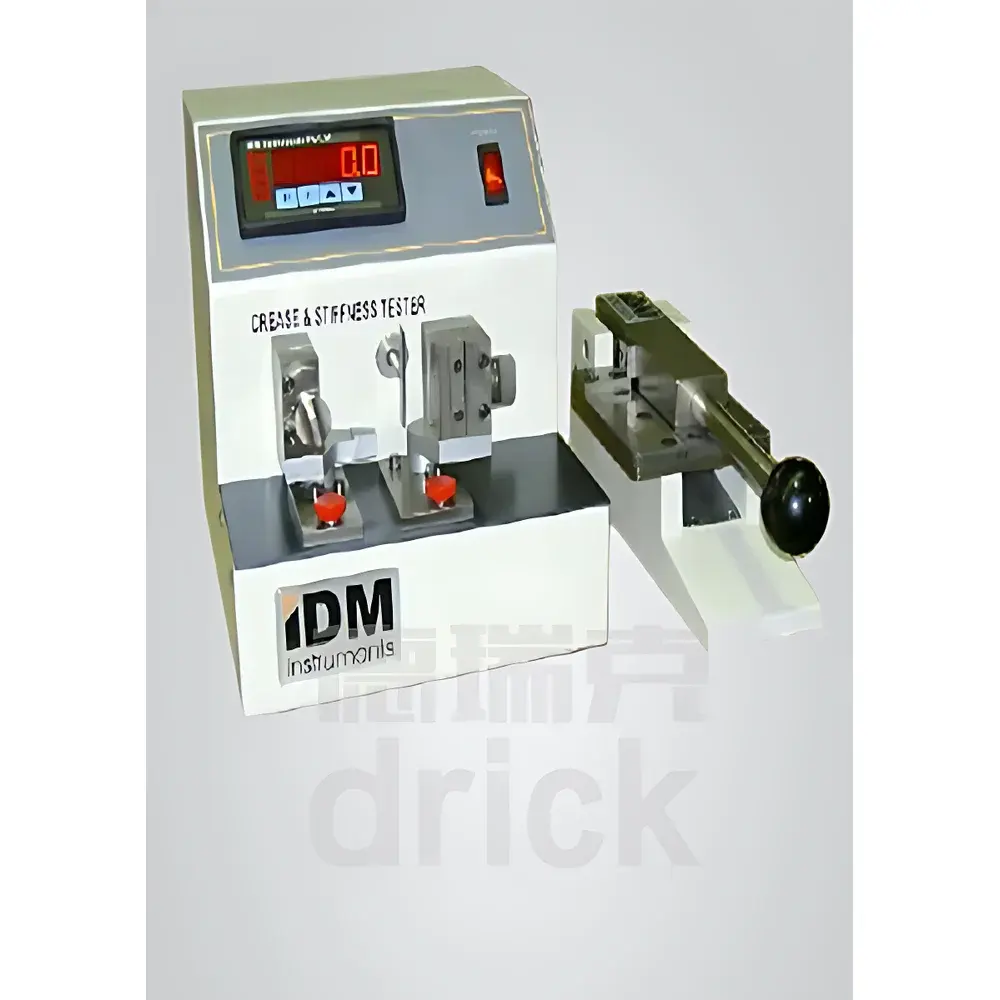
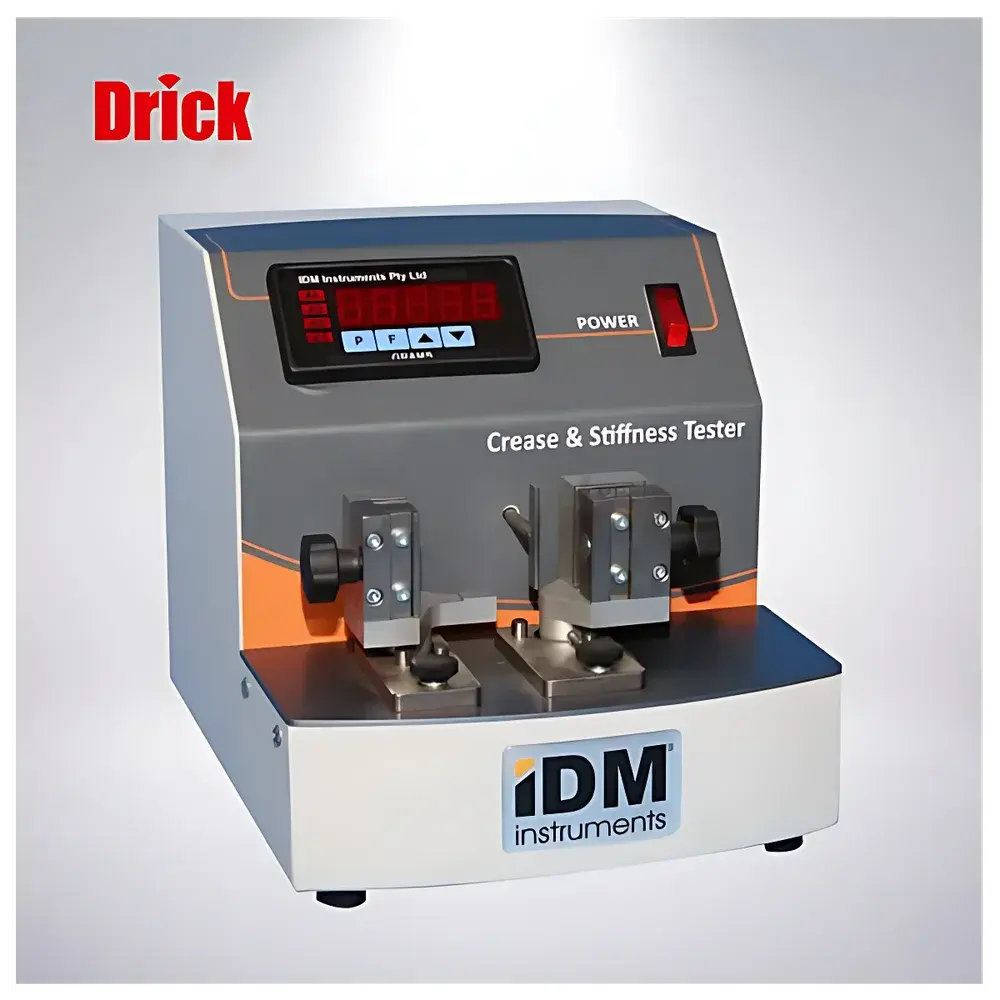
The IDM C0039 High-Precision Crease Stiffness Tester is an engineered solution for quantitative evaluation of two interdependent mechanical properties critical to folding carton performance: board bending stiffness (also referred to as “flat stiffness”) and crease line resistance (crease stiffness). Unlike generic tensile or flexural testers, the C0039 replicates the kinematic constraints and loading profiles encountered during high-speed rotary die-cutting, creasing, and folder-gluer operations. It operates on a dual-axis torsional bending principle—applying controlled angular displacement (15° for board stiffness; 90° for crease stiffness) while measuring the resulting resisting torque, which is converted into gram-force (gF) output with 0.1% full-scale resolution. This enables calculation of the critical stiffness-to-crease ratio (S/C ratio), a validated predictor of fold accuracy, hinge integrity, and downstream packaging line stability. The instrument is designed for ambient-condition testing (standardized at 23 °C ± 1 °C and 50% RH ± 2%), ensuring repeatability across laboratories and production shifts.
Key Features
- Dual-mode measurement architecture: Simultaneously supports standardized board stiffness (BS 3748, ISO 2493:1992) and crease stiffness (BS 6965) protocols within a single compact platform.
- High-resolution load cell system calibrated to 0.1% full-scale accuracy, traceable to national metrological standards.
- Fixed-angle bending fixtures: Precision-machined anvils enforce consistent 15° deflection for board stiffness and 90° rotation about the crease axis—eliminating operator-induced angular variance.
- Digital real-time display with auto-zeroing and peak-hold functionality; test completion signaled within ≤15 seconds per specimen.
- Modular sample handling: Accommodates standard specimens (70 × 38 mm for board stiffness; 38 × 36 mm for crease stiffness) with optional custom cutting dies (e.g., C0016 knife set) available for non-standard substrates or specialty board constructions.
- Robust aluminum alloy chassis (5 kg mass) ensures vibration damping and long-term geometric stability in factory-floor environments.
Sample Compatibility & Compliance
The C0039 is validated for use with solid bleached sulfate (SBS), coated recycled board (CRB), corrugated medium (single- and double-wall), and laminated paperboard up to 1.2 mm thickness. Specimen preparation follows strict dimensional tolerances defined in ISO 2493:1992 (board stiffness) and BS 6965 (crease stiffness), including edge conditioning and moisture equilibration per ISO 187. All test reports generated comply with GLP documentation requirements, supporting audit readiness under ISO/IEC 17025-accredited quality systems. While not inherently 21 CFR Part 11 compliant, the instrument’s deterministic analog signal path and non-volatile result storage allow integration into validated data acquisition workflows when paired with compliant software platforms.
Software & Data Management
The C0039 operates as a standalone benchtop instrument with embedded firmware—no proprietary PC software required for basic operation. Raw force values and calculated S/C ratios are displayed and retained in internal memory (up to 99 test records). For enterprise-level deployment, optional RS-232 or USB-to-serial interface modules enable direct export of ASCII-formatted test logs (timestamp, specimen ID, board stiffness [g], crease stiffness [g], S/C ratio, operator code) to LIMS or MES systems. Exported data conforms to ASTM E1447-22 metadata conventions, facilitating automated statistical process control (SPC) charting and trend analysis across multiple production lines.
Applications
- Pre-production validation of board supplier specifications against internal S/C ratio targets (typically 2.5–4.0 for standard RSC boxes).
- Troubleshooting recurring folding defects—e.g., “dog-earing,” hinge cracking, or glue-joint separation—by correlating measured S/C deviations with press settings (crease depth, rule hardness, anvil pressure).
- Material development support: Quantifying the effect of fiber refining, coating formulation, or moisture content on crease response.
- Quality assurance auditing: Routine checks of incoming board lots prior to die-cutting, aligned with AQL sampling plans per ISO 2859-1.
- Technical service documentation: Generating objective, standards-referenced reports for customer-facing root-cause analyses.
FAQ
Does the C0039 require annual calibration certification?
Yes—calibration against NIST-traceable deadweight standards is recommended every 12 months or after 500 test cycles, whichever occurs first. Calibration certificates include uncertainty budgets per ISO/IEC 17025 Annex A.
Can the instrument measure crease stiffness on pre-creased production samples?
Yes, provided the crease line is clean, unfractured, and oriented perpendicular to the 38 mm test width. Samples must be conditioned per ISO 187 prior to testing.
Is the C0039 compatible with 110 VAC power in North American facilities?
Yes—the unit ships with configurable input voltage selection (110 VAC @ 60 Hz or 220/240 VAC @ 50 Hz); no external transformer is required.
What maintenance is required beyond routine cleaning?
Annual inspection of bearing preload in the torsion arm assembly and verification of anvil parallelism using optical flats (±0.02 mm tolerance) are recommended.
How does the C0039 differ from general-purpose universal testing machines (UTMs)?
UTMs lack the fixed-angle, low-inertia bending geometry and substrate-specific fixture tooling required to replicate industrial creasing kinematics; their force-displacement curves do not yield directly actionable S/C ratios per packaging engineering practice.




