
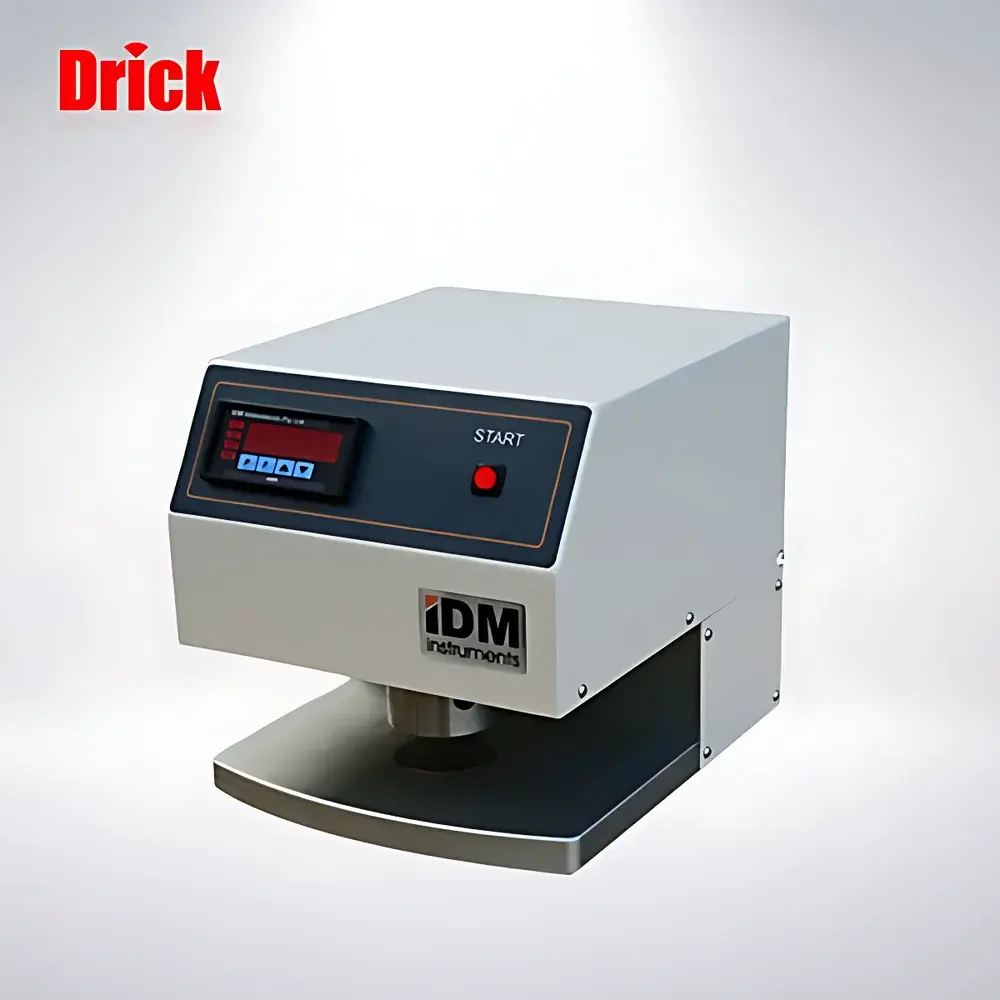
IDM D0011 High-Precision Digital Paper Thickness Tester
| Brand | IDM |
|---|---|
| Origin | Shandong, China |
| Model | D0011 |
| Measurement Range | 0–12 mm |
| Resolution | 0.001 mm |
| Pressure Options | 2 kPa (standard), 20 kPa, 50 kPa, 100 kPa (optional) |
| Platen Diameter | 35.7 mm |
| Base Diameter | 55 mm |
| Traverse Speed | 1 ± 0.1 mm/sec |
| Power Supply | 220/240 VAC @ 50 Hz or 110 VAC @ 60 Hz (customizable) |
| Dimensions (H×W×D) | 270 × 250 × 300 mm |
| Weight | 18.5 kg |
| Compliance Standards | ISO 534:1988, ASTM D645, TAPPI T 411, BS 7387, AS 1301.426s, ISO 3034, FEFCO No. 3, SCAN P31 |
| Interface | RS232 (standard), optional USB or Ethernet connectivity |
Overview
The IDM D0011 High-Precision Digital Paper Thickness Tester is an electromechanical contact gauge engineered for repeatable, traceable thickness measurement of planar sheet materials in packaging, pulp & paper, and converting laboratories. It operates on the principle of controlled-force mechanical compression between two parallel, flat circular platens—adhering strictly to the fundamental methodology defined in ISO 534:1988 and ASTM D645. Unlike non-contact optical methods, this instrument delivers direct, load-dependent thickness values under standardized pressure conditions, making it indispensable for evaluating caliper consistency, bulk density, compressibility, and interlayer bonding integrity in multi-ply structures. Its design conforms to the metrological requirements for routine quality assurance and regulatory documentation, supporting both incoming inspection and product development workflows where dimensional stability directly correlates with functional performance—such as folding endurance, print registration accuracy, and corrugated board stacking strength.
Key Features
- Microprocessor-controlled dual-platen actuation with programmable dwell time and pre-load stabilization, ensuring thermal and mechanical equilibrium prior to final reading acquisition.
- Four selectable test pressures (2 kPa, 20 kPa, 50 kPa, and 100 kPa) calibrated per ISO 2936:2019, enabling comparative analysis across material classes—from lightweight tissue to rigid duplex board.
- High-resolution linear encoder system with 1 µm resolution and ±0.5 µm repeatability over full 0–12 mm range, validated against NIST-traceable slip gauges.
- Integrated RS232 serial interface compliant with EIA-232-D specifications; supports bidirectional communication with LIMS and QA software platforms for automated data logging and audit trail generation.
- Rigid cast-aluminum frame with vibration-damped base plate and precision-ground stainless-steel platens, minimizing deflection and thermal drift during extended operation.
- User-configurable measurement parameters—including pressure selection, dwell duration, number of readings per sample, and statistical output (mean, SD, CV%)—accessible via intuitive membrane keypad and backlit LCD display.
Sample Compatibility & Compliance
The D0011 accommodates specimens up to 250 mm × 250 mm, with central placement ensured by alignment guides. It is validated for use with single- and multi-layer substrates including uncoated and coated papers, cardboard, corrugated medium, plastic films (e.g., PET, PP, PE), laminates, nonwovens, and composite packaging webs. All pressure settings comply with international standard test protocols: 2 kPa for soft tissues (ISO 534 Annex A), 100 kPa for corrugated board (ISO 3034), and intermediate loads aligned with TAPPI T 411 (paper) and FEFCO No. 3 (fluted board). The instrument’s mechanical architecture meets ISO/IEC 17025:2017 requirements for calibration traceability, and its operational firmware supports GLP/GMP-aligned record retention when integrated with compliant laboratory informatics systems.
Software & Data Management
The D0011 supports seamless integration with third-party QA applications via ASCII-based command protocol over RS232. Raw measurement data—including timestamp, pressure setting, sample ID, and individual readings—is transmitted in real time without proprietary drivers. Optional PC software (sold separately) provides SPC charting (X̄-R, Cpk), batch-level statistical summaries, PDF report generation with digital signature fields, and export to CSV, Excel, or XML formats. Audit trails include operator ID, instrument serial number, calibration date, and environmental metadata (if external hygrothermograph input is enabled). For regulated environments, the system can be configured to meet FDA 21 CFR Part 11 requirements through external validation packages and electronic signature modules.
Applications
- Caliper verification of linerboard, corrugating medium, and combined board per FEFCO and SCAN standards.
- Bulk calculation (thickness/density ratio) for coated paper grades used in high-gloss offset printing.
- Thickness profiling across sheet width to detect machine-direction variability in papermaking processes.
- Compressibility assessment of cushioning materials under incremental load for transport packaging qualification.
- Pre- and post-conversion thickness comparison (e.g., before/after coating, laminating, or embossing).
- Validation of supplier conformance to contractual thickness tolerances specified in purchase orders or technical agreements.
FAQ
What standards does the D0011 comply with for paper thickness testing?
It fully supports ISO 534:1988, ASTM D645, TAPPI T 411, BS 7387, AS 1301.426s, ISO 3034, FEFCO No. 3, and SCAN P31.
Can the instrument measure non-paper materials such as plastic films or foams?
Yes—it is validated for uniform, non-elastic planar materials with surface roughness 10 MPa.
Is calibration traceable to national metrology institutes?
Yes; factory calibration uses NIST-traceable reference blocks, and field recalibration kits are available with certificate of conformity.
Does the D0011 support automated pass/fail decision logic based on user-defined limits?
Not natively—but limit-based flagging and conditional reporting are enabled via compatible PC software or LIMS integration.
What maintenance is required to ensure long-term measurement stability?
Annual verification of platen parallelism and force calibration is recommended; daily cleaning of platen surfaces with isopropyl alcohol and lint-free cloth is sufficient for routine use.






