
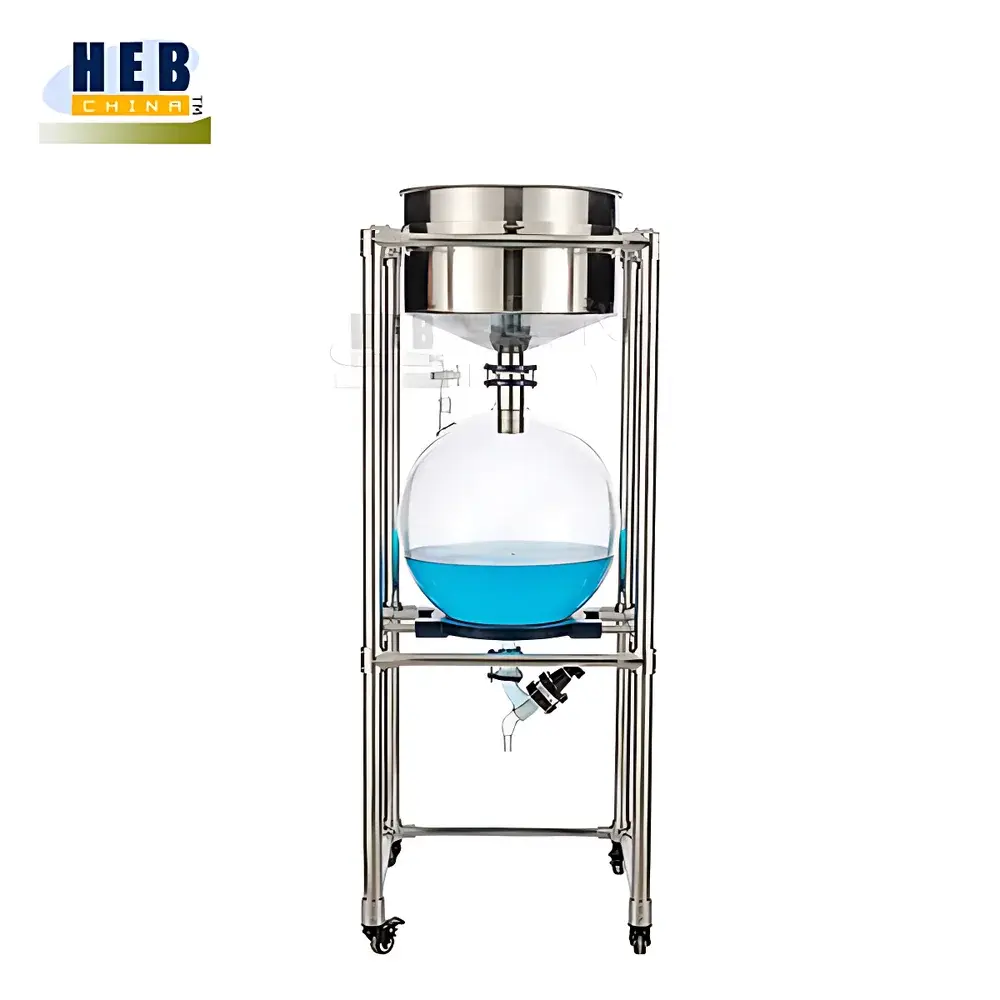
Jihepu ZF-100L Vacuum Filtration System
| Brand | Jihepu |
|---|---|
| Origin | Shandong, China |
| Manufacturer Type | Authorized Distributor |
| Origin Category | Domestic (China) |
| Model | ZF-100L |
| Price Range | USD 2,800 – 7,000 |
| Usable Volume | Large-Scale |
| Construction Material | 304 Stainless Steel |
| Operating Pressure | Low Vacuum |
| Capacity | 100 L |
| Ultimate Vacuum Level | 0.098 MPa (98 kPa absolute) |
| Filter Funnel Diameter × Height | Φ550 × 320 mm |
| Filtration Area Approx. | 0.238 m² |
| Filtration Bottle | Borosilicate Glass (Type 3.3), Spherical, 100 L, Φ610 mm |
| Vacuum Port | Standard 24/40 Ground Joint |
| Drain Port | Φ45 mm Spherical Ball Valve (Glass Body + PTFE Core, C-Type) |
| Relief Nozzle | 12 mm OD Barb Fitting |
| Frame Material | Aluminum Alloy + Stainless Steel |
| Mobility | Four Locking Casters (φ100 mm) |
| Overall Dimensions (W×D×H) | 720 × 750 × 1850 mm |
| Net Weight | 67 kg |
| Packing Dimensions | 1710 × 770 × 850 mm (Wooden Crate, 1.12 m³) |
| Gross Weight | 116 kg |
Overview
The Jihepu ZF-100L Vacuum Filtration System is a large-capacity, bench- or floor-standing laboratory filtration apparatus engineered for reliable solid–liquid separation under controlled low-vacuum conditions. It operates on the principle of pressure-driven cross-flow filtration: a vacuum source (external vacuum pump, not included) creates negative pressure across a replaceable filter medium—such as woven stainless steel mesh, polypropylene filter cloth, or PTFE membrane—mounted on a perforated 304 stainless steel funnel. This differential pressure forces liquid phase through the medium while retaining suspended solids on the surface. Designed for batch processing up to 100 L per cycle, the system supports both gravity-assisted pre-filtration and active vacuum-driven dewatering, enabling efficient slurry dewatering, catalyst recovery, crystalline product isolation, and clarification of viscous reaction mixtures in synthetic organic, pharmaceutical, and materials chemistry workflows.
Key Features
- Robust structural architecture: Load-bearing frame combines anodized aluminum alloy uprights with 304 stainless steel load-bearing components for corrosion resistance and long-term dimensional stability.
- High-integrity filtration chamber: 304 stainless steel conical funnel (Φ550 × 320 mm) features uniform 4 mm diameter perforations (pitch: 8 mm) optimized for mechanical support of filter media without channeling or bridging.
- Borosilicate glass (Type 3.3) spherical filtration bottle: 100 L capacity, thermal shock resistant (ΔT ≤ 150 °C), with standardized 24/40 ground-joint vacuum inlet and integrated three-neck configuration for optional inline manometer, vent line, or inert gas purge connection.
- Full-process fluid handling: C-type glass ball valve (Φ45 mm outlet, PTFE-sealed core) enables drip-free discharge of filtrate; auxiliary 20 mm outlet port allows simultaneous sampling or secondary transfer.
- Mobility and ergonomics: Four φ100 mm heavy-duty casters with independent locking brakes facilitate repositioning within fume hoods or shared lab spaces without disassembly.
- Vacuum interface compatibility: Standardized 24/40 joints and 12 mm OD barb fittings ensure interoperability with common vacuum regulators, vacuum gauges, and oil-free diaphragm or scroll pumps (recommended ultimate vacuum ≤ 10 kPa abs).
Sample Compatibility & Compliance
The ZF-100L accommodates heterogeneous slurries with particle sizes ranging from coarse precipitates (>100 µm) to fine colloidal suspensions (down to ~5 µm, dependent on selected filter medium). It is compatible with aqueous, polar organic (e.g., methanol, THF, DMF), and mildly acidic/basic solutions (pH 2–12); prolonged exposure to hydrofluoric acid, hot concentrated alkalis (>20% NaOH), or halogenated solvents at elevated temperature is not recommended. The borosilicate glass vessel complies with ISO 3585 and DIN 7080 specifications. All wetted metallic surfaces meet ASTM A240/A240M Grade 304 requirements. The system supports GLP-compliant documentation when paired with validated vacuum pumps and calibrated pressure transducers; it may be integrated into GMP environments where filtration steps are defined in master batch records and subject to change control.
Software & Data Management
As a manually operated, non-automated vacuum filtration platform, the ZF-100L does not incorporate embedded controllers or digital interfaces. Process parameters—including applied vacuum level, filtration duration, and filtrate volume—are recorded externally using calibrated vacuum gauges (e.g., capacitance manometers traceable to NIST standards) and volumetric receivers. For audit readiness, users are advised to log operational data in paper-based or electronic lab notebooks (ELN) compliant with 21 CFR Part 11 requirements when used in regulated pharmaceutical development or QC release testing. Optional accessories include analog vacuum regulators with dual-scale (kPa/mmHg) dials and digital vacuum sensors with 4–20 mA output for integration into centralized SCADA systems.
Applications
- Isolation of crystalline APIs and intermediates following antisolvent precipitation or cooling crystallization.
- Recovery and washing of heterogeneous catalysts (e.g., Pd/C, Raney Ni) in hydrogenation or cross-coupling reactions.
- Clarification of polymerization reaction mixtures prior to solvent removal or extrusion.
- Pre-concentration of bacterial cell lysates or protein aggregates in early-stage bioprocessing.
- Removal of desiccants (e.g., MgSO₄, Na₂SO₄) or drying agents post-extraction in natural product isolation.
- Slurry filtration in ceramic precursor synthesis and battery cathode material processing.
FAQ
What vacuum pump specifications are recommended for optimal performance?
A two-stage oil-free diaphragm pump capable of achieving ≤10 kPa absolute pressure and delivering ≥60 L/min free-air displacement is recommended. For aggressive solvents, chemically resistant vacuum lines (PTFE or Viton®) and cold traps are advised.
Can the funnel accommodate pleated membrane cassettes?
Yes—the Φ550 mm open-top geometry accepts standard 12-inch (305 mm) diameter pleated filter cassettes when mounted on a custom support ring; maximum recommended operating pressure differential is 0.1 MPa.
Is the glass filtration bottle autoclavable?
No—borosilicate glass Type 3.3 is not rated for repeated autoclave cycles (121 °C, 2 bar); cleaning is performed via solvent rinse, ultrasonic bath, or alkaline detergent soak followed by deionized water flush.
What maintenance intervals are required for long-term reliability?
Inspect O-rings and PTFE valve seals every 200 operating hours; replace casters’ brake mechanisms annually; verify vacuum joint integrity before each use via leak-down test (≤5 kPa/min pressure rise at 0.09 MPa vacuum).
Does this system comply with explosion-proof requirements for solvent-laden vapors?
The base unit has no intrinsic ignition sources; however, safe operation in Class I, Division 1 environments requires coordination with a certified explosion-proof vacuum pump and grounding of all conductive components per NEC Article 500.



