
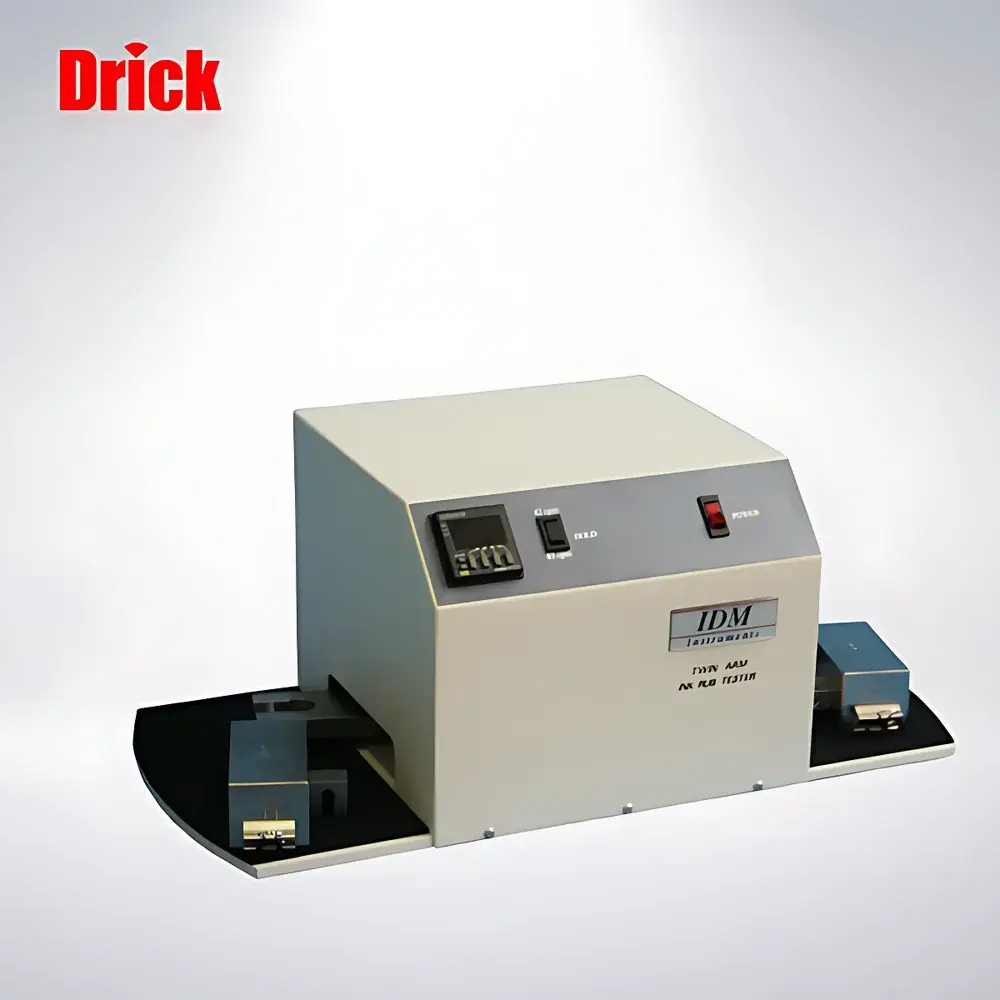
IDM I0002 Dual-Arm Ink Rub Resistance Tester
| Brand | IDM |
|---|---|
| Origin | Shandong, China |
| Manufacturer Type | Authorized Distributor |
| Country of Origin | China |
| Model | I0002 |
| Operating Speeds | 42 rpm & 85 rpm |
| Test Load Options | 2 lb & 4 lb weights |
| Cycle Counter Range | 0–9999 cycles |
| Compliance Standards | TAPPI T830, ASTM D5264 |
| Power Supply | 220/240 VAC @ 50 Hz or 110 VAC @ 60 Hz (customizable) |
| Optional Accessories | Heated weight, heated platen |
| Sample Conditioning | Dry and damp testing modes supported |
| Included Tools | Crease plate, creasing tool |
Overview
The IDM I0002 Dual-Arm Ink Rub Resistance Tester is an electromechanical instrumentation system engineered for quantitative evaluation of ink adhesion and surface abrasion resistance on printed substrates. It operates on the principle of controlled linear reciprocating motion under defined normal force, simulating real-world handling, stacking, and transport conditions that induce mechanical wear on printed surfaces. Unlike single-arm rub testers, the dual-arm architecture enables simultaneous bilateral testing—allowing comparative assessment of two samples or duplicate runs under identical mechanical parameters—thereby enhancing inter-test reproducibility and reducing operator-induced variability. The instrument is purpose-built for packaging R&D laboratories, print quality assurance departments, and contract manufacturing facilities requiring traceable, repeatable, and standards-aligned rub resistance data.
Key Features
- Dual independent motor-driven arms with selectable rotational speeds: 42 rpm and 85 rpm—enabling differentiation between low-shear (e.g., storage abrasion) and high-shear (e.g., conveyor belt friction) stress profiles.
- Calibrated load application via precision-machined stainless-steel weights: 2 lb (0.91 kg) and 4 lb (1.81 kg) options, each certified to NIST-traceable mass tolerances per ISO/IEC 17025 guidelines.
- Digital cycle counter with non-volatile memory (0–9999 cycles), retaining setpoint and elapsed count during power interruption—critical for long-duration qualification protocols.
- Integrated crease plate and standardized creasing tool for evaluating ink integrity at folded or scored regions—a key requirement for corrugated box and folding carton validation per FEFCO/ECMA specifications.
- Electrical configuration flexibility: factory-configurable for 110 VAC @ 60 Hz (North America) or 220/240 VAC @ 50 Hz (EU/Asia), with internal voltage regulation ensuring stable motor torque across input fluctuations.
- Dry and damp test modes supported via optional humidity-controlled chamber integration (not included), permitting evaluation under ISO 187 standard conditioning (23 °C ± 1 °C, 50% RH ± 2%) or customer-defined ambient states.
Sample Compatibility & Compliance
The I0002 accommodates rigid and semi-rigid planar specimens up to 300 mm × 300 mm, including corrugated board (single- and double-wall), solid bleached sulfate (SBS) board, coated and uncoated offset papers, flexographic-printed polypropylene and PET films, aluminum foil laminates, and soldermask-coated PCB substrates. All test methodologies align with internationally recognized standards: TAPPI T830 (Rub Resistance of Printing Inks) defines the 10-cycle baseline protocol using a cotton cloth abradant; ASTM D5264 (Standard Practice for Determining the Rub Resistance of Printed Materials) specifies load, stroke length (100 mm), and abradant velocity requirements. Instrument design supports GLP-compliant operation—including manual logbook documentation—and may be integrated into 21 CFR Part 11–enabled QA systems when paired with external audit-trail software.
Software & Data Management
The I0002 operates as a standalone hardware platform without embedded firmware or proprietary software. All operational parameters are set via front-panel membrane switches and displayed on a 4-digit LED counter. This architecture eliminates cybersecurity vulnerabilities associated with networked controllers and ensures long-term serviceability without OS dependency or license renewal. Test records—including sample ID, weight used, speed selected, cycle count, environmental notes (dry/damp), and operator initials—are documented manually in laboratory notebooks or exported to LIMS via standardized CSV templates generated from external data capture devices. For regulated environments, the unit’s mechanical simplicity facilitates straightforward IQ/OQ validation per ASTM E2500 and ISPE GAMP 5 Annex 15 frameworks.
Applications
- Pre-shipment validation of ink formulation durability across substrate batches in flexible packaging converters.
- Corrugated box manufacturer qualification of UV-cured and water-based inks against FEFCO Box Strength Test (BST) abrasion thresholds.
- PCB assembly line verification of soldermask rub resistance prior to component placement and wave soldering.
- Regulatory submission support for FDA-regulated medical device packaging where ISO 11607-1 mandates abrasion resistance evidence for sterile barrier integrity.
- Internal R&D correlation studies linking ink rheology (measured via Brookfield viscometry) and final rub performance on pilot-scale presses.
FAQ
Does the I0002 comply with ISO 11607-1 for medical packaging validation?
Yes—when operated per TAPPI T830 with documented environmental controls and calibrated weights, its output serves as objective evidence of ink stability under simulated distribution stresses referenced in Clause 6.4.2 of ISO 11607-1.
Can the instrument be validated for GMP environments?
Yes—the absence of embedded software simplifies IQ/OQ execution; full validation packages (including calibration certificates, traceability logs, and URS alignment reports) are available upon request.
Is third-party calibration certification provided with shipment?
A factory-issued calibration report for the 2 lb and 4 lb weights is included; NIST-traceable recalibration services are offered annually through IDM’s ISO/IEC 17025-accredited partner labs.
What abradant materials are recommended for routine use?
TAPPI-certified #400 cotton cloth (ASTM D4307-compliant) is supplied as standard; alternative abradants (e.g., wool felt, synthetic nonwovens) may be qualified per internal SOP if justified by end-use simulation requirements.
How is maintenance performed on the dual-motor drive system?
Motors require no scheduled lubrication; periodic inspection of timing belts and arm pivot bearings is recommended every 12 months or after 5,000 cycles—service manuals and spare parts kits are provided with purchase.






