
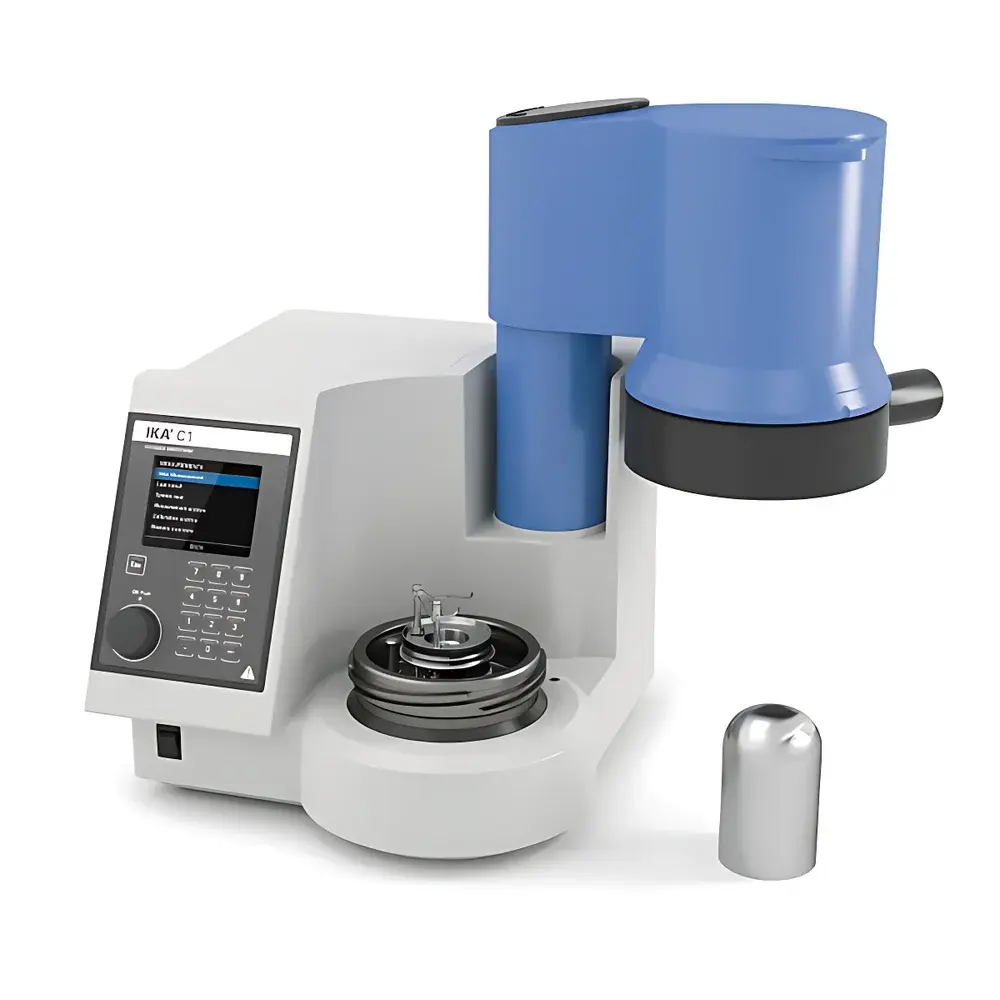
IKA C 1 Oxygen Bomb Calorimeter
| Brand | IKA |
|---|---|
| Origin | Germany |
| Manufacturer Type | Manufacturer |
| Origin Category | Imported |
| Model | C 1 |
| Instrument Type | Oxygen Bomb Calorimeter |
| Measurement Mode | Static Jacket (22 °C and 30 °C) |
| Temperature Range | 20–30 °C |
| Temperature Resolution | 0.0001 K |
| Precision | 0.15 % RSD (1 g benzoic acid, NBS 39i) |
| Single-Sample Test Time | 11 min |
| Heat Capacity | 40 000 J |
| Cooling Medium | Tap Water |
| Cooling Flow Rate | 50–60 L/h (55 L/h at 18 °C) |
| Max Oxygen Pressure | 40 bar |
| Ambient Operating Temperature | 5–40 °C |
| Relative Humidity Limit | 80 % RH |
| Protection Rating | IP20 |
| Power Supply | 100–240 V, 50/60 Hz |
| Power Consumption | 120 W |
| Dimensions | 290 × 280 × 300 mm |
| Weight | 15 kg |
| Compliance | DIN 51900, ISO 1928 |
Overview
The IKA C 1 Oxygen Bomb Calorimeter is a precision static-jacket bomb calorimeter engineered for high-accuracy determination of gross and net calorific values (higher and lower heating values) of solid and liquid fuels, including coal, coke, biomass, waste-derived fuels, and certified reference materials. It operates on the principle of adiabatic or static-jacket calorimetry—where the sample is combusted under high-purity oxygen pressure (up to 40 bar) inside a robust spherical oxygen bomb, and the resulting temperature rise in a precisely thermostated water jacket is measured with sub-millikelvin resolution (0.0001 K). The instrument conforms to internationally recognized test standards, including ISO 1928, DIN 51900, ASTM D2015, and GB/T 213, ensuring regulatory acceptability in energy certification, quality control, and R&D laboratories subject to GLP or ISO/IEC 17025 accreditation.
Key Features
- Spherical oxygen bomb design enabling rapid thermal equilibration and minimized heat loss during combustion—critical for achieving ≤0.15 % RSD repeatability (verified using 1 g NBS Standard Reference Material 39i benzoic acid).
- Static-jacket temperature control system maintaining jacket water at fixed setpoints (22 °C or 30 °C) with automatic water level regulation, dosing, filling, and draining—eliminating manual intervention and operator-induced variability.
- Integrated oxygen handling module supporting fully automated charging (to 40 bar), venting, and “purge” cycles to ensure complete removal of residual gases prior to ignition.
- High-stability platinum resistance thermometer (PRT) with digital signal conditioning delivering 0.0001 K temperature resolution across the 20–30 °C operational range.
- Modular RS232 interfaces for seamless integration with analytical balances, thermal printers, and external PCs—enabling traceable, timestamped data acquisition and audit-ready recordkeeping.
- Robust mechanical architecture (IP20-rated enclosure) and low-noise cooling circuit (50–60 L/h tap-water flow) optimized for continuous operation in ambient environments from 5–40 °C and ≤80 % RH.
Sample Compatibility & Compliance
The C 1 accommodates standard 1 g fuel samples in crucibles compatible with both pressed-pellet and powdered forms. Its spherical bomb geometry ensures uniform oxygen distribution and complete combustion of heterogeneous matrices such as lignite, RDF, and municipal solid waste. Calibration is performed using certified benzoic acid (NBS 39i), with correction algorithms embedded for nitric acid formation and fuse wire contribution per ISO 1928 Annex B. All thermodynamic calculations—including conversion between gross and net calorific value using moisture and hydrogen content inputs—are compliant with ISO 1928:2020, DIN 51900:2021, and ASTM D5865–22. The system supports full traceability documentation required for ISO/IEC 17025 audits and internal quality assurance protocols.
Software & Data Management
Calwin 6.40 software provides comprehensive control, real-time monitoring, and post-processing capabilities. It supports dual-language UI (English and Chinese), SQL-based local database storage, and direct export to LIMS via ODBC or CSV. Features include automated calibration curve generation, multi-parameter correction tables (e.g., for ambient barometric pressure and sample moisture), customizable reporting templates (PDF/Excel), and electronic signature-enabled protocol archiving. Audit trails log all user actions, parameter changes, and instrument events in accordance with FDA 21 CFR Part 11 requirements when configured with appropriate access controls and electronic signature modules.
Applications
- Determination of higher heating value (HHV) and lower heating value (LHV) of coal, coke, and petroleum coke per ISO 1928 and ASTM D5865.
- Quality assurance testing of biomass pellets, refuse-derived fuel (RDF), and sewage sludge in compliance with EN 14918 and CEN/TS 15400.
- Calorimetric validation of certified reference materials (CRMs) in national metrology institutes and proficiency testing providers.
- Research into alternative fuels, including hydrogen-enriched blends and pyrolysis oils, where precise enthalpy-of-combustion data informs energy balance modeling.
- Regulatory submissions for EPA Method 9040B, EU Directive 2018/2001 (RED II), and national energy labeling schemes requiring certified calorific data.
FAQ
What standards does the IKA C 1 support for calorific value calculation?
It natively implements ISO 1928, DIN 51900, ASTM D5865, ASTM D2015, and GB/T 213, with configurable correction models for acid formation, fuse wire energy, and latent heat of vaporization.
Can the C 1 be integrated into a laboratory information management system (LIMS)?
Yes—via Calwin 6.40’s SQL database engine and ODBC-compliant export functions, enabling bidirectional data exchange with major LIMS platforms under validated configurations.
Is the oxygen bomb certified for high-pressure operation?
The spherical oxygen bomb is manufactured and tested to meet DIN EN ISO 13703 and PED 2014/68/EU requirements for pressure equipment, with full documentation provided for CE conformity.
Does the system require external chiller units?
No—the C 1 uses tap water as its cooling medium within specified temperature (18–29 °C) and flow rate (50–60 L/h) limits; no recirculating chiller is necessary.
How is measurement traceability ensured?
Each test generates a timestamped, digitally signed calibration and measurement protocol containing raw temperature curves, correction factors, uncertainty budgets, and operator metadata—fully compliant with ISO/IEC 17025 clause 7.7.



