
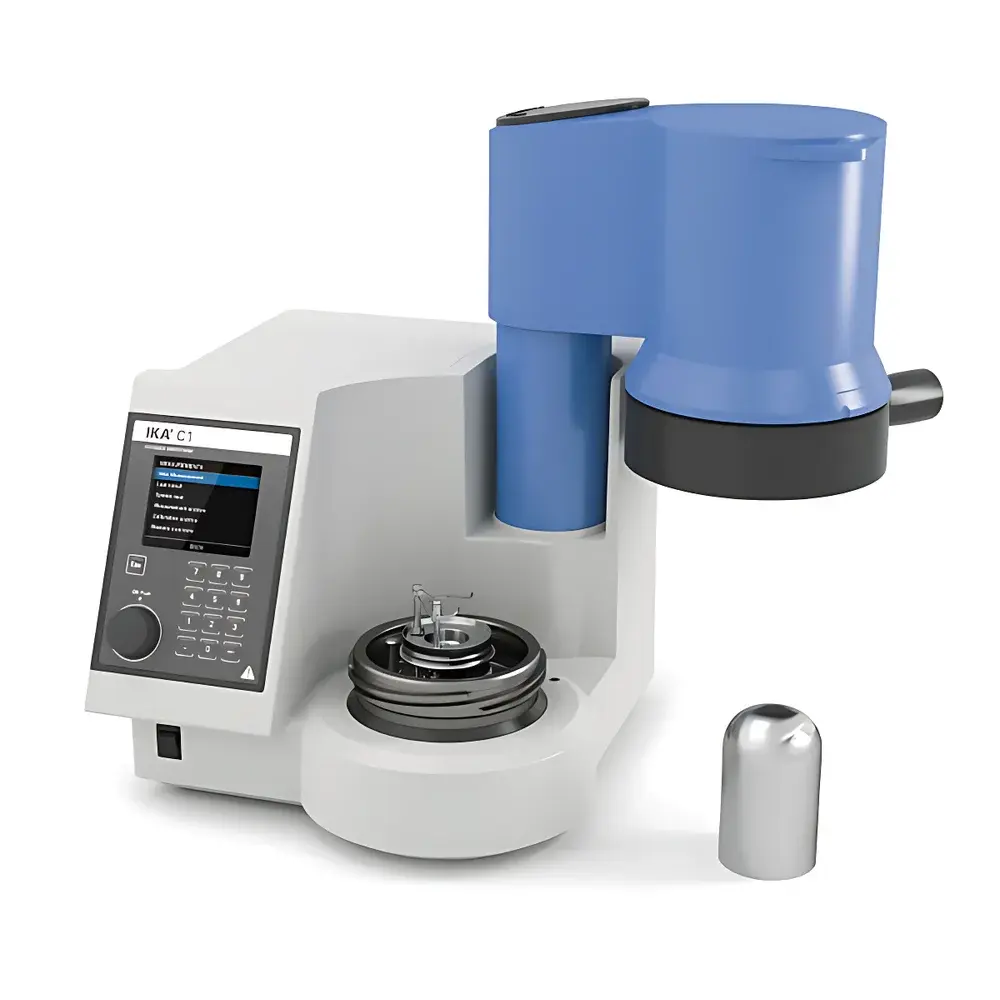
IKA C 1 Package 1/10 Static Jacket Bomb Calorimeter
| Brand | IKA |
|---|---|
| Origin | Germany |
| Manufacturer Type | Manufacturer |
| Origin Category | Imported |
| Model | C 1 Package 1/10 |
| Instrument Type | Bomb Calorimeter |
| Measurement Principle | Isoperibol (Regnault–Pfaundler isothermal principle) |
| Temperature Range | 20–30 °C |
| Temperature Resolution | 0.0001 K |
| Precision | 0.15 % RSD (1 g benzoic acid, NBS 39i) |
| Single-Sample Test Time | 11 min |
| Heat Capacity | 40,000 J |
| Outer Water Bath Capacity | Not specified |
| Inner Water Bath Capacity | Not specified |
| Cooling Medium | Tap water |
| Min. Coolant Flow Rate | 50–60 L/h at 18 °C |
| Max. Oxygen Pressure | 40 bar |
| Protection Rating | IP20 |
| Dimensions | 290 × 280 × 300 mm |
| Weight | 15 kg |
| Ambient Operating Conditions | 5–40 °C, ≤80 % RH |
| Compliance | DIN 51900, ISO 1928 |
| Interfaces | RS232 (balance, printer, PC), USB |
| Power Supply | 100–240 V, 50/60 Hz, 120 W |
Overview
The IKA C 1 Package 1/10 Static Jacket Bomb Calorimeter is a fully automated, compact benchtop instrument engineered for high-precision determination of gross and net calorific values of solid and liquid fuels, including coal, biomass, waste-derived fuels, and petrochemical samples. It operates on the isoperibol (static jacket) principle derived from the classical Regnault–Pfaundler isothermal method, wherein the temperature rise of a precisely known mass of water surrounding the combustion chamber is measured under thermally stable jacket conditions. Unlike adiabatic or dynamic jacket systems, the static jacket design eliminates active jacket temperature control—relying instead on high thermal inertia and rigorous thermal equilibrium modeling to deliver reproducible results compliant with internationally recognized standards. The C 1 integrates an innovative spherical combustion vessel—replacing legacy threaded bomb designs—to accelerate heat transfer uniformity and minimize thermal lag. Its modular architecture includes the C 1.10 standard oxygen bomb, RC 2 basic recirculating chiller, and all hardware required for commissioning, enabling immediate deployment in accredited testing laboratories.
Key Features
- Compact footprint (290 × 280 × 300 mm) — the smallest fully automated bomb calorimeter in IKA’s portfolio, optimized for space-constrained QC labs and university teaching facilities.
- Spherical oxygen bomb (C 1.10) with integrated ignition circuitry and pressure-rated sealing — designed for rapid thermal equilibration and reduced measurement uncertainty.
- Automated fluid handling system: auto-fill, auto-drain, auto-level control of inner and outer water baths; eliminates operator-induced volumetric error.
- Integrated oxygen management: programmable auto-charging (up to 40 bar), controlled venting, and “purge” cycle for residual gas removal prior to ignition.
- High-resolution temperature acquisition: platinum resistance thermometer (PRT) with 0.0001 K resolution and traceable calibration path per ISO/IEC 17025 requirements.
- Comprehensive interface suite: native RS232 ports for balance synchronization (mass input before combustion), printer output (ASTM-compliant report generation), and PC connectivity; plus USB for firmware updates and auxiliary device linking.
- Robust mechanical construction: IP20-rated enclosure, 15 kg operational mass, and vibration-damped base ensure stability during exothermic events up to 40,000 J.
Sample Compatibility & Compliance
The C 1 accommodates standard crucible formats—including the supplied C6 quartz crucible (max. 1 g sample mass) and C5010.5 large-capacity crucible support—enabling analysis of heterogeneous solids (e.g., refuse-derived fuel pellets), viscous liquids (biodiesel, heavy fuel oil), and low-energy materials (wood chips, sewage sludge). All measurements adhere strictly to the thermodynamic framework defined in DIN 51900 and ISO 1928, supporting both gross calorific value (GCV) and net calorific value (NCV) calculations using standardized correction algorithms for hydrogen content, moisture, and sulfur oxidation. The system supports multi-standard calibration workflows: users may select calculation protocols aligned with ASTM D5865, GB/T 213, GOST 147–75, or EN 14918 directly within the software environment. Full audit trail functionality—including user authentication, parameter change logging, and electronic signature capture—is available when paired with Calwin C6040 v6.40 (optional), satisfying GLP and FDA 21 CFR Part 11 data integrity requirements.
Software & Data Management
Calwin C6040 software serves as the central data acquisition and reporting engine for the C 1 platform. It provides real-time visualization of temperature curves, combustion profiles, and heat release kinetics. Raw thermograms are stored in vendor-neutral ASCII format, while processed results—including corrected energy values, RSD statistics per batch, and calibration verification logs—are exported to SQL databases or enterprise LIMS via ODBC compliance. The software supports customizable report templates conforming to ISO/IEC 17025 accreditation documentation requirements: each test record contains timestamped metadata (operator ID, ambient conditions, calibration certificate numbers, oxygen batch lot), raw sensor readings, intermediate calculation steps, and final certified values with expanded uncertainty budgets. Optional modules enable SPC charting (X-bar/R charts), trend analysis across 500+ test cycles, and automated deviation alerts triggered by RSD >0.15 % or ΔT drift exceeding ±0.001 K between replicates.
Applications
- Fuel quality assurance in power generation plants (coal, biomass co-firing, RDF/SRF).
- Research and development of alternative fuels (hydrogen-enriched syngas blends, pyrolysis oils, microalgae lipids).
- Environmental testing laboratories performing waste calorimetry per EN 13431 or EPA Method 9040.
- Academic instruction in thermodynamics, combustion science, and analytical chemistry curricula.
- Contract testing services requiring ISO/IEC 17025-accredited calorific value certification.
FAQ
What standards does the C 1 Package 1/10 comply with?
It meets the metrological and procedural requirements of DIN 51900, ISO 1928, ASTM D5865, and EN 14918 for gross calorific value determination.
Is external cooling water required?
No — the package includes the RC 2 basic recirculating chiller, eliminating dependency on municipal tap water lines or chilled water infrastructure.
Can the system calculate net calorific value (NCV)?
Yes — Calwin C6040 applies standardized corrections for latent heat of vaporization based on sample moisture and hydrogen content, per ISO 1928 Annex B.
What consumables are included in the initial kit?
The package supplies components for ~500 tests, including 25 calibration runs with NBS 39i benzoic acid, C6 quartz crucibles, ignition wires, cotton thread, and oxygen-resistant seals.
Does the C 1 support remote monitoring or network integration?
While the base configuration uses RS232/USB, optional Ethernet-to-RS232 gateways enable integration into lab-wide instrument networks and centralized data lakes via MQTT or OPC UA protocols.



