
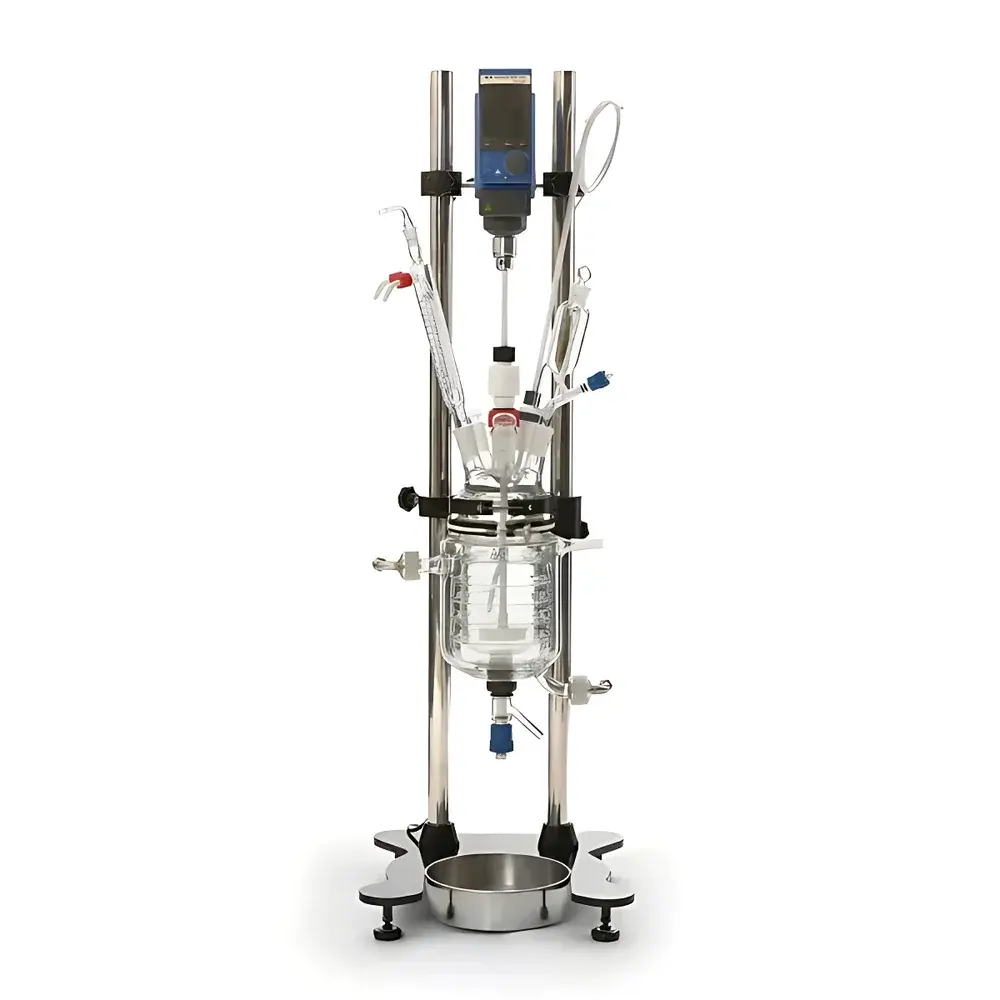
IKA 1L Dual-Jacketed Laboratory Reactor
| Brand | IKA |
|---|---|
| Origin | Germany |
| Model | 1L Dual-Jacketed Reactor |
| Capacity | 1 L |
| Jacket Type | Dual (inner & outer thermal isolation) |
| Operating Temperature Range | −90 °C to +230 °C |
| Thermal Shock ΔT | 60 °C |
| Pressure Range | 666 Pa (vacuum) to ambient |
| Wetted Materials | Borosilicate Glass 3.3, PTFE, FFKM, FKM |
| Lid Ports | 6 (SQG 29/42 × 1, TS 29/42 × 1, TS 24/40 × 4) |
| Max Stirring Speed | 800 rpm |
| Dimensions (W×D×H) | 380 mm × 380 mm × 1206 mm |
| Weight | 21 kg |
| Compliance | Designed for GLP-compliant lab environments |
Overview
The IKA 1L Dual-Jacketed Laboratory Reactor is a precision-engineered benchtop synthesis platform designed for controlled chemical reaction, high-viscosity mixing, and process development under variable thermal and pressure conditions. It operates on the principle of dual thermal isolation—featuring both an inner heating/cooling jacket and an outer vacuum-insulated annulus—to decouple internal reaction temperature from ambient fluctuations. This architecture enables stable operation across an extended thermal envelope (−90 °C to +230 °C), supporting cryogenic organometallic catalysis, exothermic polymerization, and high-temperature condensation reactions. The reactor’s core vessel is constructed from DIN ISO 3585-certified borosilicate glass 3.3, ensuring chemical inertness, optical clarity for real-time visual monitoring, and mechanical resilience against thermal shock (ΔT ≤ 60 °C). Its modular lid configuration accommodates simultaneous integration of temperature probes, pH electrodes, reflux condensers, gas inlets, and sampling ports—making it suitable for sequential or parallel multi-parameter reaction optimization.
Key Features
- Dual-jacket design: Inner jacket for active thermal fluid circulation (e.g., silicone oil or ethanol/water mixtures); outer vacuum jacket minimizes parasitic heat loss and enhances thermal stability—critical for low-temperature reactions where external condensation or frost formation must be avoided.
- Chemically resistant wetted path: All fluid-contact surfaces consist of borosilicate glass 3.3 (ASTM E438 Type I, Class A), PTFE-sealed joints, and perfluoroelastomer (FFKM) gaskets rated for aggressive solvents (e.g., HF, fuming nitric acid) and elevated temperatures up to 300 °C short-term.
- Tool-free assembly: Quick-lock clamping system with standardized ISO-KF and TS/SQG ground-glass joints enables rapid reconfiguration without torque tools—reducing setup time and operator-induced variability.
- Bottom-discharge valve with zero-dead-volume geometry: Integrated PTFE-lined ball valve ensures complete material evacuation and eliminates product hold-up, supporting quantitative yield determination and cross-batch contamination control.
- High-efficiency stirring architecture: Motor-driven overhead stirrer (max. 800 rpm) coupled with interchangeable impellers (anchor, paddle, turbine, helical ribbon) delivers uniform shear distribution—even for non-Newtonian media up to 10⁶ mPa·s viscosity—without vortex formation or wall adhesion.
Sample Compatibility & Compliance
The reactor supports liquid, slurry, suspension, and heterogeneous catalytic systems—including air- and moisture-sensitive chemistries when operated under inert gas blanket (N₂ or Ar) or static vacuum (down to 666 Pa). Its materials of construction conform to USP and cytotoxicity requirements for pharmaceutical intermediates. The system is compatible with GMP-aligned documentation practices: temperature probe outputs are calibrated traceable to NIST standards; all digital interfaces support audit trail generation per FDA 21 CFR Part 11 when integrated with validated LIMS or ELN platforms. Design adheres to CE Machinery Directive 2006/42/EC and PED 2014/68/EU for pressure equipment below 0.5 bar gauge.
Software & Data Management
While the base unit operates via analog controls, optional IKA Labworld software (v4.2+) enables PC-based logging of temperature, stirring speed, and pressure at user-defined intervals (1–60 s resolution). Data export formats include CSV and XML for post-processing in MATLAB, Python (Pandas), or JMP. The software supports alarm-triggered event tagging, SOP-linked parameter locking, and electronic signature workflows compliant with Annex 11 and ALCOA+ data integrity principles. All firmware updates undergo regression testing per IEC 62304 Class B medical device software guidelines.
Applications
- Process chemistry screening: Kinetic profiling of Suzuki couplings, Grignard additions, and asymmetric epoxidations under controlled sub-zero conditions.
- Pharmaceutical API synthesis: Solvent-mediated crystallization, hydrogenation, and hydrolysis steps requiring strict temperature ramping (±0.5 °C accuracy) and inert atmosphere maintenance.
- Materials science: Sol-gel synthesis of metal oxides, nanoparticle precipitation, and polycondensation of biodegradable polyesters (e.g., PLA, PCL).
- Scale-up correlation studies: Geometric similarity parameters (Re, Fr, Po) preserved across IKA’s modular reactor series—from 1L lab scale to 20L pilot scale—enabling predictive modeling of mass transfer limitations and heat removal capacity.
FAQ
Can this reactor be used for hydrogenation under 3 bar H₂ pressure?
No. This model is rated only for vacuum to ambient pressure (666 Pa to 101.3 kPa). For pressurized hydrogenation, consider IKA’s RCT basic+ series with reinforced glass vessels and pressure-rated seals.
Is the temperature probe included with the system?
Yes—a Pt100 Class A probe with 2-meter PTFE-insulated cable and 1/4″ NPT thread is supplied standard, pre-calibrated and documented with a certificate of conformance.
What cooling fluids are compatible with the inner jacket at −90 °C?
Ethanol/methanol mixtures or specialized low-temperature heat transfer fluids (e.g., Dowtherm J) are recommended; avoid aqueous glycols below −20 °C due to freezing risk.
Does the system meet explosion-proof requirements for solvent vapor handling?
The base unit is not ATEX-certified. Optional Ex-d flameproof motor housings and intrinsically safe sensors are available as configured accessories upon request.
How is cleaning validation performed for multi-product use?
The smooth glass interior, absence of crevices, and full drainability enable swab sampling per ICH Q5C and rinse recovery studies; residue limits are calculated using worst-case toxicological thresholds (PDE/TTC).



