
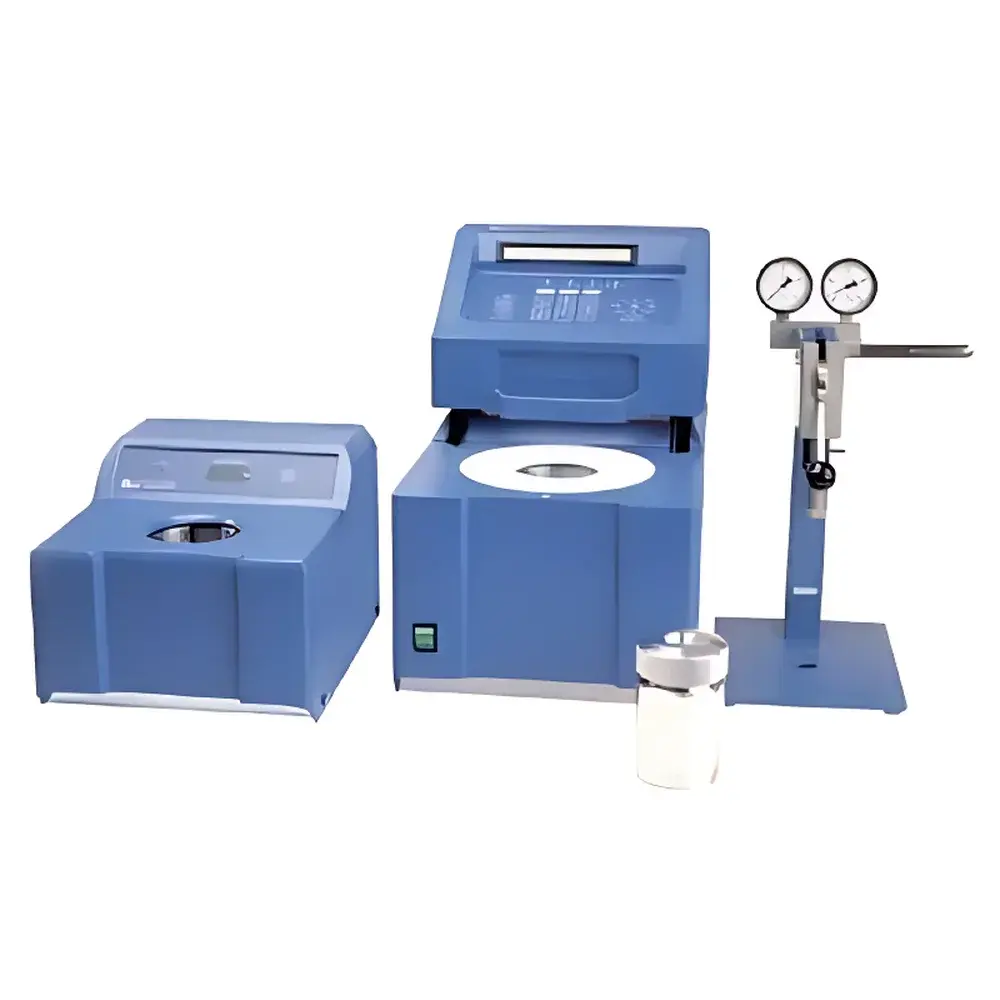
IKA C 7000 Basic Equipment Set 1 Bomb Calorimeter
| Brand | IKA |
|---|---|
| Origin | Germany |
| Manufacturer | IKA-Werke GmbH & Co. KG |
| Country of Origin | Imported |
| Model | C 7000 Basic Equipment Set 1 |
| Instrument Type | Bomb Calorimeter |
| Measurement Principle | Isoperibol Dry-Mode Combustion Calorimetry (ISO 1928) |
| Temperature Range | 20–30 °C |
| Temperature Resolution | 0.0001 K |
| Precision | 0.2 % RSD (per 1 g benzoic acid, NIST SRM 39i) |
| Single-Sample Test Duration | ~3–5 min |
| Heat Capacity | 30,000 J/K |
| Cooling Medium | Tap water |
| Minimum Cooling Flow Rate | 120–180 L/h |
| Max Operating Oxygen Pressure | 40 bar |
| Max Cooling Medium Pressure | 9 bar |
| Ambient Temperature Range | 18–30 °C |
| Relative Humidity Limit | ≤80 % RH |
| Power Supply | 220–240 V, 50/60 Hz |
| Input Power | 260 W |
| Dimensions (W×D×H) | 310 × 395 × 490 mm |
| Weight | 50.162 kg |
| Interfaces | RS232 (balance, printer, PC), Centronics printer port |
| Oxygen Bomb Recognition | Automatic encoded detection |
| Compatible Crucibles | C14 combustion crucibles (retrofittable) |
| Software | C5040 CalWin v3.x (menu-driven, GLP-compliant data handling) |
Overview
The IKA C 7000 Basic Equipment Set 1 is a high-precision, isoperibol-type dry-mode bomb calorimeter engineered for rapid and traceable determination of gross calorific value (GCV) in solid and liquid fuels, foodstuffs, and waste materials. As the world’s first commercially deployed dry-mode calorimetric system, it eliminates water jacket thermal inertia by directly measuring temperature rise within the combustion chamber—specifically from the calibrated decomposition bomb (C 7010)—enabling measurement completion in as little as 3 minutes per sample under ISO 1928 conditions. Its core architecture adheres to the fundamental thermodynamic principle of energy conservation: the heat released during complete combustion at constant volume is quantified via highly stable platinum resistance thermometry (resolution: 0.0001 K) and precisely known system heat capacity (30,000 J/K). The instrument operates exclusively in dual-dry mode—requiring no external water bath or inner/outer vessel equilibrium—thereby minimizing drift, improving reproducibility, and reducing operator dependency.
Key Features
- Automated encoded oxygen bomb recognition: Supports up to eight uniquely identified C 7010 bombs for unambiguous sample tracking and calibration traceability.
- Dual-dry measurement architecture compliant with ISO 1928:2020, eliminating dependence on water-level stability and thermal lag associated with traditional adiabatic or static-jacket systems.
- Integrated cooling system (C 7002) with flow-regulated tap-water circulation (120–180 L/h) and pressure monitoring (max 9 bar), ensuring consistent thermal sink performance across ambient fluctuations (18–30 °C).
- Robust 40-bar rated oxygen supply station (C 48) with integrated pressure regulation and leak-tight sealing—validated for repeated use with certified combustion-grade O₂ (≥99.995 % purity).
- RS232 interfaces for seamless integration with analytical balances (e.g., METTLER TOLEDO XP series), impact printers (Centronics), and laboratory PCs—enabling automated mass input and report generation.
- Modular design permits retrofitted use of C14 combustion crucibles within the C 7010 bomb, expanding compatibility with low-mass or volatile samples without hardware replacement.
Sample Compatibility & Compliance
The C 7000 Basic Equipment Set 1 is validated for heterogeneous solid fuels (coal, biomass, refuse-derived fuel), liquid hydrocarbons (diesel, biodiesel blends), and organic matrices including foodstuffs and pharmaceutical excipients. All measurements conform to ISO 1928:2020 (“Solid mineral fuels — Determination of gross calorific value by the bomb calorimeter”), with optional alignment to ASTM D5865, EN 14918, and DIN 51900. System validation includes routine verification using NIST Standard Reference Material 39i (benzoic acid), demonstrating long-term repeatability of ≤0.2 % RSD (n ≥ 10). The unit’s mechanical construction, electrical safety (IEC 61010-1), and operational documentation support GLP and GMP-aligned quality systems. Full audit trails—including user logins, method parameters, raw thermograms, and calibration history—are retained within CalWin software for regulatory review.
Software & Data Management
Controlled exclusively via IKA’s C5040 CalWin v3.x software, the system delivers menu-driven operation with intuitive workflow navigation, multi-language support (EN/DE/FR/ES), and configurable report templates compliant with ISO/IEC 17025 documentation requirements. CalWin implements electronic signatures, time-stamped data logging, and automatic calculation of corrected gross calorific value (Qgr,v) per ISO 1928 Annex B—accounting for nitric acid and sulfuric acid formation enthalpies. Raw temperature-time datasets are exportable in CSV and XML formats; all critical parameters (oxygen pressure, ignition energy, stirrer speed, cooling flow rate) are logged synchronously with thermometric acquisition. The software supports 21 CFR Part 11 readiness through optional server-based deployment with role-based access control and immutable audit logs.
Applications
- Quality control laboratories in coal-fired power plants and cement manufacturing facilities performing daily GCV verification per contractual specifications.
- Research institutions evaluating energy density of next-generation biofuels and pyrolysis oils under standardized combustion conditions.
- Food testing labs determining metabolizable energy content (Atwater factors) in compliance with AOAC 968.10 and ISO 9831.
- Waste-to-energy facilities characterizing calorific potential of municipal solid waste (MSW) and sewage sludge prior to incineration scheduling.
- Academic teaching labs requiring robust, low-maintenance calorimetry platforms with full traceability for undergraduate thermodynamics and fuel chemistry curricula.
FAQ
What distinguishes “dual-dry mode” from conventional bomb calorimetry?
Dual-dry mode eliminates both the outer water jacket and inner water vessel used in classical isoperibol or adiabatic designs. Temperature is measured directly inside the bomb’s thermal shield using a calibrated Pt100 sensor, enabling faster equilibration and intrinsic immunity to water-level errors.
Can the C 7000 be upgraded to support automated sample changers or advanced gas analysis?
The C 7000 Basic Equipment Set 1 is a fixed-configuration platform. Automation extensions (e.g., robotic sample loaders) are not supported; however, future expansion to C 7000 Advanced variants may include optional O₂/CO₂ exhaust gas coupling modules.
Is calibration verification required before each analysis session?
Per ISO 1928, system calibration must be verified at least once per day using certified benzoic acid (e.g., NIST SRM 39i); CalWin enforces this requirement via mandatory calibration check prompts prior to sample queue initiation.
Does the system meet FDA 21 CFR Part 11 requirements out-of-the-box?
The base CalWin installation provides foundational ALCOA+ data integrity features; full 21 CFR Part 11 compliance requires networked deployment with IKA’s validated CalWin Server Edition, including electronic signatures and audit trail encryption.
What maintenance intervals are recommended for the C 7010 oxygen bomb?
The C 7010 bomb requires annual hydrostatic pressure testing at 60 bar and visual inspection of the ignition circuit, sealing rings, and crucible support pins. IKA recommends replacing O-rings and crucible stands every 200 firings or biannually, whichever occurs first.
Related Products



