
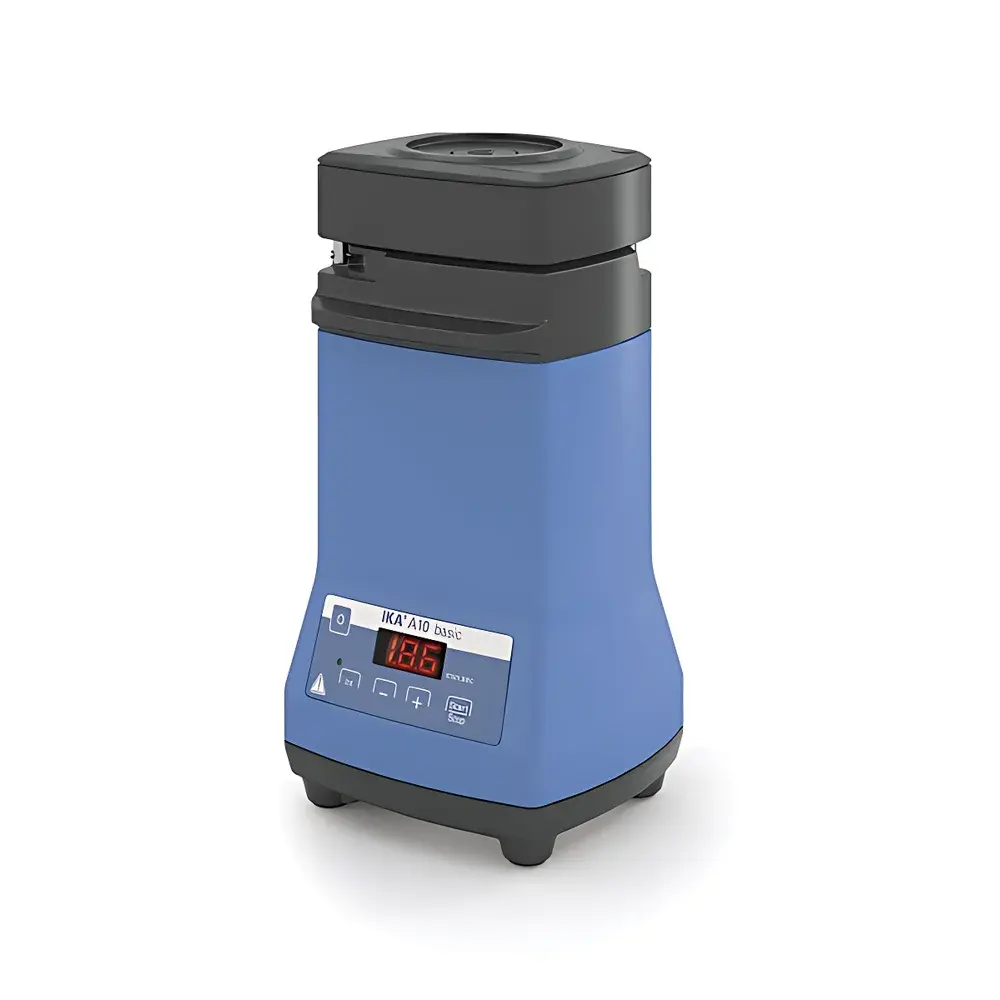
IKA A10 Basic Batch Grinder
| Brand | IKA |
|---|---|
| Origin | Germany |
| Manufacturer | IKA-Werke GmbH & Co. KG |
| Model | A10 Basic |
| Instrument Type | Batch Grinder |
| Sample Type | Soft, brittle, fibrous, and elastic materials |
| Maximum Feed Size | < 6 mm |
| Final Particle Size | < 40 µm (typical), down to ≤10 µm under optimized conditions |
| Batch Capacity | Up to 50 mL |
| Grinding Mechanism | High-speed shear and impact |
| Motor Output Power | 240 W |
| Input Power | 300 W |
| Max. Speed | 25,000 rpm (±500 rpm) |
| Peripheral Speed | 73 m/s |
| Grinding Chamber Material | Stainless Steel 1.4301 |
| Cutting Tool Material | Stainless Steel 1.4034 |
| Cooling Options | Integrated water-cooling jacket + optional dry-ice cooling |
| Duty Cycle | 5 min ON / 10 min OFF |
| Dimensions (W × H × D) | 130 × 250 × 145 mm |
| Weight | 3.13 kg |
| Ambient Operating Conditions | 5–40 °C, ≤80 % RH |
| Protection Class | IP41 (DIN EN 60529) |
| Electrical Supply | 220–240 V, 50/60 Hz |
| Compliance | CE, RoHS, IEC 61000-6-3/-4 |
Overview
The IKA A10 Basic Batch Grinder is a precision-engineered laboratory grinding instrument designed for reproducible, controlled size reduction of diverse sample types—including soft, elastic, fibrous, and moderately brittle materials—within closed stainless-steel chambers. Operating on dual mechanical principles—high-velocity impact and controlled shear—the A10 Basic delivers consistent sub-40 µm particle distributions in batch mode, with typical outputs reaching ≤10 µm when combined with optimized parameters (e.g., pre-chilling, reduced load, extended cycle timing). Its rotor-stator architecture features a dynamically balanced stainless-steel cutting tool (material 1.4034) rotating at up to 25,000 rpm within a corrosion-resistant grinding chamber (1.4301), generating a peripheral speed of 73 m/s to ensure efficient energy transfer while minimizing thermal degradation. Safety-critical interlocks mandate full lid closure before activation and enforce complete rotor standstill prior to lid release—fully compliant with EN 61000-6-2 and IEC 60335-1 requirements for laboratory equipment.
Key Features
- Brushless electronic motor delivering 240 W continuous output power, ensuring stable speed performance (25,000 rpm ±500 rpm), extended service life, and low acoustic emission (<75 dB(A) at 1 m)
- Digital timer with LED display for precise control of grinding duration (0.1–99.9 s or continuous mode), supporting repeatable protocol execution
- Integrated water-cooling jacket compatible with standard lab chillers; optional dry-ice cooling inserts enable cryogenic grinding of thermolabile or oily samples
- Ergonomic snap-lock lid mechanism with tactile feedback—reduces operator effort and eliminates misalignment risk during sealing
- Modular tooling system: interchangeable impact and shear blades (e.g., A10.1 impact blade, reduced-volume blade); all tools conform to ISO 8502-2 surface finish standards for trace-metal-sensitive applications
- Self-diagnostic interface with alphanumeric error codes (e.g., E01 = lid open, E03 = overheating) for rapid troubleshooting and maintenance logging
- IP41-rated enclosure (DIN EN 60529) and reinforced housing meet CE mechanical safety directives for unattended operation in ISO Class 7 clean benches
Sample Compatibility & Compliance
The A10 Basic accommodates feed particles up to 6 mm (Mohs hardness ≤5), including plant tissues, polymers, pharmaceutical excipients, food matrices, and biological soft tissues. It is validated for use with aqueous suspensions, lipid-rich samples (e.g., fish oil capsules), and hygroscopic powders—provided moisture content remains below 15 wt%. All wet-contact components comply with FDA 21 CFR 178.3570 (indirect food additives) and EU Regulation (EC) No. 1935/2004. The instrument supports GLP-compliant workflows through auditable time-stamped operation logs (when integrated with IKA LabWorld software), and its mechanical design conforms to ISO/IEC 17025:2017 clause 6.4.2 for equipment suitability verification.
Software & Data Management
While the A10 Basic operates as a standalone unit, it is fully compatible with IKA LabWorld Suite v4.2+ via RS232 or optional USB-to-serial adapter. This enables remote parameter setting, real-time RPM monitoring, cycle history export (CSV/Excel), and integration into LIMS environments. Audit trails include operator ID, timestamp, duration, speed setting, and error events—meeting FDA 21 CFR Part 11 requirements for electronic records when deployed with validated user authentication and digital signature modules. Firmware updates are delivered via signed .hex packages with SHA-256 checksum verification.
Applications
- Pharmaceutical R&D: Homogenization of API-excipient blends prior to dissolution testing (USP ) or laser diffraction particle sizing (ISO 13320)
- Food & Agriculture: Preparation of representative subsamples for proximate analysis (AOAC 985.29), mycotoxin extraction, or rheological characterization
- Environmental Labs: Grinding of soil cores and sediment composites for heavy metal leaching assays (EPA Method 1311)
- Materials Science: Pre-treatment of polymer pellets and elastomer scraps for FTIR spectral library development (ASTM E1252)
- Academic Research: Rapid cell lysis of soft microbial cultures and plant leaf tissue for RNA extraction protocols requiring minimal heat-induced degradation
FAQ
What is the maximum allowable feed hardness for the A10 Basic?
Samples must not exceed Mohs hardness 5—equivalent to apatite or common aluminum oxide ceramics. Harder materials (e.g., quartz, silicon carbide) will cause premature blade wear and void warranty coverage.
Can the A10 Basic be used for cryogenic grinding?
Yes—dry-ice inserts are available as accessory kits (Order No. 3021000). Ensure chamber temperature remains ≥−40 °C during operation to prevent embrittlement of stainless-steel components.
Is validation documentation available for GMP environments?
IKA provides IQ/OQ templates aligned with ASTM E2500-13 and Annex 15 of the EU GMP Guide. Full PQ support requires site-specific protocol development with certified metrology partners.
How often should the cutting tool be replaced?
Under standard use (≤200 cycles/month with soft organics), replacement is recommended every 12 months or after 500 operational hours—whichever occurs first—as verified by visual inspection for edge rounding or microcracking per ISO 8000-101.
Does the A10 Basic support continuous feeding?
No—it is strictly a batch-processing device. Continuous operation requires the IKA M20 universal grinder or the Tube Mill 100 control series.



