
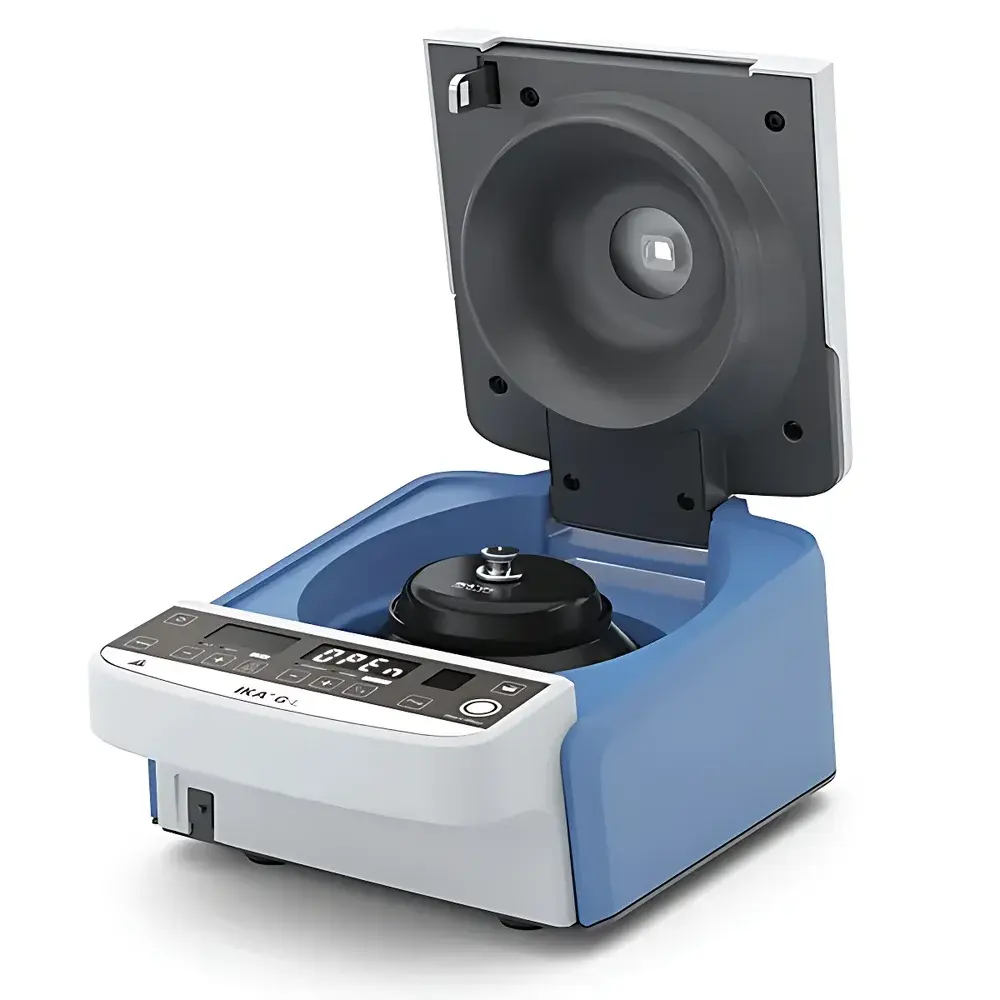
IKA G-L Compact Centrifuge
| Brand | IKA |
|---|---|
| Origin | Germany |
| Model | G-L |
| Maximum Speed | 15,700 rpm |
| Rotor Capacity | 12 × 1.5/2.0 mL tubes |
| Relative Centrifugal Force (RCF) | 16,500 × g |
| Acceleration Time to Max Speed | 17 s |
| Deceleration Time from Max Speed | 18 s |
| Speed Accuracy | ±100 rpm |
| Speed Deviation | ±2.5% |
| Timer Range | Yes (LED display) |
| Unbalance Detection | Yes |
| Quick-Stop Function | Yes |
| Auto-Lid Opening | Yes |
| Safety Lid Interlock | Yes |
| Noise Level | 55 dB(A) |
| Dimensions (W × D × H) | 200 × 140 × 280 mm |
| Weight | 3.9 kg |
| Operating Ambient Temperature | +5 to +40 °C |
| Max. Relative Humidity | 80% (non-condensing) |
| Protection Class | IP20 (DIN EN 60529) |
| Power Supply | 220–230 V, 50/60 Hz |
| Input Power | 92 W (operational), 3 W (standby) |
| USB Interface | Yes |
| Display Unit Conversion | rpm ↔ RCF |
| Motor Type | Brushless DC |
| Rotor Material | Anodized aluminum alloy |
| Compliance | CE, IEC 61010-1, IEC 61010-2-020 |
Overview
The IKA G-L Compact Centrifuge is a high-performance, benchtop centrifuge engineered for precision and reliability in molecular biology, clinical diagnostics, and routine laboratory workflows. Designed around the principles of rotor dynamics and controlled acceleration/deceleration profiles, the G-L employs a brushless DC motor to deliver stable rotational motion across its full speed range (800–15,700 rpm), generating up to 16,500 × g relative centrifugal force. Its compact footprint (200 × 140 × 280 mm) and lightweight construction (3.9 kg) make it ideal for space-constrained environments—including biosafety cabinets, laminar flow hoods, and shared core facilities—without compromising mechanical stability or thermal management. The unit operates within an ambient temperature range of +5 to +40 °C and meets IP20 ingress protection standards per DIN EN 60529, ensuring safe operation under standard laboratory conditions.
Key Features
- Intuitive Human-Machine Interface: LED-based seven-segment display with real-time rpm/RCF conversion, programmable timer, and tactile membrane keypad for rapid parameter entry and navigation.
- Enhanced Safety Architecture: Integrated lid interlock system prevents rotor activation unless the safety cover is fully closed and latched; automatic rotor braking and quick-stop functionality ensure immediate deceleration upon lid opening or emergency stop.
- Unbalance Detection & Compensation: Real-time imbalance sensing triggers automatic shutdown before critical vibration thresholds are reached, protecting both sample integrity and mechanical components.
- Optimized Thermal Management: Low-power standby mode (3 W) and efficient heat dissipation design maintain consistent internal temperature during repeated short-cycle runs typical in nucleic acid purification or PCR setup.
- Tool-Free Rotor Exchange: Pre-balanced, anodized aluminum alloy rotor (12-position, compatible with 1.5/2.0 mL microtubes and PCR strip tubes) installs without auxiliary tools and is autoclavable for GLP-compliant reuse.
- Digital Connectivity: USB interface enables firmware updates and optional data logging via IKA Labworld software (compatible with Windows-based lab management systems).
Sample Compatibility & Compliance
The G-L accommodates standard polypropylene and polycarbonate microcentrifuge tubes (1.5/2.0 mL) and 8-well PCR strips, supporting maximum sample density of 1.2 kg/dm³. Its rotor geometry and balance tolerance comply with ISO 15195:2019 requirements for analytical centrifugation devices used in clinical laboratories. All electrical and mechanical safety features conform to IEC 61010-1 (General Safety Requirements) and IEC 61010-2-020 (Particular Requirements for Laboratory Centrifuges). The device bears CE marking and supports audit-ready documentation for GLP/GMP environments, including traceable calibration records and user-accessible service logs.
Software & Data Management
While the G-L operates as a standalone instrument, its embedded USB port allows integration into centralized lab informatics platforms. Firmware updates preserve backward compatibility with legacy IKA Labworld configurations. Timestamped run logs—including speed, time, RCF, and error codes—are exportable for regulatory review. The system adheres to ALCOA+ principles (Attributable, Legible, Contemporaneous, Original, Accurate, Complete, Consistent, Enduring, Available) when paired with validated third-party LIMS solutions. No built-in 21 CFR Part 11 compliance features are present; however, external audit trail generation is supported through networked data capture protocols.
Applications
- Plasmid DNA miniprep and RNA isolation workflows requiring rapid pelleting of silica-membrane columns or magnetic beads.
- Cell lysate clarification prior to SDS-PAGE or ELISA sample preparation.
- Micro-volume precipitation steps in protein purification and metabolite extraction protocols.
- Centrifugation of diagnostic reagents, enzyme assays, and antibody conjugates where thermal stability and reproducible g-force application are critical.
- Quality control testing in pharmaceutical QC labs for suspension homogeneity verification and particulate removal.
FAQ
What tube formats are supported by the IKA G-L centrifuge?
The G-L accepts standard 1.5 mL and 2.0 mL conical-bottom microcentrifuge tubes, as well as 8-well PCR strip tubes—no adapters required.
Is the rotor autoclavable?
Yes, the included anodized aluminum rotor and lid are autoclavable at 121 °C for 20 minutes, supporting reuse in sterile applications.
Does the G-L meet international safety standards for laboratory equipment?
Yes—it complies with IEC 61010-1 and IEC 61010-2-020, carries CE marking, and satisfies mechanical and electrical safety requirements for Class II laboratory instruments.
Can the G-L be integrated into a LIMS or ELN environment?
Direct integration is enabled via USB; raw operational data can be exported and mapped to LIMS fields using configurable CSV templates.
What is the maximum allowable sample density for safe operation?
The instrument is rated for samples up to 1.2 kg/dm³—exceeding this may trigger unbalance detection or reduce rotor service life.



