
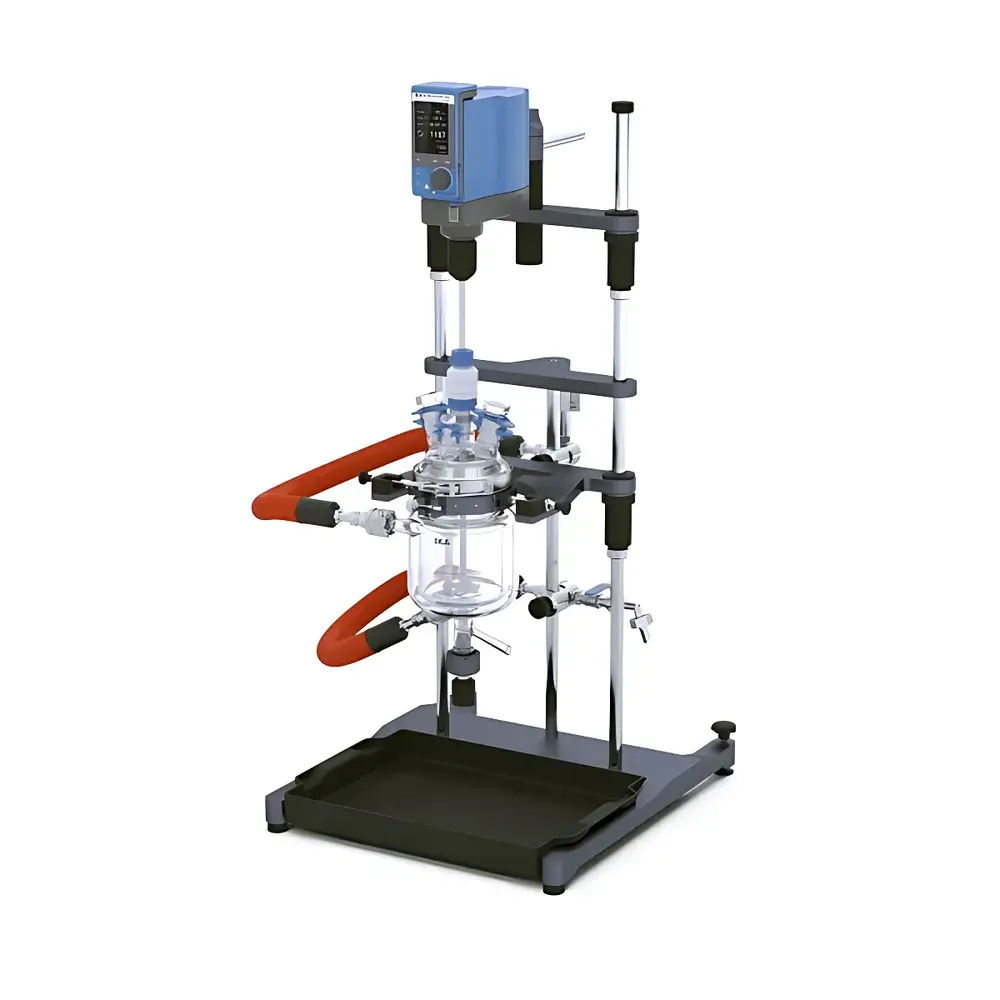
IKA EasySyn 1000 Advanced Reactor System
| Brand | IKA |
|---|---|
| Origin | Germany |
| Model | EasySyn 1000 Advanced Reactor System |
| Rated Volume | 1 L |
| Minimum Usable Volume | 120 mL |
| Minimum Sample Volume with Temperature Sensor | 260 mL |
| Operating Temperature Range | −50 to 200 °C |
| Maximum Vacuum | 3 mbar (process), 25 mbar (seal rating) |
| Stirring Shaft Max Torque | 100 N·cm |
| Flange Size | DN 100 |
| Dimensions (W × H × D) | 500 × 950 × 580 mm |
| Interfaces | RS-232, Micro-USB |
| Jacket Drain System | LT 5.40 Quick-Drain Unit |
| Vessel Material | DIN 3.3 borosilicate glass |
| Bottom Valve | Spring-loaded PTFE-coated glass valve |
| Lid Ports | 1 × NS 29/32 central, 2 × NS 29/32 side, 1 × NS 14/23 |
| Stirrer | EUROSTAR 100 control with keyless chuck, integrated timer, overload protection & temperature input |
| Agitator Blade | PTFE-coated helical impeller |
| Seal Type | High-vacuum mechanical seal rated to 25 mbar |
| Software Control | labworldsoft® 6 (RS-232 optional) |
Overview
The IKA EasySyn 1000 Advanced Reactor System is a fully integrated, benchtop-scale chemical synthesis platform engineered for reproducible, scalable, and safe execution of organic and aqueous reactions under controlled thermal, mechanical, and vacuum conditions. Based on the Couette flow principle and jacketed temperature regulation, the system combines a precision top-driven overhead stirrer, a double-walled 1 L borosilicate glass reactor vessel (DIN 3.3), and modular process interfaces to support reaction development from discovery through pilot-scale feasibility studies. Its design adheres to core principles of laboratory process intensification—enabling precise kinetic profiling, exotherm management, and multi-step sequence automation without compromising operator safety or material compatibility. The system operates across an extended thermal envelope (−50 °C to +200 °C) and maintains stable vacuum down to 3 mbar during active synthesis, with mechanical seals validated to 25 mbar ultimate vacuum—making it suitable for low-boiling solvent removal, moisture-sensitive chemistry, and catalytic hydrogenations requiring inert or reduced-pressure environments.
Key Features
- DN 100 standardized flange interface with FEP-coated O-ring ensures leak-tight, chemically resistant sealing across aggressive reagents including halogenated solvents, strong acids, and organometallics.
- Ergonomic height-adjustable support frame enables rapid vessel exchange and accommodates users of varying stature—reducing repetitive strain during routine operation and cleaning cycles.
- LT 5.40 quick-drain unit integrates thermally insulated valves and reinforced silicone hoses for complete, residue-free jacket fluid evacuation in under 45 seconds—minimizing downtime between experiments.
- EUROSTAR 100 control stirrer delivers up to 100 N·cm torque with real-time speed regulation (0–300 rpm), built-in temperature monitoring input, programmable ramping profiles, and automatic motor shutdown upon overload detection.
- NS-threaded lid ports (1 × NS 29/32 center, 2 × NS 29/32 side, 1 × NS 14/23) allow simultaneous integration of reflux condensers, addition funnels, gas inlets, pH probes, or inline FTIR flow cells without adapter stacking.
- Spring-loaded bottom discharge valve with PTFE seating prevents mechanical stress on glass during actuation and eliminates cross-contamination risk during sequential batch processing.
Sample Compatibility & Compliance
The EasySyn 1000 Advanced supports heterogeneous, homogeneous, and biphasic reaction systems—including Grignard formations, Suzuki couplings, enzymatic transformations, and nanoparticle precipitation. All wetted parts comply with USP Class VI and ISO 10993-5 standards for biocompatibility. The borosilicate glass vessel meets DIN ISO 3585 specifications for hydrolytic resistance (Class HGB 1), while FEP and PTFE components exhibit full resistance to ASTM D543-acid/base exposure. The system architecture facilitates compliance with GLP documentation requirements: labworldsoft® 6 supports user-level access control, electronic signatures, and audit-trail-enabled parameter logging per FDA 21 CFR Part 11 when deployed with validated configuration and network authentication protocols.
Software & Data Management
Control and data acquisition are centralized via IKA’s labworldsoft® 6 software suite—a Windows-based platform supporting synchronized logging of temperature (jacket and internal probe), stirring speed, torque, time-stamped event markers, and external sensor inputs (e.g., pH, conductivity). Data export is native to CSV and Excel-compatible formats; raw logs include metadata headers compliant with MIAME and ISA-Tab conventions for downstream LIMS integration. Remote operation is enabled via RS-232 serial link (standard) or optional Ethernet-to-serial bridge. All parameter changes are timestamped and attributed to individual user accounts, satisfying traceability mandates for ISO/IEC 17025-accredited laboratories.
Applications
- Optimization of reaction kinetics under variable cooling/heating ramps and controlled addition rates.
- Synthesis of air- and moisture-sensitive compounds using Schlenk-line compatible gas purging through NS ports.
- Crystallization process development with in-situ temperature-controlled nucleation and anti-solvent dosing.
- Scale-down validation of continuous flow processes by replicating residence time distributions in batch mode.
- Training platform for undergraduate and graduate synthetic methodology courses—emphasizing hazard analysis, SOP adherence, and engineering controls.
FAQ
Can the EasySyn 1000 Advanced be used for reactions requiring inert atmosphere?
Yes—the system supports nitrogen or argon purging via dedicated NS 29/32 ports; combined with vacuum evacuation cycles, it achieves O₂ levels below 10 ppm when properly sealed.
Is the jacket compatible with dry ice/acetone baths for sub-zero operation?
Yes—the DN 100 flange-mounted jacket accepts standard cryogenic heat transfer fluids; the −50 °C lower limit is verified using ethylene glycol/water mixtures at −40 °C and specialized low-temp silicone oils at −50 °C.
Does labworldsoft® 6 support automated method sequencing across multiple reactors?
No—labworldsoft® 6 is single-system focused; however, its open ASCII command protocol allows integration into third-party SCADA or LabVIEW environments for multi-unit orchestration.
What maintenance intervals are recommended for the mechanical seal?
Under normal use (≤8 hrs/day, non-abrasive media), inspect the seal every 6 months; replace annually or after 2000 operating hours—whichever occurs first.
Is the bottom valve certified for GMP-compliant API manufacturing?
While the valve meets material and cleanability criteria per ASME BPE-2022 Chapter 6, final GMP qualification requires site-specific validation including hold-time studies, cleaning verification, and particulate shedding tests.



