
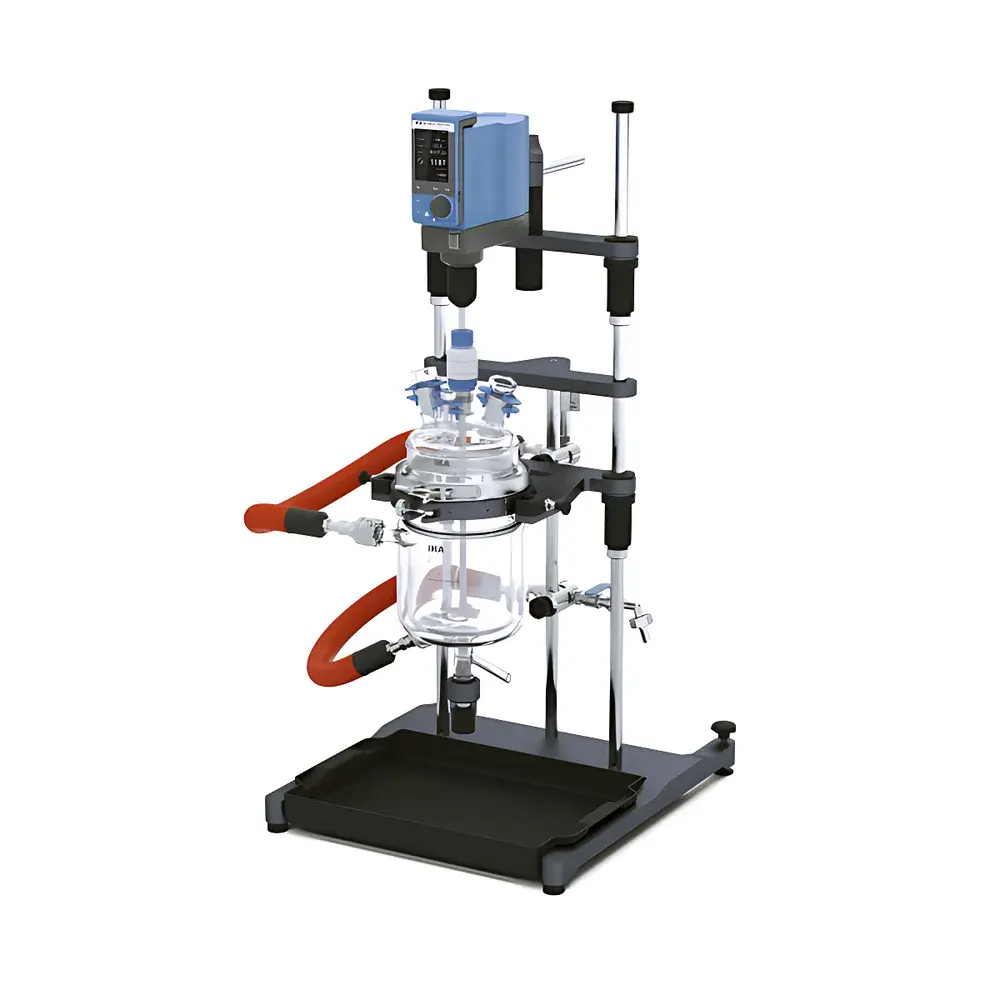
IKA EasySyn 2000 Advanced Professional Synthesis Reactor System
| Brand | IKA |
|---|---|
| Origin | Germany |
| Manufacturer Type | Original Equipment Manufacturer (OEM) |
| Product Category | Imported |
| Model | EasySyn 2000 Advanced |
| Reactor Type | Jacketed Glass Reactor |
| Usable Volume | 2 L |
| Operating Pressure Range | Low-pressure (up to 25 mbar vacuum) |
| Ultimate Vacuum | 3 mbar |
| Temperature Range | –50 °C to +200 °C |
| Vessel Material | Borosilicate Glass 3.3 |
| Stirrer Motor | EUROSTAR 100 control, max. torque 150 N·cm |
| Stirring Shaft Seal | High-vacuum PTFE-sealed |
| Vessel Fixation | DN 150 clamp system with FEP-coated O-ring |
| Port Configuration | 1 × NS 29/32 central port, 2 × NS 29/32 side ports, 1 × NS 14/23 auxiliary port |
| Drain System | LT 5.40 quick-drain unit with integrated valves and thermostatic hose connections |
| Control Interface | RS232 and USB |
| Software Compatibility | labworldsoft® 6 (optional external automation) |
Overview
The IKA EasySyn 2000 Advanced Professional Synthesis Reactor System is a fully integrated, jacketed glass reactor platform engineered for precise, reproducible, and scalable chemical synthesis under controlled temperature, pressure, and agitation conditions. Designed in accordance with ISO 9001-certified manufacturing protocols in Staufen, Germany, the system implements a Couette-type mixing geometry with top-driven mechanical stirring and double-walled thermal regulation—enabling accurate heat transfer via circulating bath fluid (e.g., silicone oil or ethanol/water mixtures). Its modular architecture supports both organic and aqueous reaction chemistries across academic research, process development, and pilot-scale feasibility studies. The reactor operates within a validated thermal envelope of –50 °C to +200 °C and maintains stable vacuum down to 3 mbar, meeting key requirements for solvent removal, distillation, hydrogenation, and moisture-sensitive transformations. All wetted parts—including vessel, lid, bottom discharge valve, and sealing elements—are constructed from chemically inert materials compliant with DIN ISO 3585 (borosilicate glass 3.3), ASTM D1600 (PTFE), and DIN 28178 (FEP), ensuring long-term compatibility with aggressive reagents such as concentrated acids, anhydrous bases, and halogenated solvents.
Key Features
- DN 150 standardized clamping system with FEP-coated O-rings for leak-tight, corrosion-resistant vessel sealing
- 2 L double-jacketed borosilicate glass 3.3 reactor vessel with integrated spring-loaded bottom discharge valve (PTFE seat)
- EUROSTAR 100 control overhead stirrer delivering up to 150 N·cm torque, featuring real-time torque monitoring, overload protection, programmable timer, bidirectional rotation, and embedded Pt100 temperature sensing
- LT 5.40 rapid drain module enabling tool-free, contamination-free evacuation of jacket fluid—reducing vessel changeover time by >60% compared to manual draining
- Ergonomic height-adjustable support frame (500 × 950 × 580 mm), compatible with user anthropometry and laboratory bench ergonomics standards (ISO 11228-1)
- Multi-port reactor head: one central NS 29/32 standard taper joint, two lateral NS 29/32 ports, and one NS 14/23 auxiliary port for simultaneous integration of condensers, addition funnels, gas inlets, or pH probes
- PTFE-coated helical impeller optimized for high-shear dispersion and low foaming in viscous or heterogeneous media
Sample Compatibility & Compliance
The EasySyn 2000 Advanced accommodates a broad spectrum of sample types—including suspensions, slurries, emulsions, and air/moisture-sensitive solutions—without compromising structural integrity or measurement fidelity. Its borosilicate glass 3.3 construction complies with ISO 3585 for hydrolytic resistance (Class HGB 1), while all polymer components meet USP Class VI biocompatibility criteria. The system supports GLP-compliant workflows through optional audit-trail-enabled labworldsoft® 6 software (configured per FDA 21 CFR Part 11 Annex 11 requirements when paired with appropriate IT infrastructure). Pressure and temperature validation reports are available upon request, aligned with ASTM E2877-22 (thermal calibration) and ISO 17025-accredited third-party verification pathways.
Software & Data Management
labworldsoft® 6 provides deterministic sequence-based control over stirring speed, temperature ramping, vacuum profiling, and timed event triggering (e.g., reagent addition or quenching). Via RS232 or USB interface, it logs timestamped parameters—including absolute torque, setpoint deviation, bath temperature, and vacuum level—at user-defined intervals (100 ms–60 s resolution). Raw data exports in CSV and XML formats facilitate post-processing in MATLAB®, Python (Pandas), or LIMS environments. Optional modules include recipe management, electronic signature enforcement, and remote monitoring via secure HTTPS endpoints—supporting centralized instrument fleets in multi-lab organizations.
Applications
- Development of Grignard, lithiation, and hydride reduction protocols requiring strict exclusion of atmospheric moisture
- Kinetic profiling of catalytic cross-coupling reactions (Suzuki, Heck, Buchwald–Hartwig) under inert gas blanket
- Controlled crystallization studies involving supersaturation induction and seeding under isothermal vacuum
- Process intensification of continuous-flow hybrid batch operations using integrated dosing pumps and inline IR probes
- Education and training in unit operations—demonstrating mass/heat transfer limitations, mixing efficiency (Blending Number), and scale-up correlations (Weber, Reynolds, and Power numbers)
FAQ
Is the EasySyn 2000 Advanced suitable for exothermic reactions requiring active cooling?
Yes—the double-jacket design supports connection to external chillers capable of –50 °C outlet temperatures; combined with the high-torque stirrer’s efficient heat dissipation, it enables precise ΔT control during highly exothermic additions.
Can the system be validated for GMP manufacturing environments?
While classified as a laboratory-scale R&D instrument, its traceable calibration paths, material certifications, and optional 21 CFR Part 11-compliant software configuration allow inclusion in early-phase process validation packages under ICH Q5A and Q7 guidelines.
What maintenance intervals are recommended for the stirring shaft seal under continuous vacuum operation?
Under nominal vacuum conditions (<10 mbar) and ambient temperature cycling, the PTFE lip seal requires inspection every 500 operational hours; replacement is advised after 2,000 hours or following exposure to halogenated solvents at elevated temperatures.
Does IKA provide IQ/OQ documentation templates for this system?
Yes—customizable Installation Qualification (IQ) and Operational Qualification (OQ) protocols are available upon order confirmation, aligned with ISO/IEC 17025 and ASTM E2500-22 frameworks.
Are alternative vessel geometries (e.g., conical bottoms or baffled designs) available?
IKA offers a catalog of interchangeable vessels—including 1 L and 3 L variants, conical-bottom reactors with full drainage, and baffled configurations for improved radial flow—each certified to the same dimensional and material specifications as the standard 2 L unit.



