
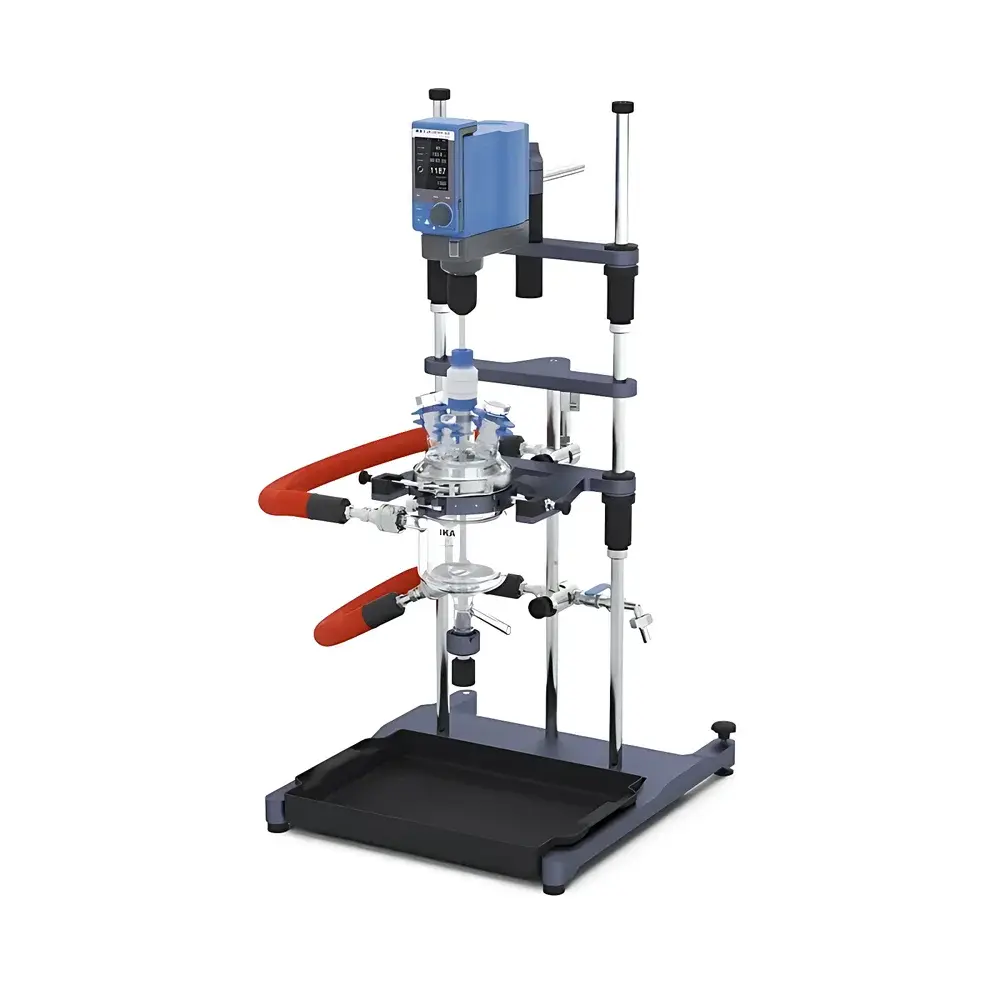
IKA EasySyn 500 Advanced Reactor System
| Brand | IKA |
|---|---|
| Origin | Germany |
| Model | EasySyn 500 Advanced Reactor System |
| Rated Volume | 0.5 L |
| Minimum Usable Volume | 30 mL |
| Minimum Sample Volume with Temperature Sensor | 260 mL |
| Operating Temperature Range | −50 to 200 °C |
| Maximum Vacuum | 3 mbar (process), 25 mbar (seal rating) |
| Stirring Shaft Max Torque | 100 N·cm |
| Flange Size | DN100 |
| Dimensions (W × H × D) | 500 × 950 × 580 mm |
| Interfaces | RS232, Micro-USB |
| Jacket Drain System | LT 5.40 Quick-Drain Unit |
| Vessel Material | DIN 3.3 borosilicate glass |
| Stirrer Type | Overhead EUROSTAR 100 control |
| Sealing | High-vacuum PTFE/FEP-coated shaft seal |
| Bottom Valve | Spring-loaded glass-safe discharge valve |
| Control Software | labworldsoft® 6 (RS232-controlled) |
Overview
The IKA EasySyn 500 Advanced Reactor System is a fully integrated, benchtop-scale chemical synthesis platform engineered for precision, safety, and scalability in laboratory environments. Designed around Couette-type overhead stirring and double-jacketed thermal management, the system enables controlled exothermic and endothermic reactions under inert, ambient, or vacuum conditions. Its core architecture supports reproducible process development from early-stage organic synthesis to pilot-scale reaction optimization—bridging the gap between discovery chemistry and process chemistry. The reactor operates across an extended thermal envelope (−50 °C to +200 °C) using external circulators, while its high-integrity vacuum-rated sealing (down to 3 mbar process vacuum, rated to 25 mbar) ensures compatibility with solvent removal, distillation, and moisture-sensitive transformations. All wetted components—including the 500 mL DN100 double-wall vessel, bottom discharge valve, and flange seals—are constructed from DIN 3.3 borosilicate glass and FEP/PTFE polymers, delivering exceptional resistance to strong acids, bases, halogenated solvents, and oxidizing reagents.
Key Features
- Overhead drive EUROSTAR 100 control stirrer with digital torque regulation (up to 100 N·cm), integrated temperature monitoring, overload protection, and programmable timer functions
- DN100 standardized flange interface with FEP-coated O-ring and quick-lock ring for rapid, leak-tight vessel assembly and disassembly
- LT 5.40 Quick-Drain Unit with dedicated valves and insulated thermal hoses—enabling full jacket fluid evacuation in <60 seconds without disassembling the reactor frame
- Ergonomic height-adjustable support frame with tool-free vessel cradling, accommodating operator anthropometry and minimizing manual handling risk
- Multi-port reactor head (1× NS 29/32 central port, 2× NS 29/32 side ports, 1× NS 14/23 auxiliary port) for simultaneous integration of condensers, addition funnels, gas inlets, pH probes, or sampling lines
- Spring-loaded bottom discharge valve with tempered glass contact surfaces—designed to prevent mechanical fracture during pressure/vacuum cycling and thermal shock
- Vacuum-compatible magnetic coupling shaft seal with dual PTFE labyrinth geometry, validated for continuous operation at ≤3 mbar absolute pressure
Sample Compatibility & Compliance
The EasySyn 500 Advanced is routinely deployed in API intermediate synthesis, catalytic hydrogenation screening, Grignard and organolithium chemistry, polymerization kinetics, and aqueous-phase nanoparticle precipitation. Its material compatibility covers >95% of reagents listed in the Corning Glass Compatibility Guide and aligns with ASTM E2739-21 (laboratory reactor safety practices). The system supports GLP-compliant workflows when paired with labworldsoft® 6’s audit-trail-enabled operation logs (user ID, timestamp, parameter setpoints, actual values, and event flags). While not intrinsically rated for ATEX Zone 1, it may be operated in certified fume hoods meeting EN 14175-3 requirements. All electrical components comply with IEC 61010-1:2010 for laboratory equipment safety.
Software & Data Management
Control and automation are executed via IKA’s labworldsoft® 6 software—a Windows-based platform supporting RS232 serial communication for synchronized parameter logging (temperature, torque, speed, time) at up to 10 Hz resolution. The software provides pre-defined method templates for reflux, gradient heating, stoichiometric addition, and vacuum ramping; all methods include configurable alarm thresholds and automatic emergency shutdown triggers (e.g., torque overshoot >110%, jacket temperature deviation >±5 K). Raw data exports to CSV or ASCII formats meet FDA 21 CFR Part 11 requirements when used with enabled electronic signatures and role-based access controls. Optional OPC UA integration allows bidirectional data exchange with LIMS or MES systems.
Applications
- Optimization of heterogeneous catalysis (e.g., Pd/C hydrogenations) under controlled H2 pressure and temperature gradients
- Kinetic profiling of SN2 substitutions and elimination reactions via in-situ temperature-programmed sampling
- Scale-down validation of commercial batch processes—particularly for crystallization induction time and metastable zone width determination
- Development of continuous-flow precursors in hybrid batch/flow configurations using bottom valve-triggered transfers
- Teaching laboratories requiring ISO/IEC 17025-aligned instrumentation for undergraduate physical organic chemistry experiments
FAQ
Can the EasySyn 500 Advanced operate under positive pressure?
No—it is designed exclusively for atmospheric and vacuum service. Positive pressure operation requires additional engineering controls and is not supported by the vessel certification.
Is the labworldsoft® 6 software included with the system?
Yes—the full license and installation media are supplied standard. Remote license activation requires internet connectivity during first launch.
What is the maximum allowable jacket fluid temperature?
The double-jacket vessel is rated for circulating fluids up to +220 °C; however, safe operational limits depend on the thermal stability of the chosen heat transfer medium (e.g., silicone oil vs. glycol/water).
Does the system meet USP requirements for extractables testing?
While not pre-qualified for USP , the borosilicate glass and FEP/PTFE construction minimize leachables—making it suitable for extractables studies when validated per USP protocol.
Can third-party sensors (e.g., FTIR probes or Raman immersion optics) be mounted directly?
Yes—NS 29/32 ports accept standard Swagelok or Chemglass adapters; custom mounting fixtures are available from IKA upon request.



