
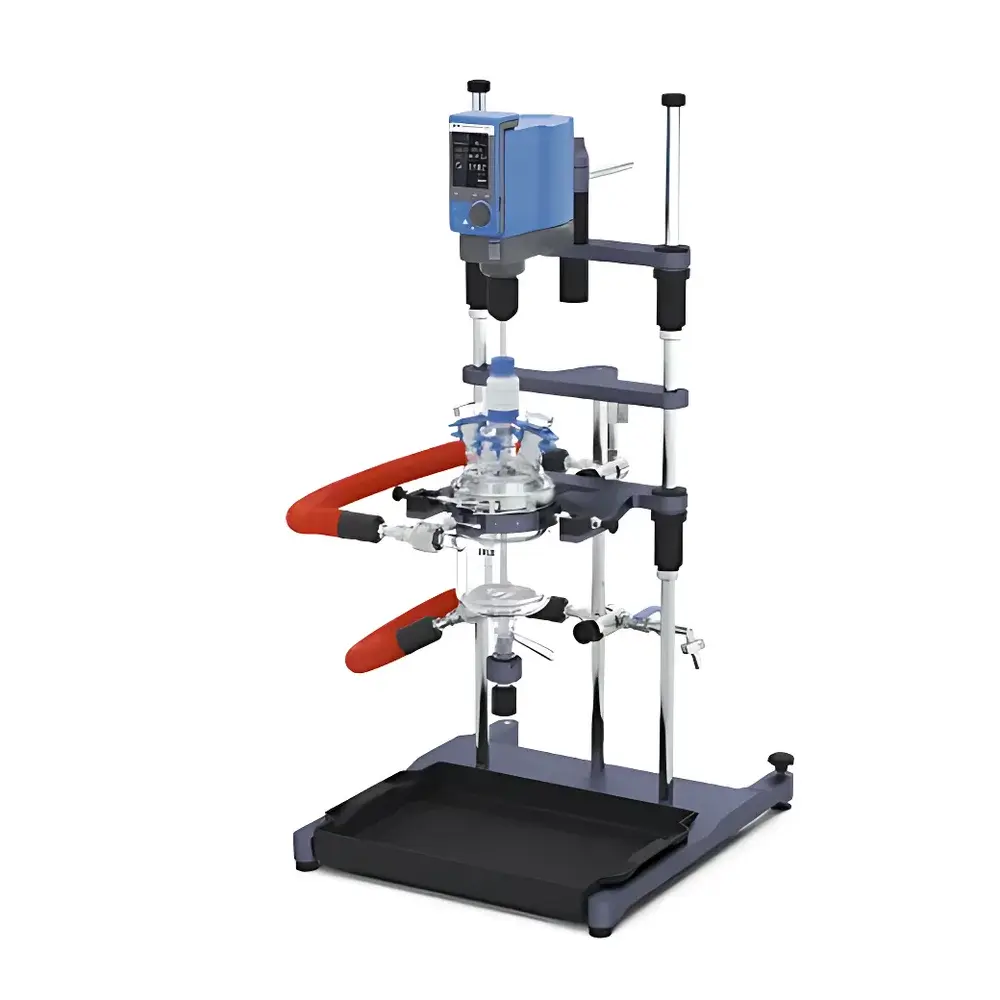
IKA EasySyn Starter & Advanced Glass Reactor Systems
| Brand | IKA |
|---|---|
| Origin | Germany |
| Manufacturer | IKA-Werke GmbH & Co. KG |
| Type | Benchtop Jacketed Glass Reactor System |
| Models | EasySyn 500/1000/2000/5000 Starter, EasySyn 500/1000/2000/5000 Advanced |
| Volumes | 500 mL, 1000 mL, 2000 mL, 5000 mL |
| Operating Temperature Range | −50 °C to +200 °C |
| Ultimate Vacuum | 3 mbar |
| Max. Stirring Torque (Starter) | 60 N·cm |
| Max. Stirring Torque (Advanced) | 100 N·cm |
| Contact Materials | Borosilicate Glass 3.3 (DIN ISO 3585), PTFE, FEP |
| Stirrer Drive | Top-mounted, digital speed control with torque monitoring, bidirectional rotation, intermittent operation, real-time torque display, relative torque measurement |
| Temperature Monitoring | Integrated Pt100 sensor port (optional probe) |
| Communication Interfaces | RS232, USB |
| Compliance | CE, RoHS, conforms to DIN EN 61000-6-2/-4 EMI immunity standards |
| Environmental Conditions | Ambient temperature +5 °C to +40 °C, max. 80 % RH, altitude ≤ 2000 m |
Overview
The IKA EasySyn Starter and Advanced glass reactor systems are fully integrated, jacketed laboratory-scale reaction platforms engineered for precise thermal control, reproducible mixing, and safe operation under reduced pressure or inert atmosphere. Based on Couette-type stirring geometry and double-jacketed borosilicate glass 3.3 vessel design, these reactors enable accurate heat transfer via external circulators (e.g., refrigerated/heated chillers) while maintaining full visual process monitoring. The modular architecture supports scalable synthesis—from exploratory screening in 500 mL vessels to pilot-scale optimization up to 5000 mL—without compromising mechanical stability or chemical compatibility. Designed explicitly for organic synthesis, catalytic reactions, nanoparticle precipitation, pH-controlled crystallization, and vacuum-assisted distillation, the EasySyn platform meets fundamental requirements of GLP-compliant laboratories conducting method development, reaction kinetics studies, or process safety assessments.
Key Features
- Modular configuration: Two standardized system tiers—Starter (EUROSTAR 60 digital drive) and Advanced (EUROSTAR 100 control drive)—each available in four volume options (500 / 1000 / 2000 / 5000 mL)
- Borosilicate glass 3.3 (DIN ISO 3585) reaction vessels with standardized NS ground-glass joints (1 × NS 29/32 center port, 2 × NS 29/32 side ports, 1 × NS 14/23 auxiliary port) ensuring leak-tight assembly and interchangeability
- Integrated top-mounted stirrer drive with digital speed regulation (0–250 rpm), real-time torque feedback, bidirectional rotation, and programmable intermittent stirring mode
- Pressure/vacuum-rated design: validated for continuous operation down to 3 mbar absolute pressure; compatible with vacuum pumps and gas dosing manifolds
- Quick-drain valve (LT 5.40) included in Advanced models for rapid, residue-free discharge under gravity or slight overpressure
- Comprehensive material compatibility: PTFE-coated impellers, FEP O-rings, and glass-to-glass sealing surfaces eliminate metallic contamination and ensure resistance to strong acids, bases, and organic solvents
- Dual-interface connectivity: RS232 and USB ports support direct data logging, remote parameter adjustment, and integration into LIMS or ELN environments
Sample Compatibility & Compliance
The EasySyn reactor series is certified for use with aqueous, polar aprotic, and non-polar organic media across a broad thermal envelope (−50 °C to +200 °C). All wetted parts comply with USP Class VI and EU Pharmacopoeia requirements for extractables testing. The system adheres to DIN EN 61010-1 for electrical safety in laboratory equipment and incorporates built-in over-torque protection and motor thermal cutoff. For regulated environments, optional Pt100 temperature probes (with 21 CFR Part 11–compliant calibration records) enable audit-ready temperature traceability. The reactor’s mechanical design satisfies ISO 8573-1 Class 4 purity requirements when operated under nitrogen purge, making it suitable for moisture- and oxygen-sensitive syntheses including Grignard, organolithium, and metal-catalyzed cross-coupling reactions.
Software & Data Management
IKA Labworld software (v4.0+) provides native driver support for both EUROSTAR variants, enabling synchronized acquisition of stirring speed, torque, temperature (via optional probe), and elapsed time. Data export is supported in CSV, Excel, and PDF formats with embedded metadata (operator ID, timestamp, version stamp). Audit trail functionality logs all parameter changes, user logins, and system events—fully compliant with FDA 21 CFR Part 11 when deployed with electronic signature modules. Remote operation via Ethernet (with optional IKA Connect module) allows secure access from lab management workstations, facilitating multi-user scheduling and centralized instrument utilization tracking.
Applications
- Controlled crystallization and polymorph screening under variable cooling rates and supersaturation profiles
- Vacuum-assisted solvent removal and low-boiling-point distillations (e.g., THF, diethyl ether, pentane)
- Heterogeneous catalysis studies requiring precise reagent addition, gas dispersion, and exotherm management
- Nanomaterial synthesis (e.g., quantum dots, metal oxides) via controlled nucleation and growth kinetics
- pH-stat and titration-controlled precipitation for pharmaceutical salt formation
- Photochemical reactions using optional quartz jackets and UV-transparent glass variants
- Process analytical technology (PAT) integration via analog outputs for real-time turbidity or conductivity monitoring
FAQ
What distinguishes the Starter and Advanced configurations?
The Advanced model includes the EUROSTAR 100 control drive (100 N·cm max torque), quick-drain valve LT 5.40, larger DN 150 flange (for 2000/5000 mL), and enhanced firmware with ramp/soak temperature programming.
Can the reactor be used for hydrogenation reactions?
Yes—when equipped with H₂-compatible pressure-rated caps (sold separately) and operated within its 3 mbar to 2 bar pressure range, the system supports catalytic hydrogenation under controlled gas flow.
Is glass breakage covered under warranty?
Borosilicate glass components are excluded from standard warranty due to inherent fragility; however, IKA offers extended consumables programs and certified replacement vessel kits with batch-specific dimensional validation reports.
How is temperature measured inside the reactor?
The system provides a dedicated Pt100 sensor port in the lid; users install a calibrated probe (e.g., IKA TF 1000 series) for direct medium temperature feedback—critical for kinetic modeling and Arrhenius analysis.
Does the system support automated reagent addition?
Yes—standard NS 29/32 side ports accept peristaltic pump tubing or syringe drivers; optional IKA Dosing Units (e.g., Dosing Unit DU 5) integrate seamlessly via Labworld for gravimetric or volumetric addition protocols.



