
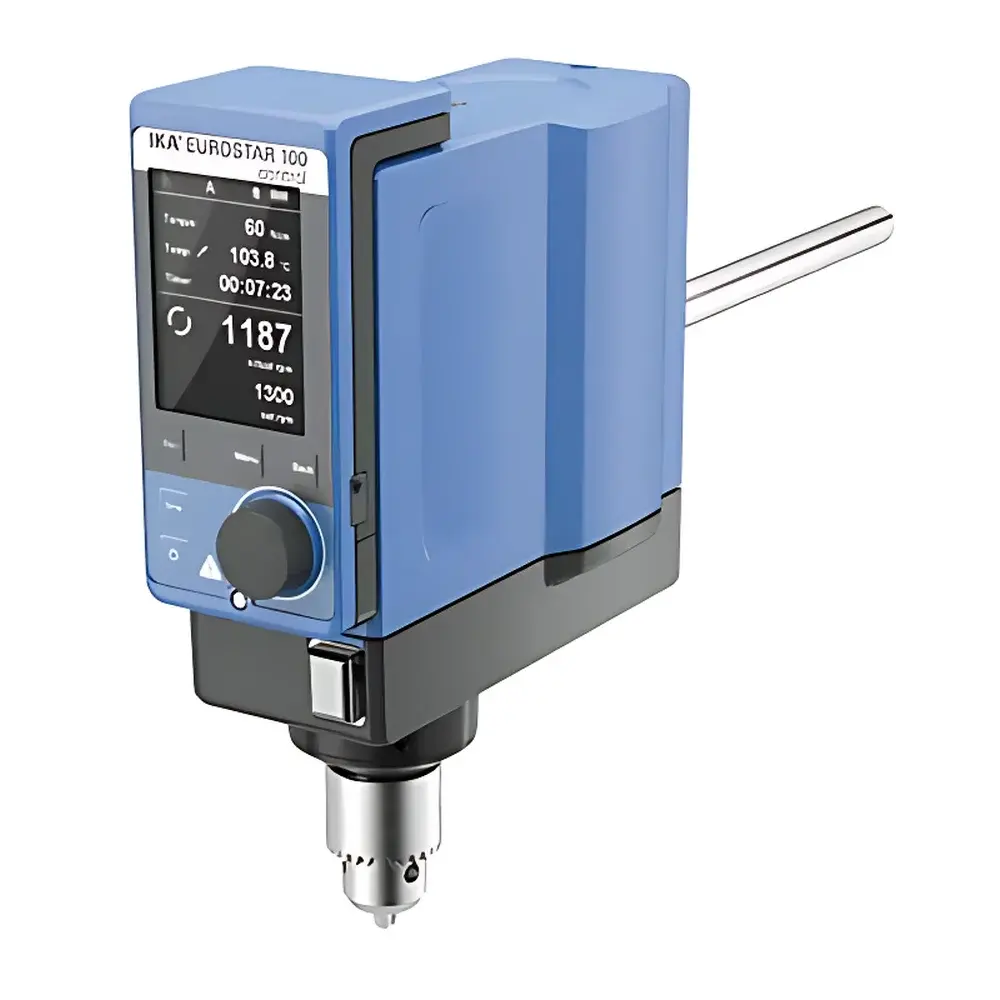
IKA EUROSTAR 100 control Overhead Electronic Stirrer
| Brand | IKA |
|---|---|
| Origin | Germany |
| Model | EUROSTAR 100 control |
| Maximum Stirring Volume | 100 L (H₂O) |
| Speed Range | 0/30–1300 rpm |
| Speed Accuracy | ±1 rpm (n > 300 rpm), ±1% (n < 300 rpm) |
| Torque Measurement Range | 0–100 N·cm |
| Max. Viscosity | 70,000 mPa·s |
| Motor Type | Brushless DC |
| Input Power | 186 W |
| Output Power | 142 W |
| Shaft Output Power | 136 W |
| Continuous Duty Cycle | 100% |
| Temperature Measurement Interface | PT1000 (±0.5 K, DIN IEC 751 Class A) |
| Ambient Operating Conditions | 5–40 °C, ≤80% RH |
| Protection Rating | IP40 |
| Dimensions (W×H×D) | 86 × 267 × 230 mm |
| Weight | 4.7 kg |
| Communication Interfaces | RS232, USB |
| Remote Control Range | up to 150 m (line-of-sight dependent) |
| Clamp Jaw Range | 0.5–10 mm |
| Hollow Shaft ID | 11 mm |
| Timer Range | 1–6000 min |
Overview
The IKA EUROSTAR 100 control is a high-performance overhead electronic stirrer engineered for precision, reliability, and operational continuity in demanding laboratory environments. Designed around a brushless DC motor architecture, it eliminates carbon brush wear—ensuring long-term speed stability, low electromagnetic interference, and maintenance-free operation over extended duty cycles. Its core measurement principle relies on real-time closed-loop feedback control: an integrated optical encoder continuously compares actual shaft speed against the user-defined setpoint and dynamically adjusts motor output to compensate for load-induced deviations—critical when processing non-Newtonian fluids or during viscosity transitions. This microprocessor-driven regulation maintains speed constancy within ±1 rpm above 300 rpm, even under variable torque conditions. The system supports both continuous and intermittent operation modes, with full 100% duty cycle capability and automatic thermal and overload protection via redundant safety circuitry.
Key Features
- Brushless DC motor delivering 142 W mechanical output and 136 W shaft power—optimized for high-torque, low-noise performance
- Real-time torque trend monitoring with ±6 N·cm measurement accuracy, enabling indirect viscosity profiling during mixing
- TFT graphical display with intuitive menu navigation, showing simultaneous readouts of speed, torque, timer, temperature (when PT1000 probe connected), and motor status
- Wireless remote control (up to 150 m line-of-sight range) with ergonomic handheld unit featuring tactile buttons and backlighting
- Dual communication interfaces (RS232 and USB) compliant with standard serial protocols for integration into LIMS or automated lab workflows
- Hollow shaft design (11 mm internal diameter) allows insertion of temperature probes, pH electrodes, or sampling needles without interrupting agitation
- PT1000-compatible temperature input channel with Class A accuracy (±0.5 K at 0 °C), supporting external process monitoring from –10 °C to +350 °C
- Robust cast aluminum housing with thermoplastic polymer coating—rated IP40 for dust resistance and suitable for ISO Class 7 (10,000) cleanroom-adjacent use
Sample Compatibility & Compliance
The EUROSTAR 100 control accommodates a broad range of sample viscosities—from low-viscosity aqueous solutions to highly structured gels and suspensions up to 70,000 mPa·s. Its universal clamp jaw (0.5–10 mm) secures standard glass, PTFE-coated, or custom impellers—including propeller, paddle, anchor, and helical types—enabling scalable mixing across volumes from 500 mL to 100 L (water-equivalent). The device complies with IEC 61000-6-3 (EMC emission standards) and IEC 61000-6-2 (immunity), and its electrical safety conforms to EN 61010-1:2019 for laboratory equipment. While not intrinsically safe or explosion-proof, its construction meets general-purpose requirements for chemical fume hoods and controlled ambient labs operating within 5–40 °C and ≤80% relative humidity.
Software & Data Management
Data acquisition and remote operation are supported via IKA’s proprietary Labworldsoft software (v5.0+), which enables real-time parameter logging—including speed, torque, temperature, and elapsed time—with timestamped CSV export. The RS232 and USB interfaces support bidirectional command sets (SCPI-compliant syntax), allowing script-driven control from Python, LabVIEW, or MATLAB environments. Audit trails, user access levels, and electronic signatures can be implemented through third-party ELN/LIMS integrations. All data transfers adhere to FDA 21 CFR Part 11 principles when deployed with appropriate system validation—supporting GLP/GMP-aligned documentation requirements for regulated pharmaceutical, cosmetic, and food testing laboratories.
Applications
This stirrer is routinely deployed in formulation development (e.g., polymer emulsions, vaccine adjuvant suspensions, and topical gel bases), where reproducible shear history directly impacts particle dispersion and phase stability. It serves as a critical tool in QC labs for dissolution testing per USP , homogeneity verification of bulk APIs, and viscosity mapping of temperature-sensitive hydrogels. In academic research, it supports rheological pre-conditioning prior to rotational rheometry, enzymatic reaction kinetics under controlled agitation, and crystallization studies requiring precise supersaturation management. Its hollow shaft and PT1000 interface make it especially valuable for in situ monitoring during solvent exchange, nanoparticle synthesis, and bioreactor seed train preparation.
FAQ
Can the EUROSTAR 100 control operate unattended for extended periods?
Yes—it is rated for 100% continuous duty cycle with integrated thermal cutoff and stall detection. Automatic shutdown occurs if motor current exceeds threshold or temperature exceeds safe limits.
Is third-party temperature probe compatibility guaranteed?
Only PT1000 sensors meeting DIN IEC 751 Class A tolerance (±0.5 K at 0 °C) are fully supported; calibration offsets may apply with non-IKA probes.
Does the device meet regulatory requirements for pharmaceutical manufacturing?
While the hardware itself is not certified for GMP production zones, its data integrity features, audit trail readiness, and compliance with EN 61010-1 and IEC 61000 standards support qualification in GxP environments when validated per site-specific protocols.
What impeller configurations are recommended for high-viscosity applications?
Anchor or helical ribbons mounted on rigid stainless-steel shafts (≤10 mm OD) are optimal; avoid flexible shafts or plastic impellers above 20,000 mPa·s to prevent resonance or deformation.
How is speed accuracy verified during routine maintenance?
Use a calibrated optical tachometer to measure actual shaft rotation while running at fixed setpoints (e.g., 100, 500, 1000 rpm); deviation must remain within published tolerances (±1 rpm or ±1%, respectively).



