
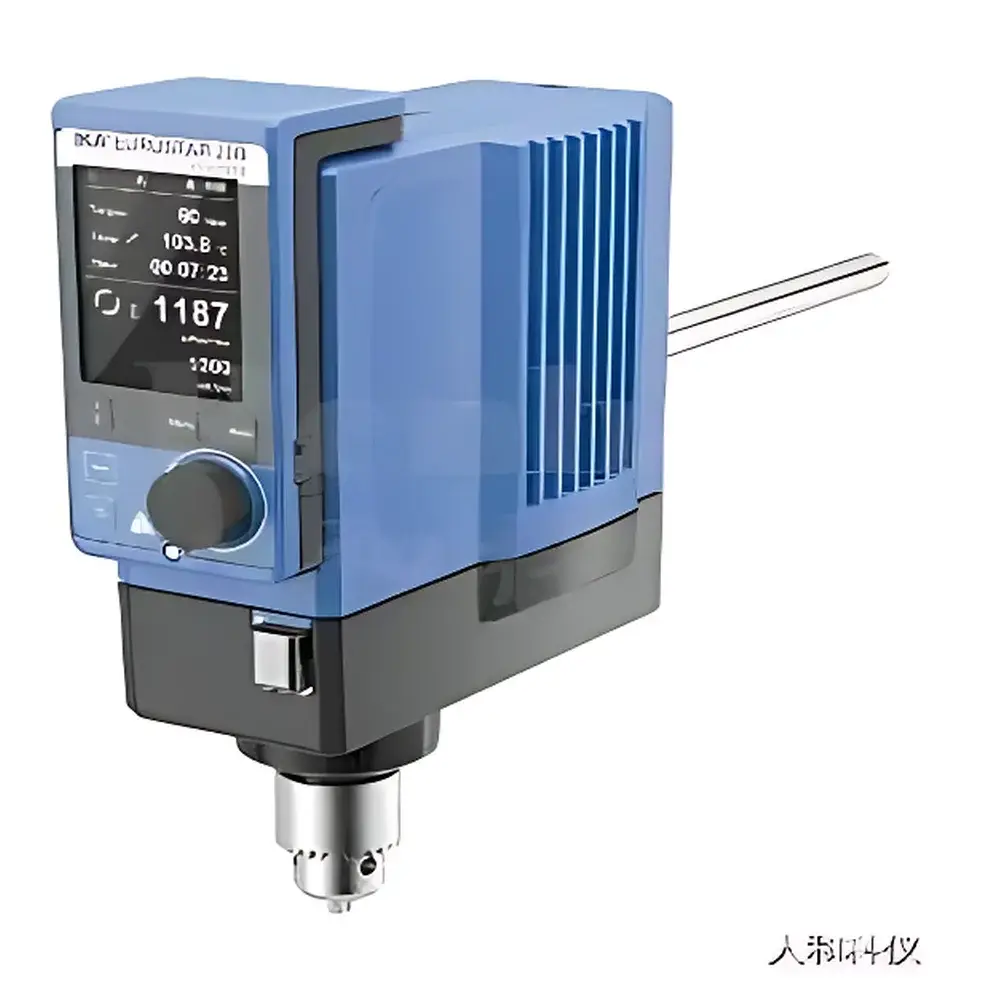
IKA EUROSTAR 200 control High-Performance Laboratory Stirrer
| Brand | IKA |
|---|---|
| Origin | Germany |
| Model | EUROSTAR 200 control |
| Stirrer Type | Electronic Overhead Stirrer |
| Max. Mixing Volume (H₂O) | 100 L |
| Speed Range | 0/6–2000 rpm |
| Motor Output Power | 84 W |
| Max. Torque (Range I / II) | 200 N·cm / 40 N·cm |
| Speed Control | Continuous, Microprocessor-Regulated |
| Display | TFT Touchscreen with Multilingual UI |
| Interfaces | RS 232, USB |
| Temp. Measurement | Integrated PT1000 Input (–10 to +350 °C, ±0.5 K Class A) |
| IP Rating | IP40 |
| Dimensions | 91 × 297 × 231 mm |
| Weight | 4.9 kg |
Overview
The IKA EUROSTAR 200 control is a high-torque, microprocessor-regulated overhead laboratory stirrer engineered for precision mixing and dispersion of demanding samples—including highly viscous liquids, suspensions, and heterogeneous reaction media—across research, quality control, and pilot-scale development environments. Based on brushless DC motor technology, it delivers stable rotational motion without mechanical wear or carbon dust contamination, ensuring long-term repeatability and compliance with GLP/GMP operational requirements. Its dual-speed-range architecture (6–400 rpm and 30–2000 rpm) enables optimal torque/speed matching for both high-viscosity (>50,000 mPa·s) and low-viscosity applications. Real-time speed feedback and closed-loop regulation maintain setpoint accuracy within ±1 rpm (n > 300 rpm) or ±3 rpm (n < 300 rpm), even during dynamic viscosity shifts—critical for polymerization, emulsification, and crystallization studies where shear history directly impacts product morphology.
Key Features
- Brushless DC motor with 84 W continuous output power and peak torque up to 200 N·cm (Range I), eliminating maintenance intervals associated with brushed motors
- Intelligent speed regulation: continuous, stepless adjustment across two calibrated ranges; automatic compensation for load-induced speed deviation
- TFT touchscreen interface with multilingual support (English, German, French, Spanish, Chinese), programmable timer (1–6000 min), and real-time graphical display of torque trend—enabling indirect viscosity profiling
- Integrated PT1000 temperature input (DIN IEC 751 Class A) supporting external probe measurement from –10 °C to +350 °C with ±0.5 K accuracy
- Dual safety architecture: hardware-based overload cutoff plus software-monitored thermal and stall protection; automatic shutdown upon motor blockage or excessive current draw
- Wireless WH 11 controller (included) with 150 m operational range (line-of-sight), enabling remote parameter adjustment and status monitoring without physical access to the unit
- RS 232 and USB interfaces for bidirectional communication with PC-based lab software (e.g., Labworldsoft); full parameter logging—including speed, torque, temperature, time, and error codes—for audit-ready data capture
- Ergonomic cast-aluminum housing with thermoplastic coating (IP40 rated), compact footprint (91 × 297 × 231 mm), and acoustic optimization for ≤55 dB(A) operation under load
Sample Compatibility & Compliance
The EUROSTAR 200 control accommodates stirring shafts with clamping diameters from 0.5 mm to 10 mm, including hollow-shaft configurations (ID 10.3 mm) suitable for in-situ temperature probe insertion. It supports standard impellers (propeller, anchor, paddle, turbine) and custom geometries for Newtonian and non-Newtonian fluids up to 100,000 mPa·s. Its design conforms to DIN EN 61000-6-3 (EMC emission limits) and DIN EN 61000-6-2 (immunity), and meets essential safety requirements per DIN EN 61010-1 for laboratory electrical equipment. While not intrinsically safe, its robust thermal management and electronic safeguards align with ISO/IEC 17025 documentation practices for method validation. Data integrity complies with ALCOA+ principles when used with validated software; raw parameter export supports FDA 21 CFR Part 11–compliant systems via third-party integration.
Software & Data Management
Through RS 232 or USB, the EUROSTAR 200 control transmits timestamped datasets—including actual vs. set speed, real-time torque, measured temperature, elapsed time, and system status flags—to host computers running IKA’s Labworldsoft or user-defined Python/Matlab scripts. All values are logged at configurable intervals (100 ms–10 s), with error codes (e.g., E01: overtemperature, E04: communication timeout) retained for root-cause analysis. The device stores no internal experiment history; all records reside externally—facilitating version-controlled SOP execution and traceable batch documentation. Export formats include CSV and XML, compatible with LIMS and ELN platforms. Firmware updates are performed via USB stick, maintaining revision control and change-log traceability per GxP requirements.
Applications
- Kinetic studies of viscous polymer solutions and organogels requiring constant shear rate despite evolving rheology
- Homogenization of pharmaceutical suspensions and ointment bases under controlled thermal conditions
- Scale-down mixing trials for bioreactor process development, using geometrically similar impellers and Reynolds number matching
- Chemical synthesis involving exothermic reactions, where simultaneous speed modulation and temperature feedback prevent thermal runaway
- Materials science workflows including ceramic slurry deagglomeration, battery electrode paste mixing, and nanocomposite dispersion
- Environmental testing of wastewater flocculants, where torque trend analysis correlates with floc growth kinetics
FAQ
Does the EUROSTAR 200 control support continuous operation at maximum torque?
Yes—it is rated for 100% duty cycle at its nominal output (84 W, 200 N·cm in Range I), provided ambient temperature remains within 5–40 °C and relative humidity ≤80% RH.
Can the WH 11 wireless controller be used with multiple EUROSTAR units simultaneously?
Each WH 11 unit is paired to a single EUROSTAR 200 control at setup; concurrent control of multiple stirrers requires separate WH 11 controllers or PC-based centralized management via Labworldsoft.
Is the PT1000 temperature input compatible with third-party probes?
Yes—any PT1000 sensor meeting DIN IEC 751 Class A tolerance (±0.15 + 0.002×|T| K) may be connected via the rear-panel 4-pin plug; calibration offset can be entered manually in the device menu.
What is the minimum detectable torque resolution?
Torque is displayed in 1 N·cm increments; measurement uncertainty is ±20 N·cm in Range I and ±6 N·cm in Range II, referenced to full-scale torque capacity.
How is firmware updated, and is rollback supported?
Firmware is updated via FAT32-formatted USB drive containing the official .bin file; the device retains the previous version until confirmation, enabling manual reversion if validation fails.
Related Products



