
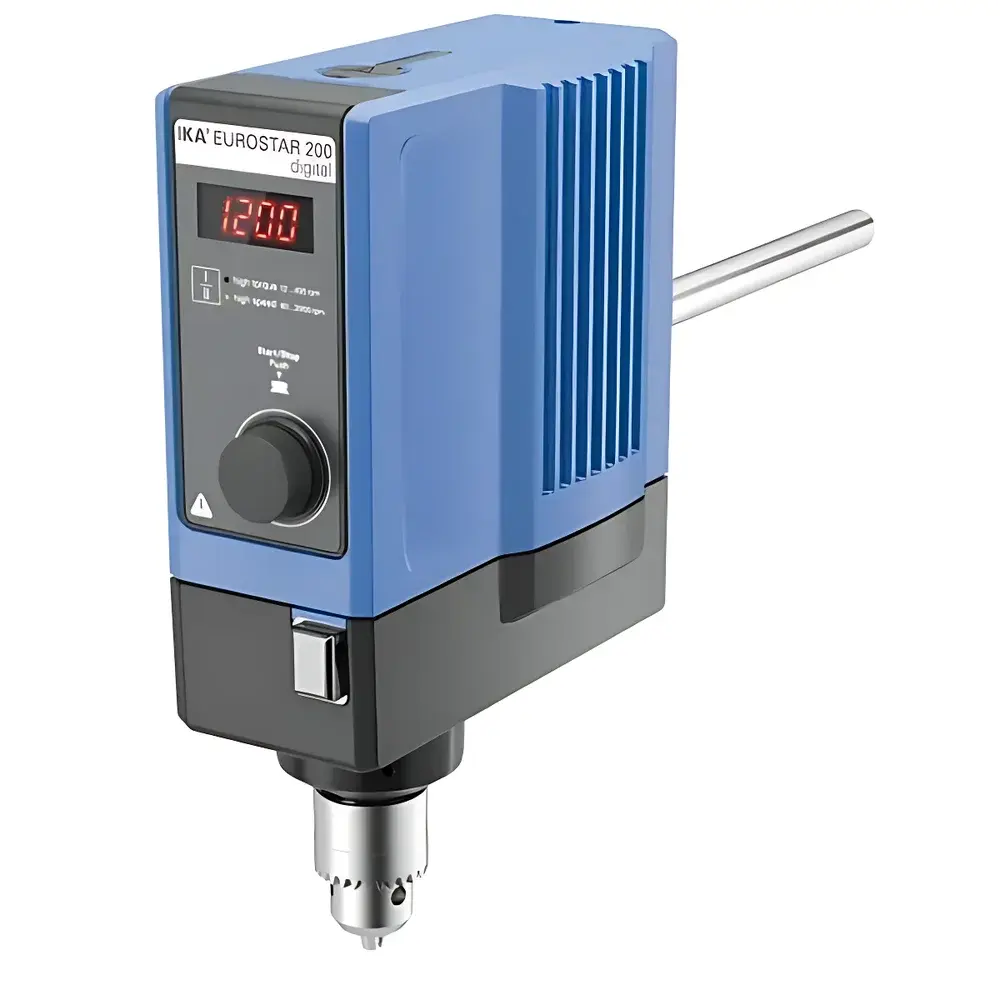
IKA EUROSTAR 200 digital Overhead Stirrer
| Brand | IKA |
|---|---|
| Origin | Germany |
| Model | EUROSTAR 200 digital |
| Max. Stirring Volume (H₂O) | 100 L |
| Motor Input Power | 130 W |
| Motor Output Power | 84 W |
| Drive Type | Brushless DC Motor |
| Speed Display | LED, 7-segment |
| Speed Range | 0/6–2000 rpm (2 ranges) |
| Max. Viscosity | 100,000 mPa·s |
| Max. Torque (Range I) | 200 N·cm |
| Max. Torque (Range II) | 40 N·cm |
| Speed Control | Electronic, Stepless |
| Speed Setting Accuracy | ±1 rpm |
| Speed Measurement Deviation | ±1% (n > 300 rpm), ±3 rpm (n < 300 rpm) |
| Chuck Type | Plug-in collet (Ø 10 mm) |
| Chuck Jaw Range | 0.5–10 mm |
| Hollow Shaft ID | 10.3 mm |
| Hollow Shaft Insertion (at standstill) | Yes |
| Extension Arm Diameter | 16 mm |
| Extension Arm Length | 220 mm |
| Rated Torque | 2 N·m |
| Housing Material | Cast aluminum with thermoplastic polymer coating |
| Dimensions (W×H×D) | 91 × 274 × 209 mm |
| Weight | 4.6 kg |
| Ambient Temperature Range | 5–40 °C |
| Relative Humidity Limit | 80% RH |
| Protection Class | IP 42 (DIN EN 60529) |
| Voltage | 230 V |
| Frequency | 50/60 Hz |
| Continuous Operation Capability | Yes |
| Safety Features | Automatic stall detection, overload shutdown, real-time speed deviation correction, error code display |
Overview
The IKA EUROSTAR 200 digital is a high-performance overhead stirrer engineered for precision mixing and dispersion in demanding laboratory environments. Utilizing a brushless DC motor architecture, it delivers exceptional torque stability, thermal efficiency, and extended service life—eliminating carbon brush wear and associated maintenance. Its dual-range electronic speed control (6–400 rpm and 30–2000 rpm) enables optimal performance across both high-viscosity batch processing and low-viscosity high-shear applications. Designed for reproducible rheological consistency, the system continuously monitors actual shaft speed against setpoint and dynamically adjusts power delivery to maintain rotational fidelity—even during viscosity fluctuations or transient load changes. This closed-loop regulation ensures compliance with method-critical stirring protocols in QC, R&D, and process development workflows.
Key Features
- Brushless DC motor delivering 84 W continuous output power and peak torque of 200 N·cm (Range I) or 40 N·cm (Range II)
- Microprocessor-controlled, stepless speed regulation with ±1 rpm setting accuracy and real-time feedback correction
- LED-based 7-segment display for intuitive speed readout and diagnostic error code reporting
- Hollow shaft design (10.3 mm internal diameter) permitting insertion of temperature probes or pH electrodes without interrupting operation
- Integrated safety circuitry featuring automatic motor shutdown upon stall detection, thermal overload, or excessive current draw
- Robust cast aluminum housing with thermoplastic polymer coating for chemical resistance and mechanical durability
- IP 42 ingress protection (per DIN EN 60529) suitable for standard laboratory ambient conditions (5–40 °C, ≤80% RH)
- Compact footprint (91 × 274 × 209 mm) and lightweight construction (4.6 kg) enabling flexible benchtop integration
Sample Compatibility & Compliance
The EUROSTAR 200 digital supports mixing volumes up to 100 L (water-equivalent) and handles viscosities up to 100,000 mPa·s—making it suitable for polymer solutions, suspensions, emulsions, and non-Newtonian fluids. Its standardized 10 mm plug-in collet accommodates stirring elements from 0.5 mm to 10 mm diameter, including anchor, paddle, propeller, and dissolver geometries. The device conforms to IEC 61000-6-3 (EMC emission) and IEC 61000-6-2 (immunity) standards. While not intrinsically rated for hazardous areas, its design aligns with general laboratory safety practices under ISO/IEC 17025 and supports GLP-compliant documentation when paired with validated SOPs and audit-trail-enabled software interfaces.
Software & Data Management
Although the EUROSTAR 200 digital operates as a standalone instrument with local parameter control, it features a serial interface (RS232) compatible with IKA’s labworldsoft® platform for remote operation, protocol scripting, and time-stamped data logging. When integrated into networked lab environments, speed profiles, runtime logs, and error events can be archived in accordance with FDA 21 CFR Part 11 requirements—including user authentication, electronic signatures, and immutable audit trails—provided the host system implements appropriate validation and access controls. Firmware updates are delivered via IKA’s official support portal to ensure continued regulatory alignment.
Applications
- Batch homogenization of pharmaceutical suspensions and ointment bases under controlled shear history
- Preparation of catalyst slurries and battery electrode pastes requiring uniform particle distribution
- Viscosity-dependent reaction monitoring in organic synthesis and polymerization studies
- Stirring of high-density microbial cultures in bioreactor seed train preparation
- Dispersion of nanomaterials in solvent systems where cavitation minimization is critical
- QC testing of industrial coatings, adhesives, and sealants per ASTM D1847 or ISO 2557
FAQ
What is the maximum permissible viscosity for continuous operation?
Continuous operation is rated up to 100,000 mPa·s at speeds ≥60 rpm in Range I; operation above this limit requires intermittent duty cycling and thermal monitoring.
Can the stirrer accommodate custom impellers with non-standard shaft diameters?
Yes—via optional collet adapters (e.g., IKA part no. 0000020000); however, mechanical balance and radial runout must be verified prior to use.
Is the hollow shaft compatible with all commercially available probe types?
It accepts standard 6–10 mm OD rigid probes; flexible or insulated cables require external guide sleeves to prevent torsional stress.
Does the unit support analog signal output for PLC integration?
No native 0–10 V or 4–20 mA outputs are provided; external signal converters or labworldsoft®-mediated OPC UA bridging is required.
How is calibration traceability maintained for speed accuracy?
Speed calibration is performed using NIST-traceable optical tachometers during factory acceptance testing; field verification follows ISO 17025-accredited procedures using certified reference instruments.



