
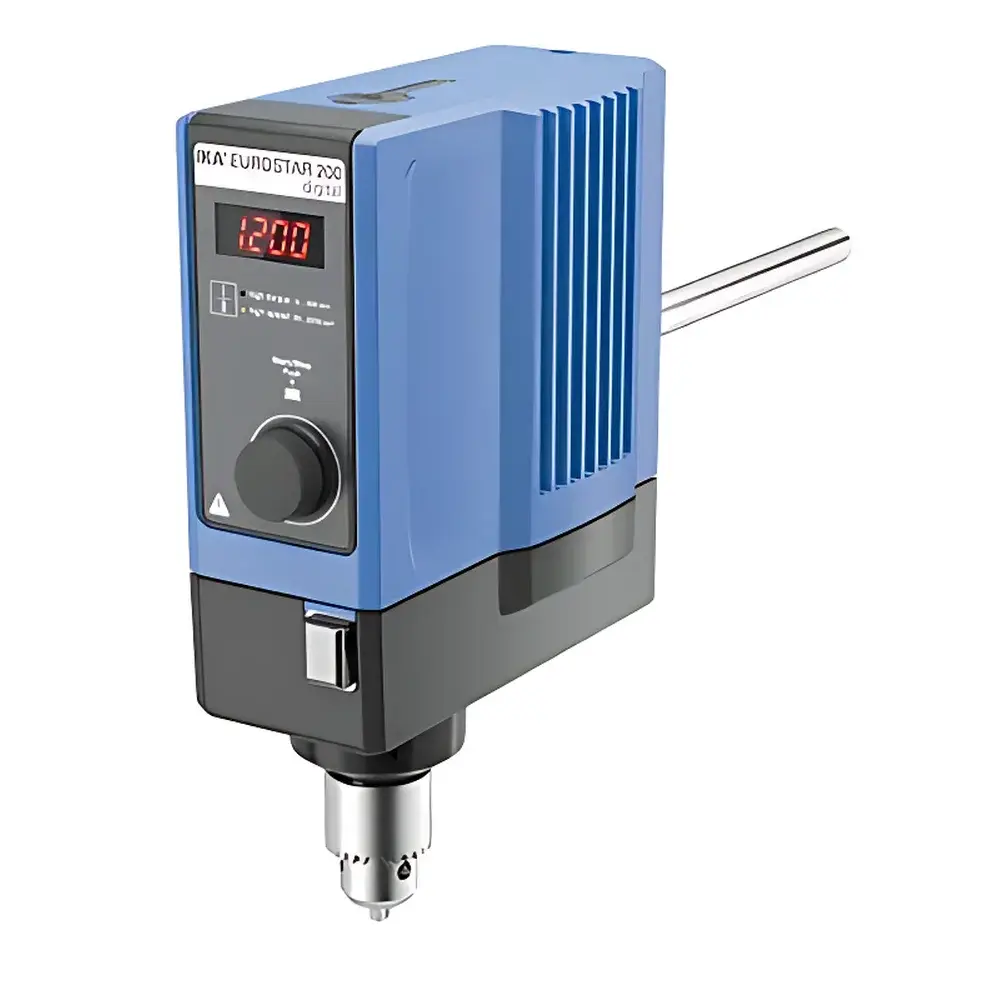
IKA EUROSTAR 200 digital Overhead Stirrer
| Brand | IKA |
|---|---|
| Origin | Germany |
| Manufacturer | IKA-Werke GmbH & Co. KG |
| Model | EUROSTAR 200 digital |
| Type | Electronic Overhead Stirrer |
| Max. Mixing Volume (H₂O) | 100 L |
| Speed Range | 0/6–2000 rpm (dual-range, microprocessor-controlled) |
| Motor | Brushless DC |
| Max. Torque | 200 N·cm (Range I), 40 N·cm (Range II) |
| Power Input | 130 W |
| Power Output | 84 W |
| Speed Display | LED, 7-segment |
| Speed Accuracy | ±1 rpm (n > 300 rpm), ±3 rpm (n < 300 rpm) |
| Max. Viscosity | 100,000 mPa·s |
| Shaft Clamping Range | 0.5–10 mm |
| Hollow Shaft Diameter | 10.3 mm |
| IP Rating | IP42 |
| Dimensions (W×H×D) | 91 × 274 × 209 mm |
| Weight | 4.6 kg |
| Operating Ambient | 5–40 °C, ≤80% RH |
| Voltage | 230 V / 100–115 V, 50/60 Hz |
Overview
The IKA EUROSTAR 200 digital is a high-performance, microprocessor-controlled overhead stirrer engineered for precision mixing and dispersion tasks in demanding laboratory environments. Designed around a brushless DC motor architecture, it eliminates carbon brush wear, ensuring long-term torque stability, low maintenance, and silent operation—critical for extended unattended runs in QC labs, R&D facilities, and pilot-scale process development. Its dual-speed range architecture (6–400 rpm and 30–2000 rpm) enables optimal torque delivery across viscosity regimes: high-torque low-speed operation for viscous polymer solutions or pastes, and high-speed shear-intensive dispersion of nanoparticles or suspensions. Real-time closed-loop speed regulation continuously compares actual shaft rotation against setpoint and dynamically compensates for load-induced drift—maintaining ±1 rpm accuracy above 300 rpm—even during viscosity transitions caused by temperature shifts, chemical reaction progress, or additive incorporation. This active regulation distinguishes the EUROSTAR 200 digital from open-loop analog stirrers and underpins its suitability for GLP-compliant method validation and ISO 17025-accredited testing workflows.
Key Features
- Brushless DC motor with 84 W continuous output power and 200 N·cm maximum torque (Range I), delivering consistent rotational energy without thermal derating
- Dual-range electronic speed control: 6–400 rpm (high-torque mode) and 30–2000 rpm (high-speed mode), selectable via front-panel toggle
- Real-time closed-loop feedback system ensures speed constancy under variable load; automatically corrects deviations induced by viscosity changes or vessel geometry effects
- Hollow shaft design (10.3 mm internal diameter) permits inline insertion of temperature probes, pH electrodes, or sampling needles without interrupting agitation
- IP42-rated cast aluminum housing with thermoplastic polymer coating provides mechanical robustness and resistance to common lab solvents and cleaning agents
- Integrated safety circuit halts operation instantly upon motor stall, thermal overload, or abnormal current draw—compliant with EN 61000-6-2/6-4 EMC standards
- LED 7-segment display with error code diagnostics (e.g., E1 = overload, E2 = sensor fault) supports rapid troubleshooting and audit-ready operational logs
Sample Compatibility & Compliance
The EUROSTAR 200 digital accommodates a broad spectrum of sample types—from low-viscosity aqueous buffers (≥1 mPa·s) to highly structured gels and non-Newtonian suspensions up to 100,000 mPa·s—when paired with appropriate impellers (e.g., anchor, helical ribbon, or turbine). Its 100 L water-equivalent capacity (in standard cylindrical glass or stainless-steel vessels ≥300 mm diameter) meets ASTM D2196 and ISO 2557-2 requirements for viscosity measurement consistency. The device conforms to DIN EN 61010-1 for electrical safety in laboratory equipment and carries CE marking under the EU Machinery Directive 2006/42/EC. Its stable speed control and error-traceable operation support alignment with FDA 21 CFR Part 11 expectations for electronic records when integrated into validated SOPs.
Software & Data Management
While standalone operation requires no PC, the EUROSTAR 200 digital features an RS232 interface (optional USB-RS232 adapter) compatible with IKA Labworldsoft v5.x for remote parameter setting, real-time speed/temperature logging (when used with external probe), and export of timestamped .csv datasets. Audit trails—including start/stop timestamps, speed setpoints, and fault codes—are retained in non-volatile memory for GLP/GMP documentation. Firmware updates preserve calibration integrity and are performed via serial command protocol traceable to IKA’s certified calibration laboratory (DAkkS-accredited).
Applications
- Viscosity-dependent reaction monitoring in polymerization and condensation synthesis
- Homogenization of pharmaceutical suspensions and ointment bases per USP <1058> guidance
- Cell culture media preparation requiring oxygen transfer optimization at defined shear rates
- Electrodeposition bath conditioning in materials science labs
- Standardized dissolution testing (e.g., USP Apparatus 2 adaptation with custom vessel mounts)
- Long-duration stability studies of emulsions and colloidal dispersions
FAQ
What impeller types are recommended for high-viscosity applications?
Anchor, helical ribbon, and double-helical impellers mounted on 10 mm shanks are optimal for viscosities >50,000 mPa·s. Ensure impeller diameter occupies 60–70% of vessel ID for laminar flow efficiency.
Can the EUROSTAR 200 digital be integrated into automated reactor systems?
Yes—via RS232 serial commands (ASCII protocol), it accepts external speed setpoints and reports status flags, enabling synchronization with PLC-controlled heating/cooling and dosing modules.
Is calibration traceable to national standards?
Factory calibration uses DAkkS-traceable tachometers and torque sensors; optional on-site recalibration services include certificate of conformity per ISO/IEC 17025.
Does the hollow shaft support vacuum or pressure-rated vessels?
The hollow shaft itself is not rated for pressure differentials; however, it is routinely used with standard jacketed reactors under ambient pressure when sealed with O-ring-compatible feedthroughs.
What maintenance intervals are specified for continuous operation?
No scheduled maintenance is required for the brushless motor; annual verification of clamping force, shaft runout (<0.05 mm), and thermal cutoff response is recommended for GxP environments.



