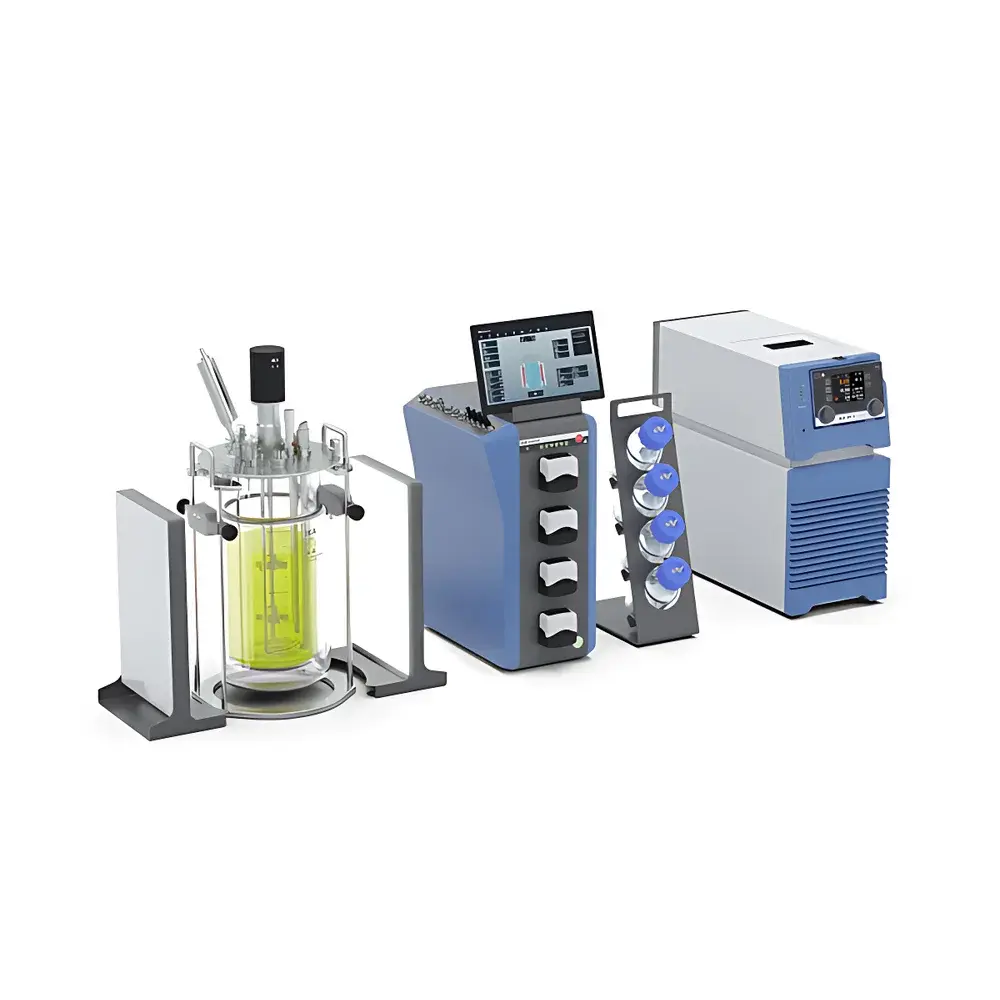
IKA HABITAT Photo Ferment CCT Controlled Photobioreactor System
| Brand | IKA |
|---|---|
| Origin | Germany |
| Manufacturer | IKA Works GmbH & Co. KG |
| Model | HABITAT Photo Ferment CCT |
| Vessel Volume | 0.5–10 L |
| Gas Supply | Four independent mass flow-controlled gas lines (N₂, O₂, air, CO₂) |
| pH Control Range | 0–14 pH |
| Accuracy | ±0.02 pH |
| Dissolved Oxygen (DO) Control Range | 0–200% saturation |
| Accuracy | ±0.3% sat |
| Temperature Control Range | 0–100 °C |
| Accuracy | ±0.2 °C |
| Stirring Speed | 1–2200 rpm |
| Speed Deviation | ±2% (≥100 rpm), ±5 rpm (<100 rpm) |
| LED Illumination | Adjustable intensity & timing for circadian simulation |
| Chaotic Mixing Mode | Enabled |
| Integrated Peristaltic Pumps | 4 Watson-Marlow 114DV heads (acid, base, antifoam, feed) |
| Data Storage | 32 GB internal |
| Compliance Options | FDA 21 CFR Part 11–compliant software version available |
| Interfaces | Ethernet, USB, RS232, external pump/thermostat/single-use reactor ports |
| Protection Rating | IP20 |
| Power Input | 100–240 V, 50/60 Hz |
| Max. Power Consumption | 1100 W |
Overview
The IKA HABITAT Photo Ferment CCT is a fully integrated, modular photobioreactor control system engineered for precision cultivation of light-dependent microorganisms—including microalgae, cyanobacteria, and photosynthetic yeasts—under rigorously defined physiological conditions. Unlike conventional fermenters, the HABITAT Photo Ferment CCT implements dual-mode operation: as a standard stirred-tank bioreactor when paired with IKA’s HRC 2 thermostatic circulators, and as a high-fidelity photobioreactor when coupled with its programmable LED illumination panel. Its core architecture follows the Couette–Taylor flow principle for fluid dynamics optimization, while the proprietary Chaotic Mixing algorithm introduces non-periodic, deterministic agitation patterns that enhance mass transfer homogeneity—particularly critical for oxygen-sensitive or shear-sensitive photoautotrophic cultures. The system operates within a validated process control framework compliant with GLP and GMP-aligned laboratory practices, supporting traceable parameter logging, electronic signatures, and audit-ready data export.
Key Features
- Four-Channel Mass Flow Control: Independent, digitally regulated gas delivery for N₂, O₂, compressed air, and CO₂—each with full-range adjustability (0–20,000 cc/min) and ±2% full-scale repeatability—enabling dynamic headspace composition tuning for carbon fixation studies or hypoxic/oxic transitions.
- Chaotic Mixing Technology: A mathematically derived impeller motion profile that disrupts laminar zones and minimizes localized shear gradients, improving nutrient/gas distribution without compromising cell integrity—validated for Chlorella vulgaris, Phaeodactylum tricornutum, and Synechocystis sp. PCC 6803 cultivations.
- Modular Sensor Integration: Native support for pH, DO, temperature, level, foam, conductivity, turbidity, and CO₂ sensors—all calibrated via in-software guided workflows with automatic timestamped records per calibration event.
- 10.4″ Tablet-Based HMI: Touch-enabled interface running real-time embedded Linux OS; supports remote access via Ethernet/WiFi; displays live trends, alarm states, and PID loop diagnostics; stores up to 32 GB of time-stamped process data with CSV/PDF export capability.
- Four-Watson-Marlow Peristaltic Pumps: Programmable bidirectional operation with flow range 1–270 mL/min; compatible with silicone tubing (ID 0.5–4.8 mm); integrated auto-fill function ensures reproducible reagent dosing during fed-batch or perfusion modes.
- Thermal Management Flexibility: Compatible with both jacketed vessels (via HRC 2 series circulators) and single-wall vessels (with integrated 250 W heating blanket); temperature maintained within ±0.2 °C across 0–100 °C range using PT1000 feedback and cascade PID control.
Sample Compatibility & Compliance
The HABITAT Photo Ferment CCT accommodates sterile, single-use or reusable glass vessels from 0.5 L to 10 L working volume, with optional double-jacketed configurations for precise thermal coupling. It supports aerobic, microaerobic, anaerobic, and photomixotrophic cultivation strategies across bacterial, yeast, fungal, and eukaryotic algal systems. All hardware and firmware comply with IEC 61000-6-2 (EMC immunity) and IEC 61010-1 (safety for laboratory equipment). Optional 21 CFR Part 11 software configuration provides role-based user access, electronic signature enforcement, and immutable audit trails—meeting regulatory requirements for pharmaceutical-grade strain development, bioprocess characterization, and QC release testing under ISO 9001 and ISO 13485 environments.
Software & Data Management
The embedded control software delivers deterministic real-time scheduling for multi-parameter cascaded loops (e.g., pH → acid/base pump; DO → O₂/N₂ blending; temperature → heater/circulator). Calibration management includes step-by-step wizards for pH (2-/3-point), DO (air-saturation/water-saturation), and temperature (ice-point/reference bath), each generating PDF reports with operator ID, timestamp, and deviation logs. Process data are stored in SQLite format with SHA-256 hashing for integrity verification; raw datasets support post-hoc analysis in MATLAB, Python (pandas), or industry-standard SCADA platforms via OPC UA (optional add-on). Backup/export functions include scheduled cloud sync (SFTP/HTTPS), local USB dump, and network share mapping.
Applications
- Photosynthetic biomass production for biofuel precursors (e.g., triacylglycerol profiling in Nannochloropsis)
- Metabolic engineering of cyanobacterial chassis for recombinant protein expression under controlled photon flux density (PFD)
- Photoinhibition and non-photochemical quenching (NPQ) kinetics studies requiring millisecond-resolution light/dark cycling
- CO₂ sequestration efficiency quantification in flue-gas-fed algal consortia
- GMP-compliant seed train expansion of phototrophic cell banks for clinical-grade therapeutic algae
- Long-term stability testing of immobilized photobiocatalysts under continuous illumination and gas exchange
FAQ
Can the HABITAT Photo Ferment CCT operate without the LED panel?
Yes—it functions identically to the standard HABITAT Ferment CCT configuration when the LED module is disconnected, retaining full bioreactor control capabilities for heterotrophic or chemotrophic cultures.
Is third-party sensor integration supported?
The system provides analog (0–10 V / 4–20 mA) and digital (RS485 Modbus RTU) input channels; custom drivers can be deployed via the open API toolkit for validated OEM sensors.
What sterilization protocols are validated for the vessel and control tower?
All wetted parts—including vessel, lid assembly, and sensor housings—are autoclavable at 121 °C for 20 min; the control tower electronics are rated for ambient steam exposure but must remain outside the sterilizer chamber.
How is chaotic mixing validated experimentally?
IKA provides application notes documenting particle image velocimetry (PIV) comparisons against conventional Rushton impellers, demonstrating >35% improvement in volumetric mass transfer coefficient (kLa) under identical power input conditions.
Does the system support DoE (Design of Experiments) scripting?
Yes—the software includes built-in DoE templates (full factorial, central composite, D-optimal) with automated parameter ramping, hold steps, and conditional branching based on real-time sensor thresholds.