
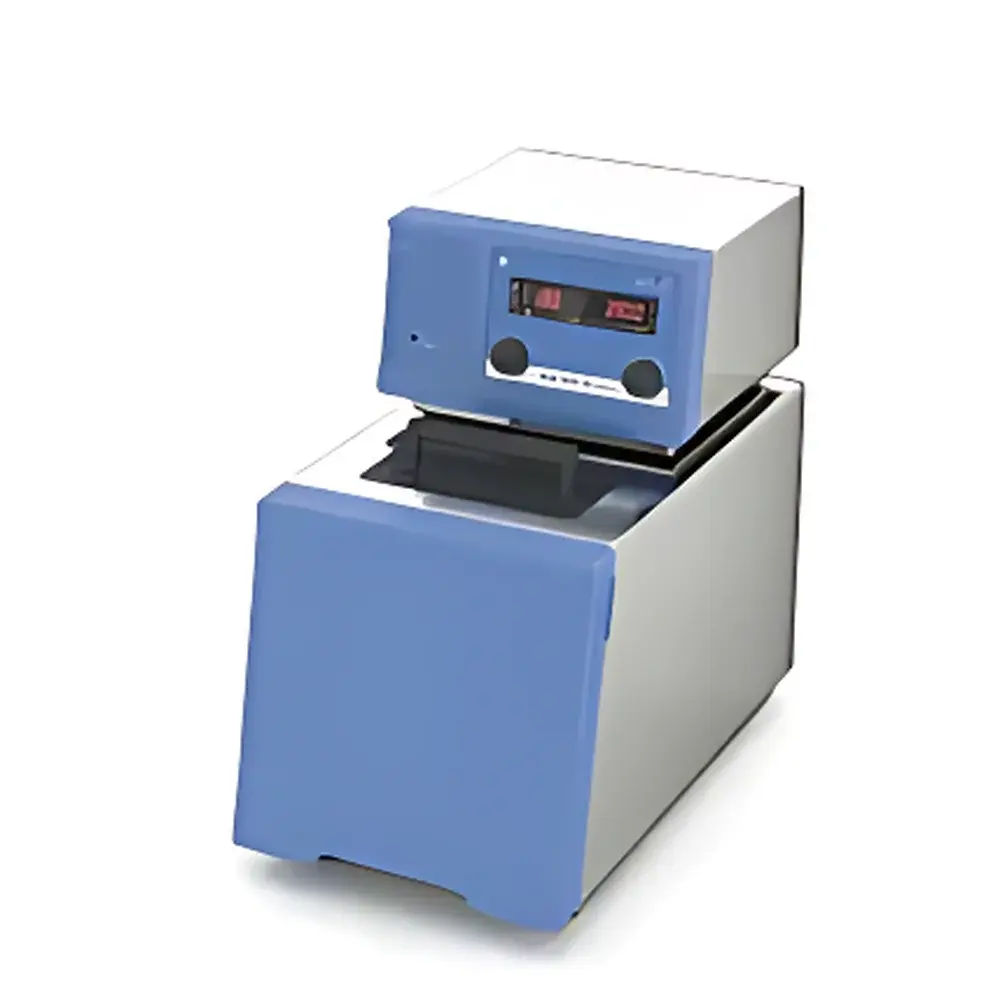
IKA HBC 10 Basic Heating Circulator
| Brand | IKA |
|---|---|
| Origin | Germany |
| Model | HBC 10 Basic |
| Instrument Type | Constant-Temperature Bath Circulator |
| Circulation Mode | Internal Circulation |
| Temperature Control | Heating-Only |
| Bath Volume | 11 L |
| Temperature Range | 0–260 °C |
| Temperature Stability | ±0.02 K |
| Construction Material | Stainless Steel |
| Safety Certification | UL Listed, DIN 12876 Class III (FL) for Flammable Liquids |
| Interface | USB/RS232 |
| Display | Large LED Screen |
| Sensor | Integrated PT100 |
| Cooling Option | Built-in Cooling Coil |
| Pump | Adjustable Pressure/Suction Pump with Keypad & Rotary Dial Control |
| Software Compatibility | labworldsoft® for Process Control, Data Logging & Firmware Updates |
| Alarm System | Visual and Audible Alerts |
| Drainage | Integrated Drain Valve with Hose Connection |
Overview
The IKA HBC 10 Basic Heating Circulator is a precision-engineered thermal management system designed for stable, repeatable heating of external equipment or internal bath media in laboratory environments. Operating on the principle of forced convection via an integrated circulation pump, it maintains uniform thermal distribution across the stainless-steel bath chamber (11 L capacity) and enables direct heat transfer to connected apparatus—such as reactors, viscometers, or condensers—through external recirculation loops. Its temperature range spans from ambient to 260 °C, supporting applications involving silicone oils, glycols, and other high-boiling-point heat transfer fluids. Engineered for reliability under continuous operation, the unit features optimized thermal insulation, a high-surface-area aluminum散热器 (heat exchanger), and a robust stainless-steel housing compliant with DIN 12876 Class III (FL) standards for use with flammable liquids. UL listing further confirms its adherence to North American electrical safety requirements.
Key Features
- Stainless-steel bath chamber (11 L volume) with smooth, corrosion-resistant interior for easy cleaning and long-term chemical compatibility
- High-efficiency heating system with rapid warm-up times enabled by low-thermal-mass design and superior insulation
- Precision temperature control with stability of ±0.02 K at setpoint, achieved via PID algorithm and integrated PT100 sensor
- Adjustable pressure/suction pump with intuitive keypad-and-rotary-dial interface for precise flow rate modulation
- Built-in cooling coil for auxiliary temperature regulation—particularly valuable during extended high-temperature runs or when managing exothermic processes
- Large, high-contrast LED display showing real-time temperature, pump speed, and system status
- Dual-stage alarm system with optical and acoustic alerts for overtemperature, dry-run, or communication failure conditions
- Drain valve with standard hose connection enables safe, hands-free emptying of hot bath fluid without operator exposure
Sample Compatibility & Compliance
The HBC 10 Basic accommodates a broad spectrum of heat transfer media—including water, ethanol/water mixtures, silicone oils (e.g., DC200 series), and polyethylene glycols—within its validated operational envelope. Its DIN 12876 Class III (FL) certification verifies suitability for use with flammable liquids up to flash points ≥ 60 °C, provided appropriate ventilation and containment protocols are followed. The unit complies with IEC 61010-1 for laboratory electrical equipment safety and meets UL 61010-1 requirements for North American markets. It supports GLP-compliant workflows through traceable temperature logging and audit-ready event records when paired with labworldsoft® software.
Software & Data Management
Equipped with both USB and RS232 interfaces, the HBC 10 Basic integrates seamlessly into automated laboratory networks. labworldsoft® serves as the native control and documentation platform, enabling remote parameter setting, real-time monitoring, time-stamped data acquisition (temperature, pump speed, alarms), and export to CSV or PDF formats. The software supports firmware updates over USB, ensuring long-term compatibility with evolving regulatory expectations—including configurable electronic signatures and 21 CFR Part 11–compliant audit trails when deployed in regulated QC/QA environments. All logged data retain ISO/IEC 17025–aligned metadata (operator ID, instrument ID, timestamp, environmental context).
Applications
- Temperature stabilization of jacketed glass reactors and pilot-scale synthesis vessels
- Calibration of thermometers, RTDs, and thermocouples per ASTM E74 and ISO 17025 guidelines
- Viscosity measurements requiring precise thermal conditioning of samples prior to rheometer analysis
- Controlled heating of chromatography columns, distillation heads, or reflux condensers
- Material testing procedures demanding reproducible thermal ramping (e.g., polymer melt index, thermal expansion coefficient determination)
- Preparation and maintenance of standardized test baths for pharmacopeial dissolution testing (USP , )
FAQ
Does the HBC 10 Basic support external temperature sensing?
Yes—it accepts optional external PT100 probes for process-critical applications where bath temperature differs from target sample temperature.
Can it be operated without connecting to labworldsoft®?
Absolutely—the unit functions autonomously with full local control, display, and alarm functionality independent of PC connectivity.
Is the cooling coil sufficient for active sub-ambient operation?
No—the built-in coil provides only auxiliary heat dissipation; it does not enable refrigeration or cooling below ambient temperature.
What maintenance intervals are recommended for long-term reliability?
IKA recommends annual verification of temperature accuracy using a NIST-traceable reference thermometer and periodic inspection of pump seals and drain valve integrity.
How is compliance with 21 CFR Part 11 ensured?
When used with labworldsoft® in validated configuration, the system supports user authentication, electronic signatures, immutable audit logs, and role-based access control—fulfilling core technical requirements of Part 11.



