
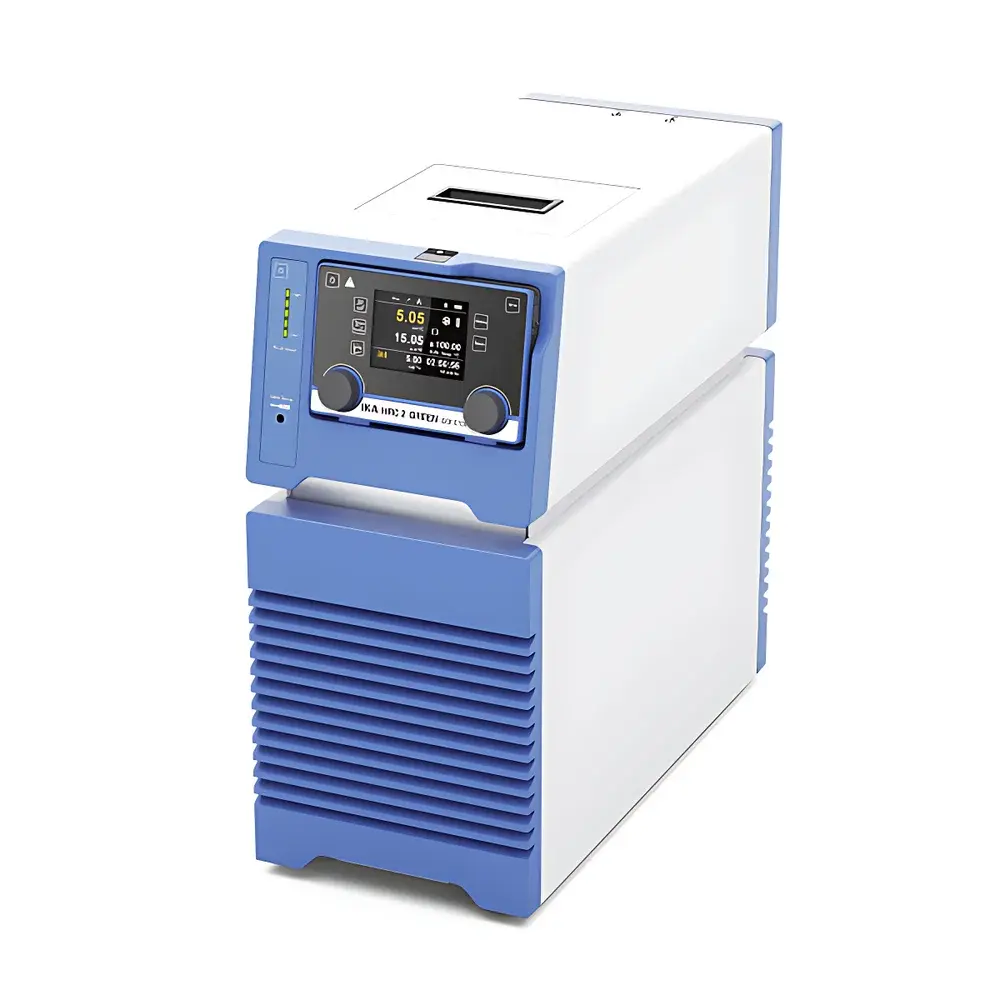
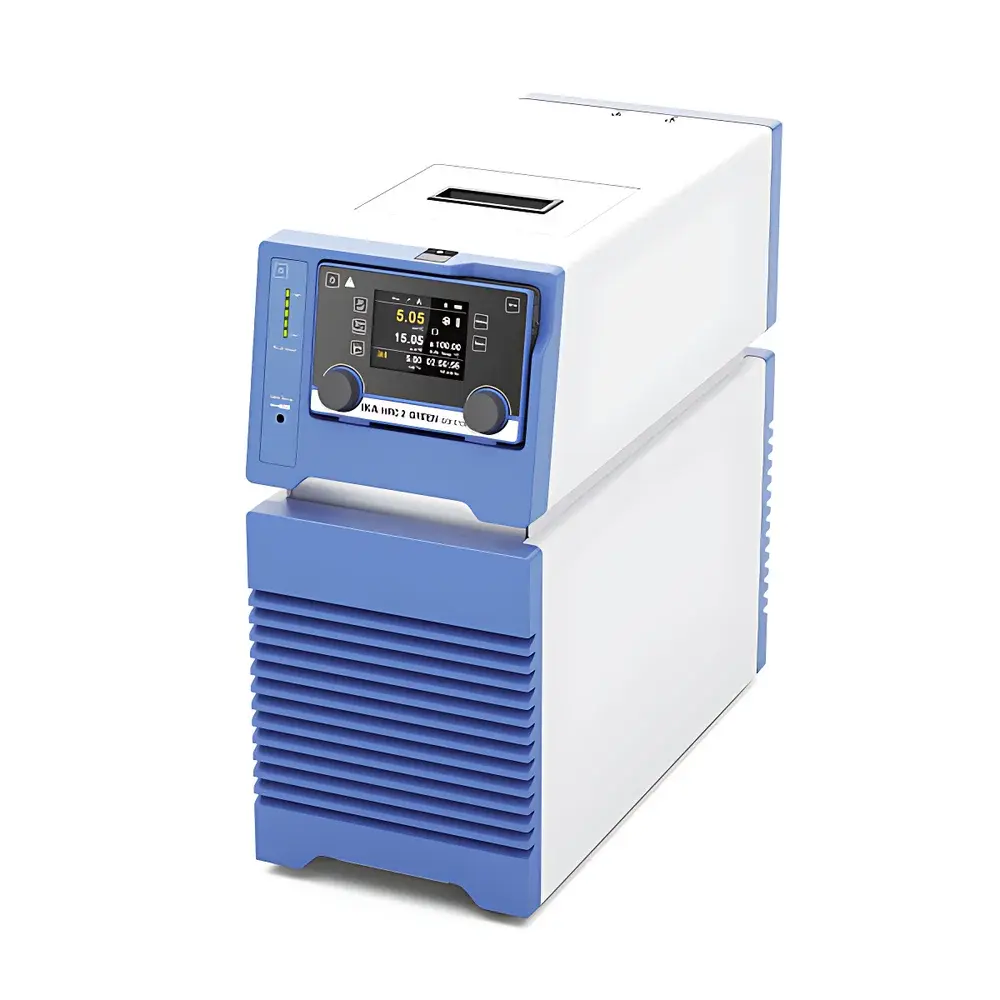
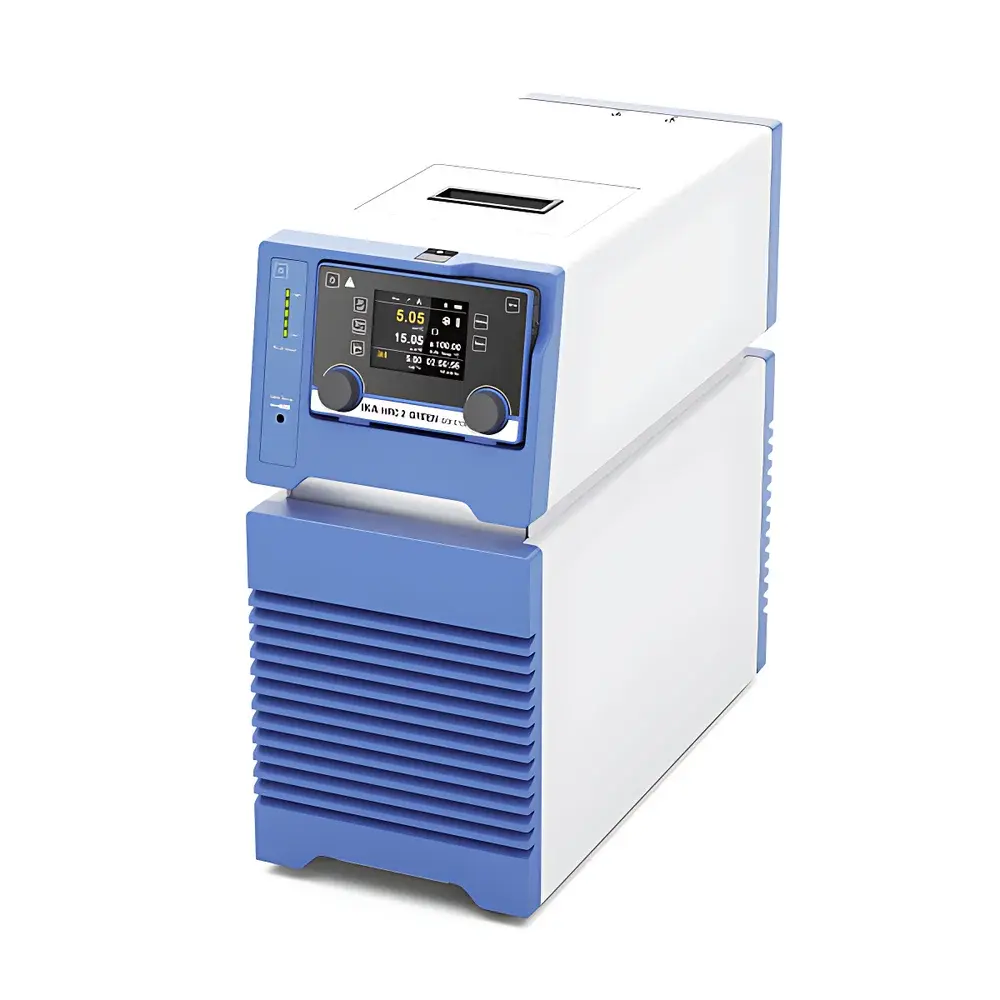
IKA HRC2 green control Heating and Cooling Circulating Bath
| Brand | IKA |
|---|---|
| Origin | Germany |
| Manufacturer | IKA-Werke GmbH & Co. KG |
| Type | HRC2 green control |
| Temperature Range | −30 °C to +100 °C |
| Internal Temp Stability (@+70 °C, water) | ±0.05 K |
| Heating Power | 1500 W (230 V) |
| Cooling Capacity | 620 W (@20 °C), 600 W (@10 °C), 480 W (@0 °C), 350 W (@−10 °C), 200 W (@−20 °C), 80 W (@−30 °C) |
| Refrigerant | R290 (79 g, GWP < 3) |
| Max Pressure | 21 bar |
| Pump Type | Variable-speed PEEK pressure/suction pump |
| Flow Rate | 0–21 L/min (adjustable, 2000–4000 rpm) |
| Max Pressure at Zero Flow | 0.5 bar |
| Bath Volume | 1.4–4.0 L |
| Display | LED, resolution 0.01 K |
| External PT100 Sensor Input | Yes |
| Safety Features | Dual PT100/PT1000 sensors, adjustable safety cutoff (0–110 °C), overpressure protection, secondary safety circuit, audible/visual alarms |
| Compliance | DIN 12876 Class III, DIN EN 60751 Class A (PT100), IP21, CE, RoHS |
| Interfaces | RS232, Micro-USB, analog output (0–10 V), digital alarm outputs (30 V AC/DC, 1 A), solenoid valve output (24 V DC, 0.8 A), 5 V DC auxiliary input |
| Noise Level | 58 dB(A) |
| Dimensions (W×D×H) | 220 × 480 × 525 mm |
| Weight | 26.5 kg |
| Ambient Operating Conditions | 5–32 °C, ≤80 % RH |
Overview
The IKA HRC2 green control is a high-precision heating and cooling circulating bath engineered for demanding laboratory temperature control applications requiring both thermal stability and operational flexibility. Based on the principle of closed-loop liquid circulation with active heat exchange, it employs a variable-speed scroll compressor and an environmentally optimized refrigeration cycle using propane (R290) — a natural refrigerant with a global warming potential (GWP) of less than 3 — to deliver efficient, low-noise cooling across a broad operational range. Its dual-sensor architecture (PT100 working sensor + PT1000 safety sensor), combined with PID-based temperature regulation and real-time monitoring via a high-resolution LED display (0.01 K resolution), ensures compliance with DIN 12876 Class III requirements for safety-critical thermostatic equipment. Designed for continuous 100 % duty-cycle operation, the HRC2 green control supports both internal bath temperature control and external jacketed reactor or coil-based temperature conditioning — making it suitable for integration into reaction calorimetry, material testing, pharmaceutical stability studies, and bioreactor thermal management systems.
Key Features
- Wide operational temperature range from −30 °C to +100 °C, enabling cryogenic process support and high-temperature synthesis applications
- Dual-sensor safety system: independent PT100 (DIN EN 60751 Class A) for process control and PT1000 for redundant overtemperature cutoff, configurable between 0 °C and 110 °C
- Variable-speed PEEK diaphragm pump with fully adjustable flow (0–21 L/min) and pressure capability up to 0.5 bar, compatible with viscosities up to 50 mm²/s
- Energy-efficient R290 refrigeration circuit with integrated inverter-driven compressor, delivering 620 W cooling capacity at 20 °C ambient and maintaining 80 W at −30 °C
- Intuitive local interface with LED display and optional wireless remote control (Wico) for safe operation outside fume hoods or gloveboxes
- Programmable temperature profiles: up to 10 stored programs, each supporting 10 sequential steps with ramp/soak logic and timer-based execution
- Comprehensive alarm system including visual indicators, audible alerts, and relay-based dry-contact outputs (30 V AC/DC, 1 A) for integration into lab-wide safety interlocks
- Multi-protocol connectivity: RS232 and Micro-USB for instrument control and data logging; analog voltage output (0–10 V) for external DAQ systems; dedicated 24 V DC solenoid valve driver (0.8 A)
Sample Compatibility & Compliance
The HRC2 green control is certified to DIN 12876 Class III — the highest safety classification for thermostats used with flammable liquids or pressurized systems — and conforms to IP21 ingress protection for indoor laboratory use. It meets essential requirements of the EU Machinery Directive 2006/42/EC and Low Voltage Directive 2014/35/EU, and carries CE and RoHS markings. Its R290 refrigerant charge (79 g) complies with F-Gas Regulation (EU) No. 517/2014 Annex III limits for hermetically sealed systems. The unit supports external temperature feedback via PT100 sensors (absolute accuracy ±0.5 K, adjustable via calibration), enabling precise control of jacketed reactors, condensers, or inline heat exchangers. Bath fluid compatibility includes water, water-glycol mixtures, silicone oils, and other non-corrosive heat transfer media with viscosity ≤50 mm²/s. All electrical interfaces are isolated and rated for continuous operation under GLP/GMP-aligned environmental conditions (5–32 °C, ≤80 % RH).
Software & Data Management
While the HRC2 green control operates autonomously via its embedded controller, it provides full bidirectional communication capabilities for integration into centralized lab automation frameworks. RS232 and Micro-USB ports support ASCII command protocols for remote start/stop, setpoint adjustment, status polling (e.g., actual temperature, pump speed, alarm state), and real-time data streaming. Analog output (0–10 V) maps measured temperature linearly to external chart recorders or SCADA systems. For audit-trail compliance in regulated environments (e.g., FDA 21 CFR Part 11, ISO/IEC 17025), third-party software platforms can log timestamped temperature, power consumption, and alarm events — provided the host system implements user authentication, electronic signatures, and immutable storage. Calibration data (including PT100 offset correction) is retained in non-volatile memory and accessible via service mode.
Applications
- Pharmaceutical development: Controlled crystallization, dissolution testing, and stability chamber support per ICH Q1 guidelines
- Chemical synthesis: Exothermic reaction quenching, Grignard or lithiation reactions requiring sub-zero bath temperatures
- Materials science: Thermal cycling of polymer composites, DSC reference baths, and rheological sample conditioning
- Biotechnology: Fermenter jacket temperature control, cold-chain validation, and enzyme activity assays at defined thermal setpoints
- Quality control labs: ASTM D2570 (viscosity bath), ISO 3104 (kinematic viscosity), and USP environmental monitoring support
- Academic research: Teaching labs requiring robust, safe, and reproducible temperature control across physical chemistry and biochemistry curricula
FAQ
What safety certifications does the HRC2 green control hold?
It complies with DIN 12876 Class III, CE, RoHS, and meets essential requirements of the EU Machinery and Low Voltage Directives.
Can the unit operate continuously at its temperature extremes?
Yes — rated for 100 % duty cycle across its full −30 °C to +100 °C range, subject to ambient conditions (5–32 °C, ≤80 % RH).
Is external temperature control supported?
Yes — via optional external PT100 sensor input with ±0.5 K absolute accuracy (calibration-adjustable).
What refrigerant is used, and why is it environmentally advantageous?
R290 (propane), a natural hydrocarbon refrigerant with GWP < 3 and zero ozone depletion potential (ODP), compliant with EU F-Gas Regulation Annex III.
How is data integrity ensured during long-term experiments?
Real-time temperature and status data can be streamed via RS232 or USB to validated software with audit-trail functionality; analog output enables passive recording without digital dependency.
What maintenance intervals are recommended?
No scheduled refrigerant servicing is required; annual verification of pump seals, sensor calibration, and safety cutoff functionality is advised per ISO/IEC 17025 preventive maintenance protocols.



