
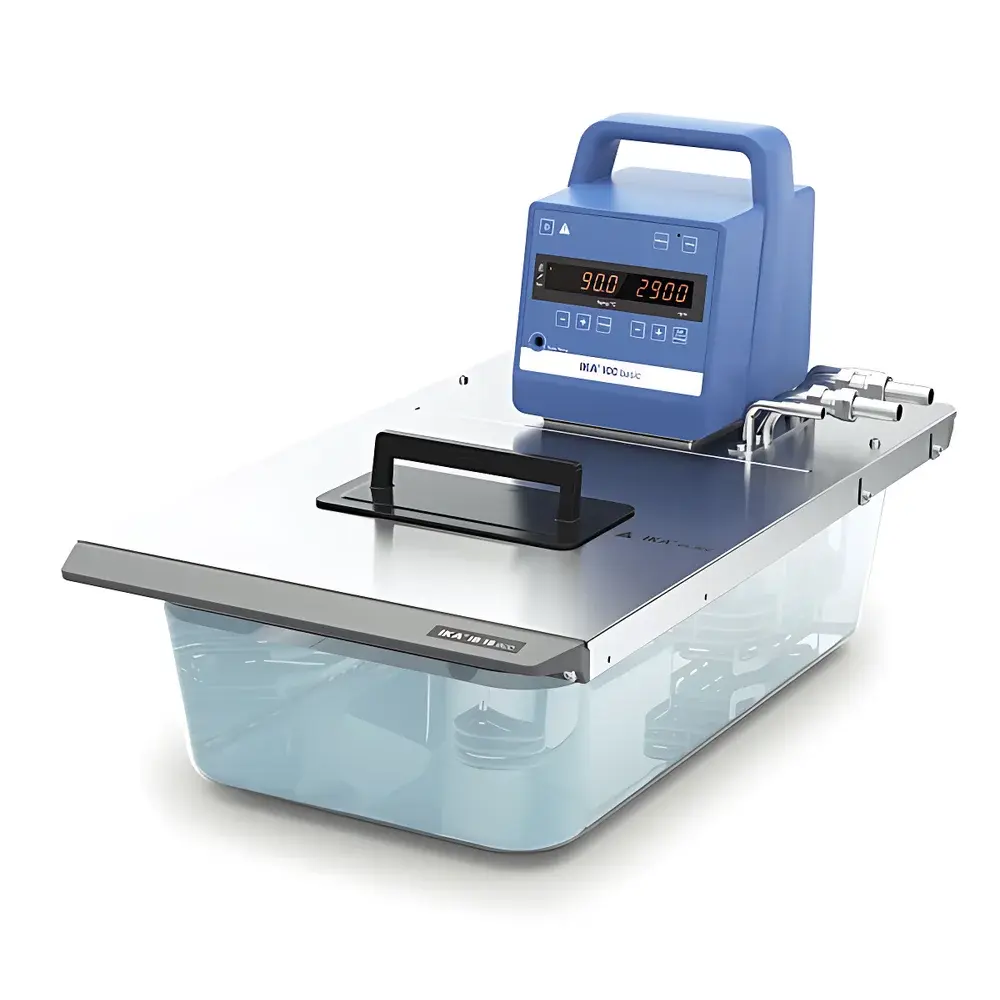
IKA ICC basic eco 18 c Immersion Circulator with Integrated Bath Tank
| Brand | IKA |
|---|---|
| Origin | Germany |
| Manufacturer | IKA-Werke GmbH & Co. KG |
| Type | ICC basic eco 18 c |
| Instrument Category | Compact Immersion Circulator (DIN 12876 Class III) |
| Bath Volume | 18 L |
| Temperature Range | 10–150 °C |
| Temperature Stability | ±0.02 K |
| Heating Power | 2100 W |
| Supply Voltage | 230 V AC, 50/60 Hz |
| Pump Flow Rate | up to 18 L/min (0 bar backpressure) |
| Max. Pressure | 0.3 bar |
| Max. Suction Head | 0.2 bar |
| External Sensor Input | Yes |
| Display Resolution | 0.1 K |
| Safety Cut-off Range | 0–160 °C |
| Protection Rating | IP21 |
| Interface | RS232, USB |
| Dimensions (Unit) | 145 × 340 × 200 mm |
| Weight | 3.75 kg |
| Ambient Operating Conditions | 5–40 °C, ≤80 % RH |
Overview
The IKA ICC basic eco 18 c is a compact, CE-compliant immersion circulator engineered for precise temperature control in laboratory-scale thermal applications. Unlike conventional water baths or standalone heaters, this unit integrates a thermostatically regulated circulation system with a dedicated 18 L polypropylene bath tank—designed for stable, uniform heat transfer via forced convection. Its core operation relies on a PT100 working sensor and redundant PT1000 safety sensor, both compliant with DIN 12876 Class III requirements for laboratory heating equipment. The device maintains temperature stability of ±0.02 K across its full operating range (10–150 °C), making it suitable for applications demanding high reproducibility—such as enzymatic assays, polymer dissolution studies, calibration of thermometers, and pre-conditioning of samples prior to rheological or spectroscopic analysis. The integrated pump supports both internal recirculation and external loop configurations, enabling use with jacketed reactors, distillation setups, or custom thermal manifolds.
Key Features
- Integrated 18 L chemical-resistant polypropylene bath tank (max. 100 °C with aqueous media only)
- Dual-sensor architecture: PT100 for process control + PT1000 for independent overtemperature protection
- Adjustable safety cutoff (0–160 °C) with visual and audible alarms for deviation events
- High-efficiency heating element delivering 2100 W nominal power at 230 V AC, 50/60 Hz
- Variable-speed pressure/suction pump (0–18 L/min flow; 0.3 bar max. pressure; 0.2 bar suction head)
- DIN 12876 Class III certification for laboratory-grade thermal equipment
- IP21 ingress protection rating for safe operation in standard lab environments
- RS232 and USB interfaces for remote monitoring, parameter logging, and firmware updates
- LED display with 0.1 K resolution and dual-channel readout (process temp. + safety temp.)
- Full 100 % duty cycle capability for continuous unattended operation
Sample Compatibility & Compliance
The ICC basic eco 18 c is validated for use with aqueous solutions, silicone oils, and low-viscosity heat-transfer fluids compatible with polypropylene (e.g., Dow Corning PMX-200 series up to 100 °C). It conforms to DIN 12876-1:2015 for laboratory heating devices and meets essential requirements under the EU Machinery Directive 2006/42/EC and Low Voltage Directive 2014/35/EU. For GLP/GMP-regulated environments, the unit supports traceable calibration via external reference sensors and provides audit-ready event logs—including temperature excursions, alarm triggers, and safety cutoff activations—when paired with IKA Labworldsoft™ or third-party SCADA systems. While not FDA 21 CFR Part 11–certified out-of-the-box, its digital interface enables integration into compliant data management workflows when configured with electronic signature and audit trail protocols.
Software & Data Management
The ICC basic eco 18 c communicates via standardized ASCII protocol over RS232 or virtual COM port (USB). It transmits real-time temperature values, pump status, alarm states, and safety cutoff settings. IKA Labworldsoft™ (v5.0+) supports automated data capture, trend visualization, and export to CSV or Excel formats. All logged parameters—including timestamps, setpoints, and deviations—are stored locally in non-volatile memory and persist through power cycles. The device supports external calibration offset entry via software, allowing traceable adjustment against NIST-traceable references. No cloud connectivity or proprietary drivers are required; communication is fully interoperable with LabVIEW, Python (pySerial), or MATLAB-based automation frameworks.
Applications
- Thermal equilibration of cuvettes, vials, and reaction vessels prior to UV-Vis or fluorescence measurements
- Controlled solubilization of temperature-sensitive polymers (e.g., PNIPAM, PLGA) in pharmaceutical formulation development
- Stabilization of enzymatic reaction mixtures during kinetic profiling (e.g., LDH, HRP assays)
- Pre-heating and conditioning of calibration standards for DSC, TGA, or viscometry instruments
- External temperature control of jacketed glass reactors (up to 2 L volume) using closed-loop circulation
- Supporting ASTM D5296 (gel permeation chromatography) column oven pre-conditioning protocols
- ISO 17025-accredited labs performing thermometer calibration per ISO/IEC 17025:2017 Clause 6.4.10
FAQ
Can the ICC basic eco 18 c be used with oil baths above 100 °C?
No—the integrated polypropylene bath tank is rated for aqueous media only up to 100 °C. For oil-based operation beyond this limit, an external stainless-steel or aluminum bath must be connected via the pump’s external circulation ports.
Is external calibration supported?
Yes—via the RS232/USB interface, users can input correction offsets referenced to a certified secondary standard (e.g., Fluke 1523), with all adjustments recorded in the device’s event log.
Does the unit meet GLP requirements for audit trails?
While the hardware records alarms and safety events, full GLP compliance requires integration with validated software (e.g., Labworldsoft™ with enabled audit trail module) to ensure electronic signatures, user access control, and immutable data archiving.
What is the minimum fluid depth required for stable operation?
The bath must maintain ≥150 mm liquid depth to ensure proper submersion of the heating element and sensor assembly; insufficient depth may trigger thermal cut-off or instability.
Can the pump run dry without damage?
No—continuous dry running will cause irreversible pump seal degradation. The unit includes no dry-run protection; manual verification of fluid level is mandatory before activation.



