
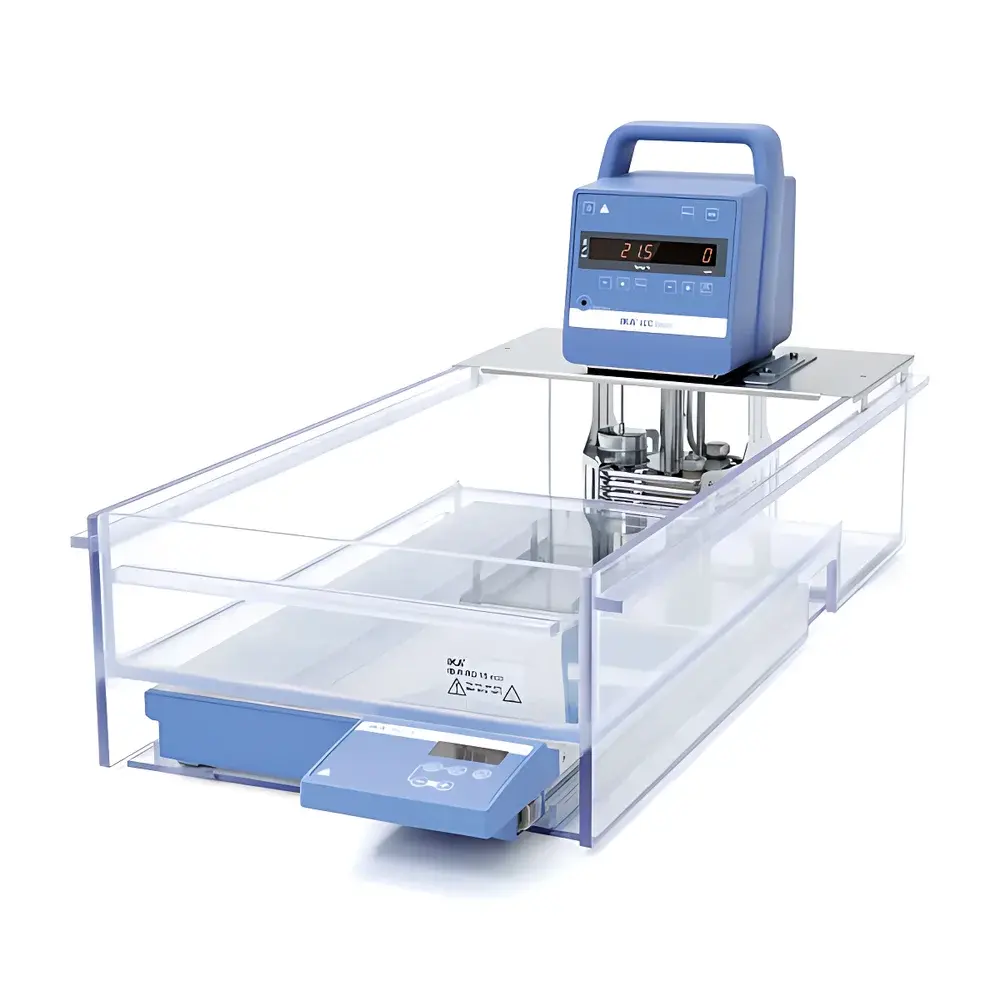
IKA ICC basic RO 15 Immersion Circulator
| Brand | IKA |
|---|---|
| Origin | Guangdong, China |
| Manufacturer Type | Manufacturer |
| Product Category | Domestic |
| Model | ICC basic IB R RO 15 eco |
| Instrument Type | Constant-Temperature Bath Circulator |
| Circulation Mode | Internal & External |
| Temperature Control | Heating-Only |
| Bath Volume Capacity | 25 L |
| Temperature Range | Ambient +10 °C to 150 °C |
| Temperature Stability | ±0.02 °C |
| Input Power | 2100 W |
| Supply Voltage | 230 V |
| Pump Flow Rate (max) | 18 L/min |
| Max Pressure (zero flow) | 0.3 bar |
| Safety Cut-off Range | 0–160 °C |
| Protection Rating | IP21 |
| Compliance | DIN 12876 Class III, DIN EN 60529 |
| Interface | RS232, USB |
| Dimensions (W×D×H) | 145 × 340 × 200 mm |
| Weight | 3.75 kg |
| Operating Ambient | 5–40 °C, ≤80% RH |
Overview
The IKA ICC basic RO 15 is a compact, high-precision immersion circulator engineered for stable, reproducible temperature control in laboratory applications requiring external thermal regulation of reactors, jacketed vessels, or analytical instrumentation. Based on resistive heating and forced liquid circulation via an integrated pressure/suction pump, the device operates according to the principles of convective heat transfer—delivering uniform thermal energy through calibrated fluid movement. Its design adheres strictly to DIN 12876 Class III safety standards for laboratory heating equipment, ensuring suitability for continuous-duty operation in regulated environments such as QC labs, R&D facilities, and academic research settings. Unlike open-bath systems, the RO 15 functions as a closed-loop external circulator, enabling precise thermal management of external vessels up to 25 L capacity while maintaining full operational independence from bath volume constraints.
Key Features
- High-stability temperature control with ±0.02 °C stability at setpoint (DIN 12876 compliant), achieved via dual-sensor architecture: PT100 working sensor and redundant PT1000 safety sensor
- Integrated dual-mode pump delivering up to 18 L/min flow rate at 0 bar backpressure, with adjustable pressure (0.3 bar max) and suction (0.2 bar max) for compatibility with diverse reactor geometries and tubing configurations
- Heating-only operation optimized for water and silicone oil media, with maximum operating temperature of 150 °C and extended low-temperature capability down to ambient +10 K (–20 °C with external chiller integration)
- Dual LED display showing real-time working temperature and independently monitored safety temperature; visual and audible alarms triggered upon deviation or safety threshold breach
- Programmable safety cut-off range (0–160 °C), secondary overtemperature protection, overvoltage safeguard, and automatic pump dry-run prevention
- RS232 and USB interfaces support instrument connectivity to LIMS or PC-based control software, enabling remote monitoring, parameter logging, and audit-trail generation per FDA 21 CFR Part 11 requirements
Sample Compatibility & Compliance
The ICC basic RO 15 is compatible with standard laboratory fluids including deionized water, glycol-water mixtures, and silicone oils (viscosity ≤ 50 cSt). Its plastic bath housing (eco-series) is rated for continuous use up to 100 °C with aqueous media only; stainless-steel probe and pump components ensure chemical resistance and long-term reliability. The unit meets DIN 12876 Class III classification for immersion circulators used in critical thermal processes and conforms to DIN EN 60529 (IP21) for protection against vertically falling solids and limited ingress of moisture. It supports GLP/GMP-aligned workflows through traceable calibration options, hardware-level temperature logging, and configurable alarm thresholds—all documented in accordance with ISO/IEC 17025 calibration traceability requirements.
Software & Data Management
Through its native RS232 and USB ports, the RO 15 integrates seamlessly with IKA LabWorld software or third-party SCADA/LIMS platforms. Users can configure ramp-soak profiles, export time-stamped temperature logs (CSV format), and enforce user-access levels for parameter modification. Audit trail functionality records all critical events—including setpoint changes, alarm triggers, and safety cutoff activations—with timestamp, operator ID, and contextual metadata. Data integrity is preserved via non-volatile memory storage and optional digital signature verification, satisfying regulatory expectations for electronic records under FDA 21 CFR Part 11 and EU Annex 11.
Applications
- Temperature-controlled synthesis in jacketed glass reactors (e.g., Grignard, hydrogenation, polymerization)
- Calibration of thermocouples, RTDs, and infrared sensors using traceable fluid baths
- Thermal preconditioning of samples prior to rheological, viscometric, or DSC analysis
- Stabilization of optical benches, spectrophotometer cuvette holders, or electrophoresis tanks
- Supporting ASTM D2857 (FTIR sample temperature control), ISO 11357 (DSC calibration), and USP <1031> (thermal analysis validation)
FAQ
Can the RO 15 be used with silicone oil above 100 °C?
Yes—provided the external bath vessel is chemically compatible and rated for elevated temperatures; the eco-series plastic housing is limited to 100 °C with water only, but the immersion probe and pump assembly are rated to 150 °C.
Is external cooling integration supported?
Yes—the unit accepts chilled fluid input via its external circulation port, enabling operation down to –20 °C when paired with a compatible recirculating chiller.
Does it support GLP-compliant calibration documentation?
Yes—calibration certificates traceable to national standards (e.g., NIST, PTB) are available; internal sensor verification routines and external probe calibration modes are included.
What is the minimum recommended bath depth for stable operation?
A minimum immersion depth of 150 mm is required to ensure full coverage of the heating element and temperature sensor, preventing thermal drift and dry-run conditions.
Can multiple RO 15 units be synchronized via network interface?
Not natively—the RS232/USB interface supports point-to-point communication only; centralized control requires integration through a host PC or PLC gateway.



