
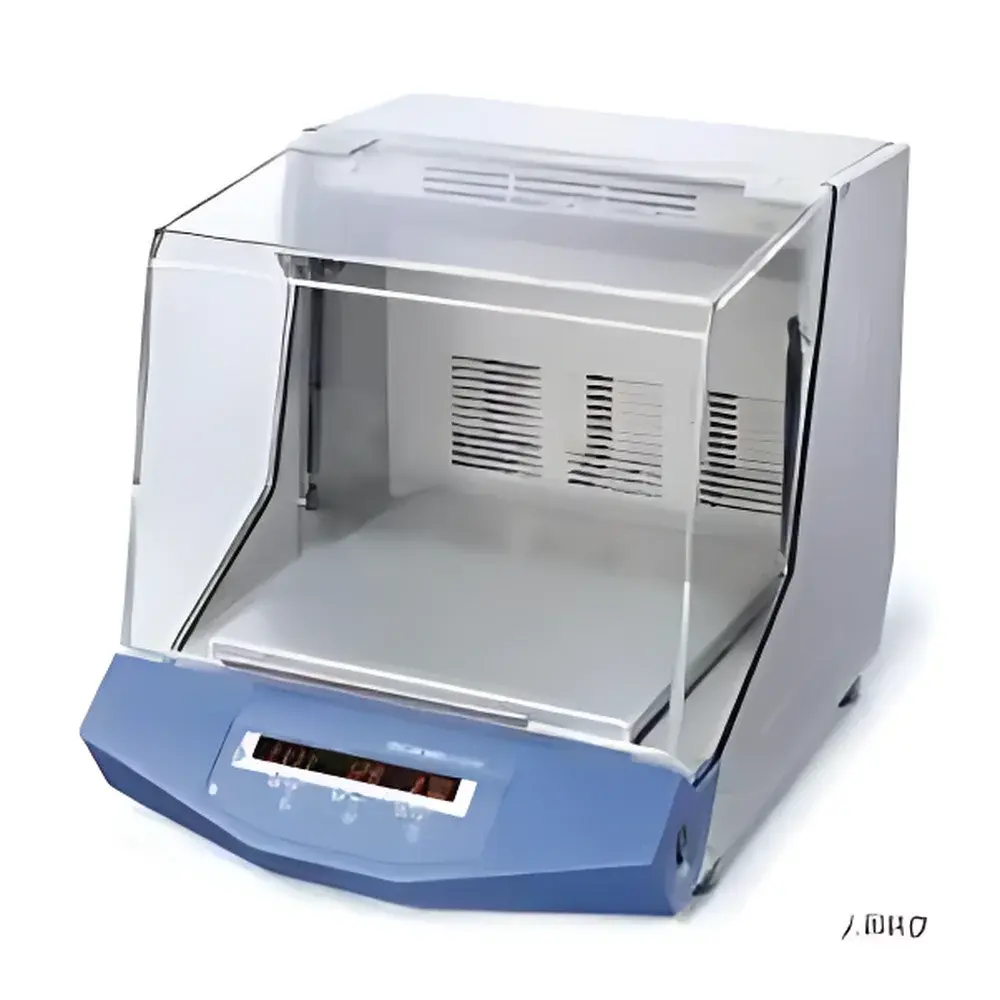
IKA KS 3000 ic control Temperature-Controlled Orbital Shaker
| Brand | IKA |
|---|---|
| Origin | Germany |
| Model | KS 3000 ic control |
| Timer Range | 1–59940 min |
| Oscillation Speed | 10–500 rpm |
| Orbit Diameter | 20 mm |
| Temperature Range | RT +5 °C to 80 °C |
| Chamber Volume | 50 L |
| Max Load Capacity (incl. clamps) | 7.5 kg |
| Display | LED (speed, temperature, timer) |
| Control System | PID with PT1000 sensor input |
| Interfaces | RS 232, USB |
| Compliance | DIN EN 60529 IP30 |
| Power Supply | 230/115/100 V, 50/60 Hz |
| Input Power | 1120 W |
| Weight | 37 kg |
| Dimensions (W×D×H) | 465 × 430 × 695 mm |
Overview
The IKA KS 3000 ic control is a precision-engineered orbital shaker designed for demanding life science and bioprocessing applications requiring simultaneous temperature control, high-speed stability, and long-term unattended operation. Utilizing a robust brushless DC motor and an integrated PID temperature regulation system, it maintains thermal uniformity and mechanical reproducibility across extended incubation cycles — critical for microbial culture expansion, protein expression studies, solubility testing, and cell-based assays. Its compact footprint (465 × 430 × 695 mm) and 50 L chamber volume support scalable workflows without compromising benchtop efficiency. The unit features a thermally insulated stainless-steel chamber, external cooling coil compatibility (for sub-ambient operation down to 12 °C when paired with an external chiller), and a rigid aluminum-alloy platform engineered for minimal vibration transmission and consistent 20 mm orbital motion.
Key Features
- Orbital shaking motion with precise 20 mm diameter orbit and speed resolution of 1 rpm across 10–500 rpm range
- Integrated PID temperature controller with PT1000 sensor input; achieves ±0.5 K accuracy (in 0.5 L water at 37 °C, ambient 22 °C) and ±0.05 K stability under static load conditions
- Wide temperature range from RT +5 °C to 80 °C; optional external cooling extends effective low-end limit to 12 °C
- Large backlit LED display showing real-time speed, temperature, and remaining timer duration
- Electronic safety interlock: automatic motor stop upon lid opening, preventing accidental exposure or sample disturbance
- Dual communication interfaces — RS 232 and USB — enabling remote parameter setting, real-time data streaming, and audit-ready logging via labworldsoft® software (sold separately)
- IP30-rated enclosure (DIN EN 60529) with antimicrobial-coated ABS front panel and PMMA transparent viewing window
- Drain port at rear panel for safe removal of condensate or spilled media; removable collection tray included
- Continuous-duty rated motor (10 W output, 45 W input); 100% duty cycle capability for uninterrupted 24/7 operation
Sample Compatibility & Compliance
The KS 3000 ic control accommodates standard laboratory vessels — including Erlenmeyer flasks (up to 5 L), test tubes, deep-well plates, and custom bioreactor vessels — via interchangeable clamping systems (e.g., universal spring clamps, flask holders, microplate adapters). Its 330 × 330 mm platform supports heterogeneous loading configurations while maintaining dynamic balance up to 7.5 kg total mass (including fixtures). Temperature uniformity is validated per ISO 291:2019 (plastics — standard atmospheres) methodology: ±0.5 K across five 0.5 L flasks at 37 °C. The system meets general laboratory safety requirements per IEC 61010-1 and carries CE marking. While not inherently 21 CFR Part 11 compliant, its digital interface and labworldsoft® integration support configurable user access levels, electronic signatures, and immutable audit trails when deployed within validated GxP environments (e.g., GLP-compliant microbiology labs or QC bioprocess development suites).
Software & Data Management
Remote operation and traceable data acquisition are enabled through IKA’s labworldsoft® software suite (license required separately). This Windows-based application provides full bidirectional control — including ramp profiles, multi-step protocols, and alarm thresholds — with timestamped export to CSV or Excel formats. All parameter changes, runtime events (e.g., lid open, temperature deviation >±1 K), and error codes (e.g., E03 = overtemperature, E12 = communication timeout) are logged with operator ID and system time. When configured with network-enabled hardware and role-based authentication, the setup satisfies ALCOA+ principles (Attributable, Legible, Contemporaneous, Original, Accurate) for regulated documentation. Raw serial data from RS 232 or USB can also be parsed by third-party LIMS or SCADA systems using ASCII protocol documentation provided in the technical manual.
Applications
- Bacterial and yeast cultivation under controlled aeration and thermal conditions
- Enzyme kinetics studies requiring precise agitation-coupled temperature ramps
- Solubility and dissolution profiling of pharmaceutical excipients and APIs
- Cell suspension culture in serum-free or chemically defined media
- Antibiotic susceptibility testing (AST) with standardized shaking parameters per CLSI M07-A11
- Extraction optimization for natural products (e.g., polyphenols, alkaloids) in solvent-based systems
- Preparative-scale protein refolding and aggregation suppression assays
FAQ
Can the KS 3000 ic control operate below ambient temperature?
Yes — when connected to an external recirculating chiller via the rear-mounted cooling coil, the unit achieves stable setpoints as low as 12 °C (provided coolant supply remains >3 °C).
Is labworldsoft® included with the instrument?
No — labworldsoft® is licensed separately and must be ordered as an add-on module. Basic local control remains fully functional without software.
What is the maximum flask size supported on the standard platform?
With appropriate clamp configuration, up to 5 L Erlenmeyer flasks may be accommodated; load distribution must remain symmetrical to maintain rotational balance.
Does the unit support programmable ramping of temperature or speed?
Ramping functionality is available exclusively via labworldsoft®; the onboard interface supports only fixed-point setpoints and timer-based start/stop.
How is temperature calibration performed?
Users may perform two-point calibration using certified reference PT1000 probes; factory calibration certificates (traceable to DKD/DAkkS) are available upon request.
Related Products



