
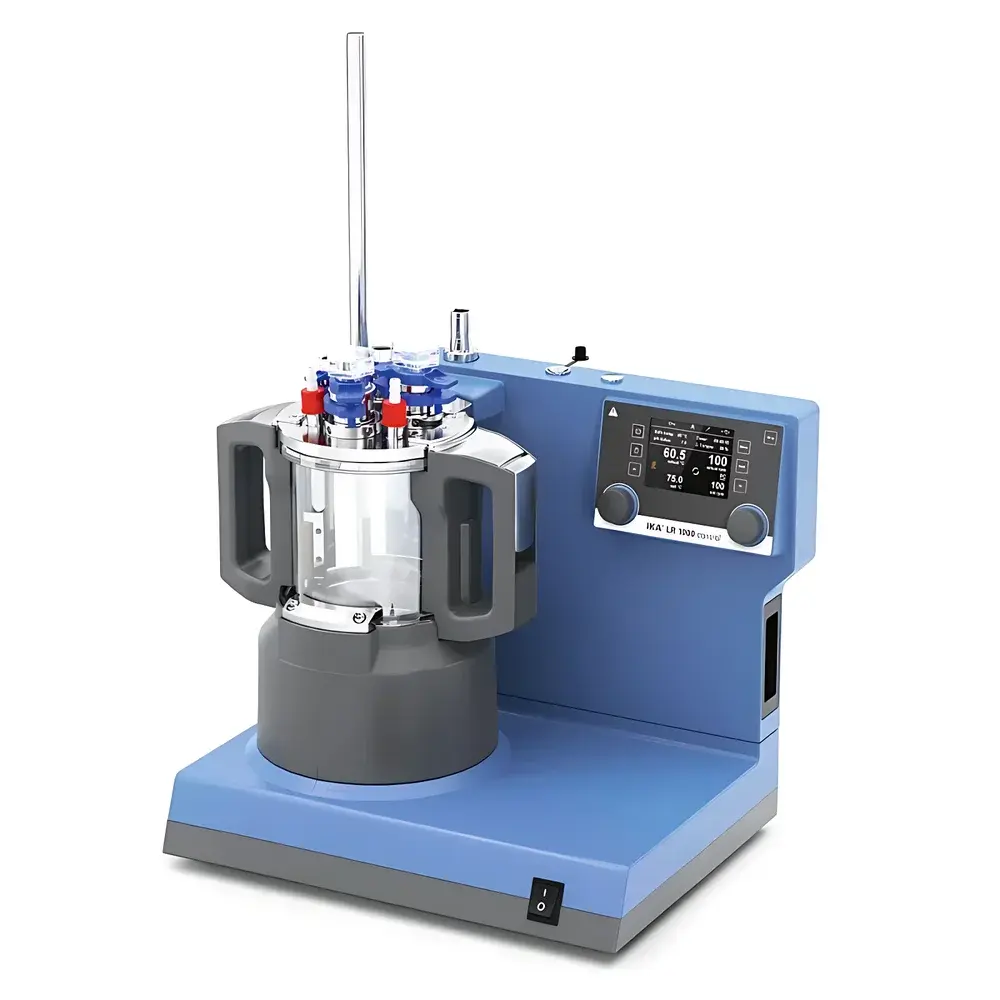
IKA LR 1000 control System High-Viscosity Laboratory Reactor
| Brand | IKA |
|---|---|
| Origin | Germany |
| Model | LR 1000 control System |
| Max. Working Volume | 1000 mL |
| Min. Sample Volume with Disperser | 500 mL |
| Max. Operating Temperature | 120 °C (Heating Block up to 180 °C) |
| Vacuum Capability | down to 25 mbar |
| Max. Viscosity Handling | 100,000 mPa·s |
| Speed Range | 10–150 rpm (adjustable in 1 rpm increments) |
| Stirring Shaft Diameter (with Integrated Clamp) | 16 mm |
| Wetted Materials | AISI 316L stainless steel, Borosilicate Glass 3.3, PTFE, PEEK, FFKM |
| Reaction Vessel Ports | 2 × NS 29/32, 2 × NS 14/23, 2 × GL 14 |
| Continuous Duty Cycle | 100 % |
| Temperature Measurement Accuracy | ±0.1 K |
| Rated Torque | 3 Nm |
| Heating Power Output | 1000 W |
| Cooling Medium Max. Pressure | 1 bar |
| Weighing Capacity | 2000 g |
| Weighing Resolution | 1 g |
| pH Measurement Range | 0–14 |
| pH Resolution | 0.1 |
| Min. Adjustable Speed | 10 rpm |
| Adjustable Safety Circuit Range | 47–225 °C (±10–20 K deviation tolerance) |
| Minimum Cooling Medium Inlet Temperature | 3 °C |
| Heating Temp. Control Accuracy | ±1 K |
| Sensor-Based Temp. Control Accuracy | ±0.2 K |
| Speed Deviation | ±5 rpm |
| Display Type | TFT touchscreen |
| External Temp. Sensor Interface | PT100 |
| Stirrer Shaft Output | Specialized torque-sensing shaft |
| Torque Measurement & Trend Logging | Yes |
| Integrated Timer | Yes |
| Timer Display | TFT |
| Speed Control Resolution | 1 rpm/step |
| Cooling Method | External circulation (via integrated cooling jacket interface) |
| Process Temp. Sensor | PT100 |
| Safety Temp. Sensor | PT1000 |
| Process Temp. Display | TFT |
| Safety Temp. Display | TFT |
| External Sensor Status Indication | Yes |
| Thermal Cut-Out Protection | Yes |
| MV1 Solenoid Valve Interface | Yes |
| pH Sensor Interface | Yes |
| pH Display | TFT |
| Dimensions (W×D×H) | 443 × 360 × 295 mm |
| Weight | 16 kg |
| Ambient Operating Temperature | 5–40 °C |
| Max. Relative Humidity | 80 % (non-condensing) |
| Enclosure Rating | IP21 (per DIN EN 60529) |
| Communication Interfaces | RS232, USB, Bluetooth |
| Electrical Supply | 230 V AC, 50/60 Hz (optional 115 V version available) |
| Max. Input Power | 1200 W |
Overview
The IKA LR 1000 control System is an integrated high-viscosity laboratory reactor engineered for precise control of chemical synthesis, emulsification, polymerization, and formulation processes under temperature-, vacuum-, pH-, and torque-monitored conditions. Based on Couette-type mixing geometry and direct-drive magnetic coupling, it delivers robust mechanical stability and reproducible shear profiles across wide viscosity ranges—from low-viscosity solutions to highly structured gels and pastes up to 100,000 mPa·s. Its modular architecture combines heating (via bottom-integrated 1000 W Peltier-free resistive element), active cooling (through jacketed circulation interface), real-time torque sensing, gravimetric monitoring (±1 g resolution), and electrochemical process tracking (pH 0–14, ±0.1 unit) within a single platform. Designed for compliance-critical environments, the system supports audit-ready data acquisition when paired with labworldsoft® software—enabling full traceability aligned with GLP, GMP, and FDA 21 CFR Part 11 requirements.
Key Features
- Integrated multi-parameter control: simultaneous regulation and logging of temperature (process and safety channels), rotational speed (10–150 rpm, adjustable in 1-rpm steps), torque (0–3 Nm), pH, weight (0–2000 g), and vacuum (down to 25 mbar)
- Dual temperature sensing architecture: PT100 immersion probe (included) for direct sample measurement + redundant PT1000 safety sensor with independent overtemperature cutoff (configurable 47–225 °C, ±10–20 K hysteresis)
- Chemically resistant wetted path: AISI 316L stainless steel, borosilicate glass 3.3 (DIN ISO 3585), PTFE, PEEK, and FFKM seals ensure compatibility with aggressive solvents, bases, and oxidizing agents
- Six-port reaction head (2 × NS 29/32, 2 × NS 14/23, 2 × GL 14) enables flexible integration of condensers, dropping funnels, gas inlets, reflux modules, or inline sensors
- TFT touchscreen interface with intuitive menu navigation, multilingual support, and real-time trend visualization for all measured parameters
- MV1 solenoid valve interface for automated liquid addition or quenching; optional T 25 digital disperser for high-shear homogenization and emulsification
- Full communication suite: RS232, USB 2.0, and Bluetooth 4.2 for remote parameter setting, live data streaming, and long-term experiment archiving via labworldsoft®
Sample Compatibility & Compliance
The LR 1000 control System accommodates batch volumes from 500 mL (with disperser) to 1000 mL in standard configuration, supporting viscous systems including silicone elastomers, pharmaceutical suspensions, cosmetic creams, battery electrolytes, and catalytic slurries. All contact materials comply with USP Class VI, FDA 21 CFR 177.1550 (food-contact plastics), and EU Regulation (EC) No. 1935/2004. The system meets electromagnetic compatibility standards per EN 61326-1 and safety requirements per EN 61010-1. Its IP21-rated enclosure ensures operational integrity in standard laboratory environments (5–40 °C, ≤80 % RH non-condensing). For regulated workflows, optional labworldsoft® provides electronic signatures, user access levels, audit trails, and encrypted raw data export—fully compliant with ALCOA+ principles and suitable for regulatory submissions.
Software & Data Management
labworldsoft® (sold separately; free trial available) serves as the central data acquisition and control hub. It enables synchronized acquisition from all onboard sensors—including torque, temperature, pH, weight, and vacuum—with timestamped, CSV- and PDF-exportable reports. The software supports method-based protocol execution, alarm-triggered actions (e.g., automatic shutdown on torque overshoot or pH drift), and secure user authentication. Raw datasets retain metadata such as operator ID, instrument serial number, calibration timestamps, and environmental logs—essential for GLP audits and quality system validation. Remote desktop access and scheduled backups further enhance data integrity and continuity across multi-shift operations.
Applications
- Pharmaceutical development: solvent-free API crystallization, sustained-release matrix preparation, and in-process rheological monitoring of hydrogels
- Personal care formulation: cold-process emulsification of oil-in-water creams, viscosity profiling during thickener hydration, and pH-driven phase inversion studies
- Materials science: controlled polymerization of acrylic monomers under inert atmosphere, nanoparticle dispersion stability testing, and thermoset curing kinetics
- Agrochemical R&D: suspension concentrate stabilization, wettable powder reconstitution analysis, and adjuvant interaction screening
- Academic research: kinetic modeling of heterogeneous catalysis, calorimetric reaction profiling (via torque-to-power correlation), and mechanistic studies of thixotropic recovery
FAQ
Can the LR 1000 control System operate under inert gas or reduced pressure?
Yes—it features integrated vacuum capability down to 25 mbar and includes gas-tight sealing elements compatible with nitrogen or argon purging through standard NS/GL ports.
Is external cooling required for operation below ambient temperature?
No active sub-ambient cooling is built-in; however, the jacketed vessel interface supports connection to external chillers or dry ice/ethanol baths for rapid cooldown to ≥3 °C inlet temperature.
How is torque measurement used in practice?
Real-time torque values correlate directly with medium viscosity and structural breakdown; trending torque during ramped speed profiles allows detection of yield points, gelation onset, or particle agglomeration events.
What safety mechanisms prevent overheating or mechanical overload?
Dual independent thermal cutoffs (PT100 + PT1000), hardware-based emergency stop triggered by lid removal, motor current limiting, and configurable torque threshold alarms collectively enforce fail-safe operation.
Does the system support automated dosing or titration protocols?
When coupled with the optional MV1 solenoid valve module and labworldsoft®, programmable liquid addition—based on time, pH threshold, or torque deviation—is fully supported.



