
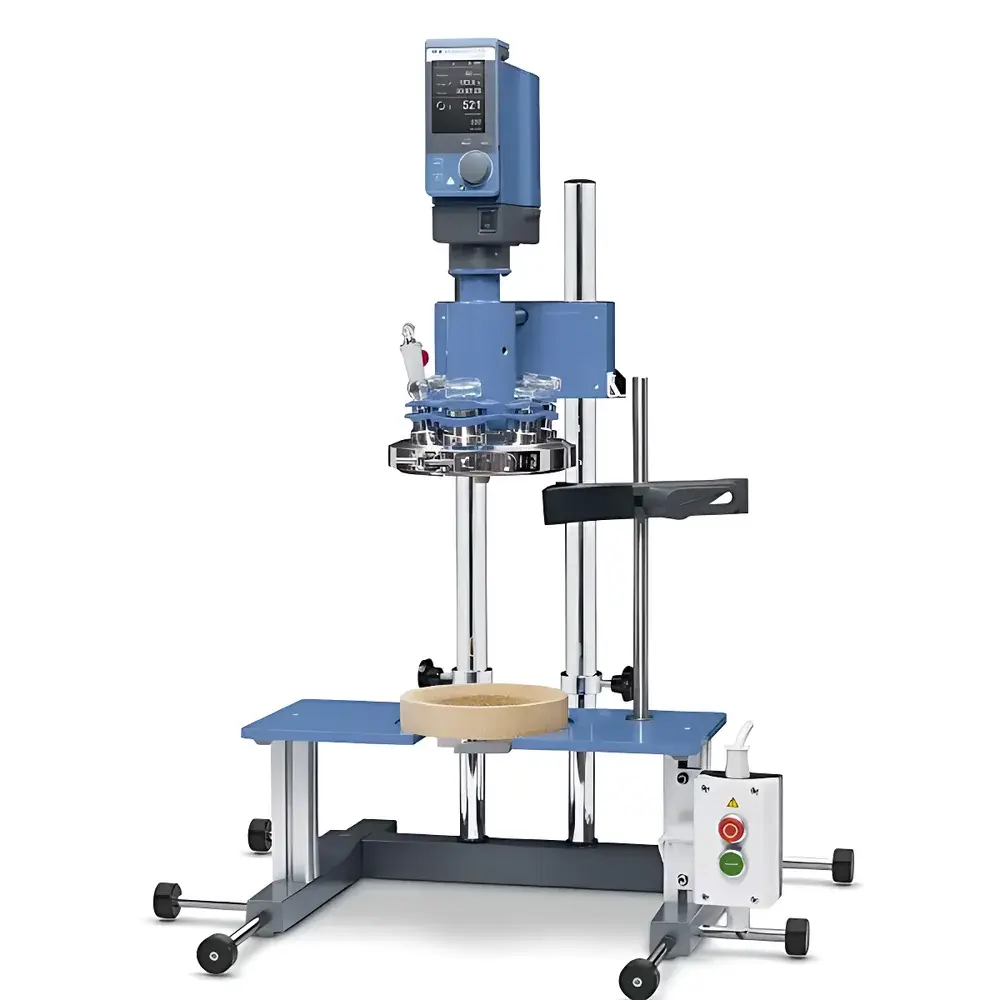
IKA LR-2.ST the Compact Power Laboratory Reactor System
| Brand | IKA |
|---|---|
| Origin | Germany |
| Model | LR-2.ST the Compact Power |
| Usable Volume | 500–2000 mL |
| Temperature Range | Ambient to 230 °C |
| Vacuum Capability | Down to 25 mbar |
| Max. Viscosity Handling | 50,000 mPa·s |
| Speed Range | 8–290 rpm |
| Lifting Stroke | 390 mm |
| Wetted Materials | Borosilicate Glass (DIN ISO 3585), FFPM, PTFE, Stainless Steel 1.4571 |
| Reactor Opening Configuration | 3× NS 29/32 + 2× NS 14/23 |
| Max. Stirring Torque | 60 N·cm |
| Dimensions (W×H×D) | 460 × 1240 × 430 mm |
| Weight | 25 kg |
| Ambient Operating Conditions | 5–40 °C, ≤80 % RH |
| Control | Microprocessor-based speed regulation with load compensation |
| Safety | Integrated safety switch, motor torque monitoring, overheat protection |
Overview
The IKA LR-2.ST the Compact Power is a modular, benchtop-scale laboratory reactor system engineered for precise control and reproducible execution of chemical synthesis, homogenization, emulsification, and high-viscosity mixing processes under controlled temperature, pressure, and agitation conditions. Based on Couette-type shear mechanics, the system integrates a high-torque EUROSTAR 60 control stirrer with a vertically adjustable support frame and a multi-port borosilicate glass reactor vessel. Its design prioritizes mechanical stability during exothermic or viscous reactions—particularly where torque demand exceeds standard laboratory stirrers—and enables operation under reduced pressure (down to 25 mbar) without compromising seal integrity or thermal uniformity. The reactor’s architecture supports simultaneous integration of auxiliary modules—including ULTRA-TURRAX® dispersing tools, Pt100 temperature probes, reflux condensers, dosing funnels, and pH electrodes—via standardized NS ground-glass joints (NS 29/32 and NS 14/23), ensuring compatibility with standard lab glassware and process scalability.
Key Features
- High-torque stirring capability (up to 60 N·cm) delivered via a brushless DC motor with microprocessor-regulated speed control, maintaining set rpm ±1% even under dynamic viscosity changes up to 50,000 mPa·s
- Vertically adjustable support column with 390 mm stroke allows precise positioning of the drive unit relative to vessel height and facilitates safe installation/removal of heavy or hot reactors
- Chemically resistant wetted materials: DIN ISO 3585 borosilicate glass vessels, perfluoroelastomer (FFPM) seals rated for continuous service up to 230 °C and compatible with aggressive solvents including chlorinated hydrocarbons, strong acids, and bases
- Modular port configuration (3× NS 29/32, 2× NS 14/23) enables flexible attachment of ancillary instrumentation without custom adapters or machining
- Integrated safety switch deactivates motor when lid is opened; real-time torque trend display provides indirect viscometric feedback during reaction progression
- Included WiCo wireless controller permits fully isolated operation inside fume hoods—eliminating cable routing hazards and enabling ergonomic remote adjustment of speed, timer, and safety lockout
Sample Compatibility & Compliance
The LR-2.ST accommodates liquid, slurry, and semi-solid reaction media across a broad polarity and volatility spectrum. Its FFPM/PTFE/glass material set complies with USP Class VI biocompatibility requirements and exhibits no extractables under typical synthetic conditions. The system meets IEC 61010-1:2010 for electrical safety in laboratory environments and conforms to EN 60529 (IP20) for enclosure protection. While not certified as explosion-proof, its vacuum-rated construction and sealed electronics are suitable for use with flammable solvents under inert atmosphere (N₂ or Ar) when operated within specified ambient humidity limits (≤80 % RH). Documentation packages support GLP-compliant recordkeeping when paired with IKA LabWorld software (optional) and external data loggers meeting FDA 21 CFR Part 11 audit-trail requirements.
Software & Data Management
The LR-2.ST operates autonomously via front-panel controls but interfaces seamlessly with IKA LabWorld PC software (v4.0+) for protocol-driven operation, time-stamped parameter logging (speed, torque, temperature input), and export to CSV or PDF formats. When connected to optional Pt100 sensors and heating mantles, LabWorld enables closed-loop temperature ramping and event-triggered actions (e.g., reduce speed upon reaching target viscosity threshold). All logged datasets include operator ID, timestamp, and instrument serial number—supporting traceability in regulated environments. Raw torque vs. time curves serve as qualitative indicators of gelation, polymerization onset, or phase separation, supplementing dedicated rheometric analysis.
Applications
- Synthesis of polymeric materials (polyesters, polyacrylates) requiring extended high-shear mixing at elevated temperatures
- Pharmaceutical intermediate development under vacuum-assisted solvent removal or moisture-sensitive conditions
- Development of nanoparticle dispersions and Pickering emulsions using combined stirring and ULTRA-TURRAX® dispersion
- Process optimization studies for heterogeneous catalysis, where catalyst suspension stability and mass transfer efficiency depend on impeller geometry and Reynolds number control
- Evaluation of thermal stability and decomposition kinetics of energetic materials under controlled heating profiles
FAQ
Can the LR-2.ST be used for reactions requiring strict anhydrous conditions?
Yes—when coupled with appropriate drying tubes, vacuum-purged inert gas lines, and FFPM-sealed ports, the system maintains moisture exclusion below 10 ppm H₂O in closed-loop configurations.
Is the EUROSTAR 60 stirrer compatible with third-party overhead stirrers or digital controllers?
No—the EUROSTAR 60 is proprietary to IKA and communicates exclusively via its integrated bus interface; however, analog 0–10 V speed input is available for external PLC integration.
What maintenance intervals are recommended for long-term reliability?
Annual inspection of FFPM seals and torque calibration is advised; glass components should be inspected for star cracks or etching prior to each high-temperature cycle.
Does the system support automated addition of reagents during reaction?
Yes—via optional programmable peristaltic pumps (e.g., IKA RW 20) connected to NS 14/23 ports and triggered through LabWorld event scripting.
Can torque data be exported in real time for external process modeling?
Yes—LabWorld supports TCP/IP streaming of live torque, speed, and temperature values to MATLAB, Python, or SCADA systems via standard Ethernet.



