
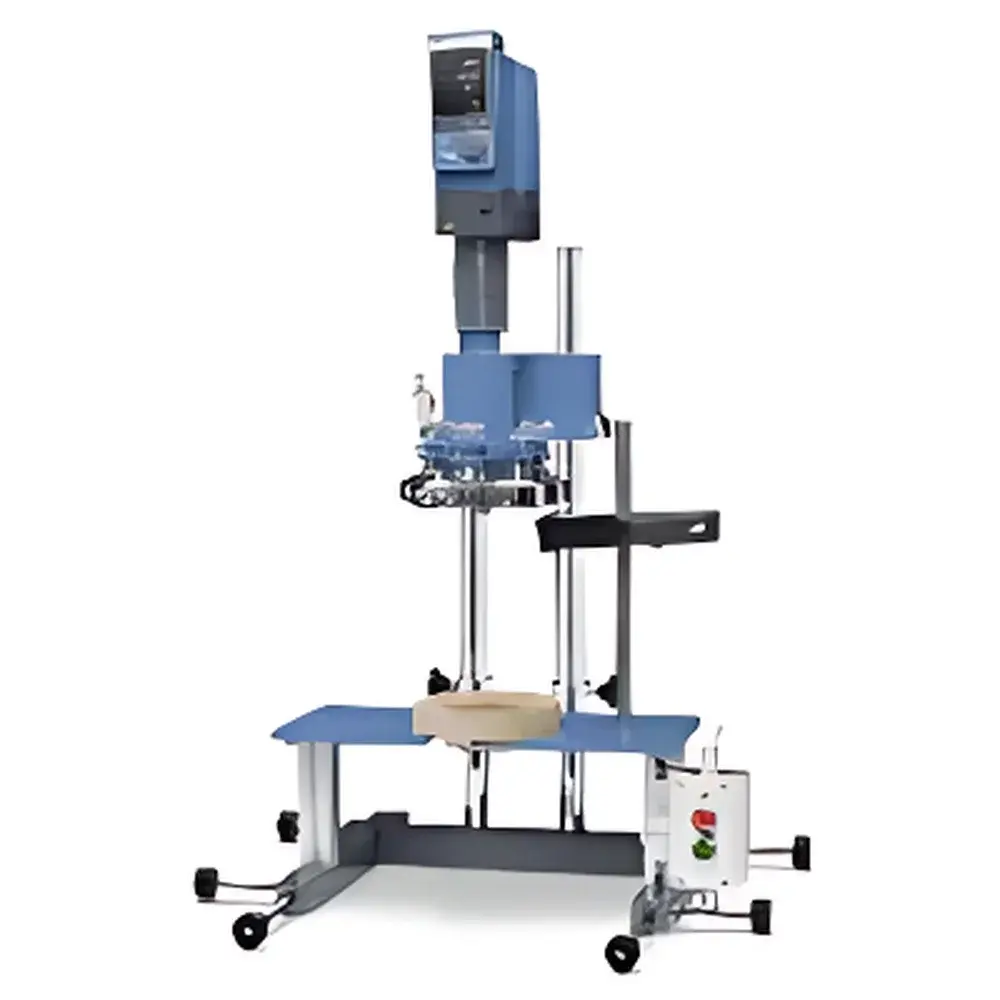
IKA LR-2.ST the High-Performer Modular Laboratory Reactor System
| Brand | IKA |
|---|---|
| Origin | Germany |
| Model | LR-2.ST the High-Performer |
| Usable Volume | 500–2000 mL |
| Temperature Range | Ambient to 230 °C |
| Vacuum Capability | Down to 25 mbar |
| Max. Viscosity Handling | 150,000 mPa·s |
| Speed Range | 8–290 rpm |
| Lifting Column Travel | 390 mm |
| Wetted Materials | Borosilicate Glass (DIN ISO 3585), FFPM, PTFE, Stainless Steel 1.4571 |
| Reactor Opening Configuration | 3× NS 29/32 + 2× NS 14/23 |
| Max. Stirring Torque | 660 N·cm |
| Dimensions (W×H×D) | 460 × 1240 × 430 mm |
| Weight | 25 kg |
| Ambient Operating Conditions | 5–40 °C, ≤80% RH |
Overview
The IKA LR-2.ST the High-Performer is a modular, vacuum-capable laboratory reactor system engineered for reproducible synthesis, reaction monitoring, and high-viscosity mixing under controlled thermal and mechanical conditions. Based on Couette-type shear principles, it integrates a high-torque overhead stirrer with a vertically adjustable lifting column and thermally stable glass-jacketed vessel architecture. Designed for scalable process development in fine chemical, pharmaceutical, and polymer R&D laboratories, the system supports continuous torque measurement as an indirect viscosity indicator—enabling real-time tracking of polymerization, curing, or precipitation kinetics without inline rheometry. Its rigid mechanical design accommodates extended operation at elevated temperatures and reduced pressure, making it suitable for solvent reflux, distillation, and moisture-sensitive reactions.
Key Features
- High-torque overhead drive (660 N·cm) with microprocessor-controlled speed regulation—maintains setpoint accuracy ±1% across full load range, even at low rpm (8 rpm minimum) and high viscosity (up to 150,000 mPa·s)
- Motorized lifting column with 390 mm vertical travel—enables precise positioning of stirrer shaft and accessories relative to vessel geometry; integrated limit switches prevent over-travel
- Vacuum-rated sealing system using perfluoroelastomer (FFPM) gaskets—chemically resistant to aggressive solvents (e.g., DMF, THF, chlorinated hydrocarbons) and thermally stable up to 230 °C
- Modular reactor head with five standardized ground-glass ports (3× NS 29/32, 2× NS 14/23)—supports simultaneous integration of temperature probes (Pt100), condensers, addition funnels, gas inlets, and ULTRA-TURRAX® dispersing tools
- Wireless controller (WiCo) with IP54 rating—enables full parameter control (speed, timer, torque display) from outside fume hoods, reducing operator exposure during hazardous reactions
- Borosilicate glass vessel (DIN ISO 3585 compliant) with jacketed double-wall construction—compatible with external heating/cooling circulators for precise temperature ramping and hold profiles
Sample Compatibility & Compliance
The LR-2.ST accommodates heterogeneous, viscous, and gas-evolving reaction mixtures—including slurries, emulsions, organometallic intermediates, and cross-linking prepolymers. All wetted surfaces comply with USP Class VI and FDA 21 CFR §177.2600 for repeated contact with pharmaceutical process streams. The FFPM seals meet ASTM D1418 classification for fluorocarbon elastomers and demonstrate no measurable extractables in GC-MS screening per ICH Q5C guidelines. System architecture supports GLP-compliant documentation when paired with optional IKA Labworldsoft™ data logging (audit trail, electronic signatures, and 21 CFR Part 11–ready configuration).
Software & Data Management
When connected via RS232 or USB to IKA Labworldsoft™ v5.x, the LR-2.ST enables time-synchronized recording of speed, torque, temperature (via optional Pt100 probe), and elapsed reaction time. Raw torque vs. time curves are exportable in CSV and Excel formats for post-processing in MATLAB or Python-based kinetic modeling workflows. The software supports user-defined method templates with parameter locks—ensuring consistent execution across operators and shifts. All data files include embedded metadata (operator ID, timestamp, instrument serial number) and support hash-based integrity verification for regulatory submissions.
Applications
- Kinetic studies of step-growth polymerizations (e.g., polyurethane, epoxy curing) via torque trend analysis
- Development of nanoparticle dispersions using integrated ULTRA-TURRAX® rotor-stator systems
- Process safety evaluation of exothermic nitration or Grignard reactions under controlled vacuum and cooling
- Crystallization screening with real-time supersaturation monitoring through viscosity inflection points
- Synthesis of battery electrolyte additives under inert atmosphere and reduced pressure
- Scale-down validation of pilot-plant batch processes in accordance with ASTM E2500-13 (good practice for scale-up)
FAQ
Can the LR-2.ST operate under inert gas blanket while maintaining vacuum integrity?
Yes—the dual-seal reactor head design allows simultaneous inert gas purging (via dedicated NS 14/23 port) and vacuum application (via separate vacuum port), with FFPM gaskets ensuring leak rates <1×10⁻⁴ mbar·L/s per DIN 28403.
Is torque data traceable for regulatory submission?
When configured with Labworldsoft™ and enabled audit trail settings, torque measurements are timestamped, digitally signed, and stored with immutable metadata—fully compliant with ALCOA+ principles for GMP environments.
What is the maximum allowable working pressure differential across the glass vessel?
The standard borosilicate glass vessel (DIN ISO 3585) is rated for 0.5 bar overpressure and 0.975 bar vacuum (25 mbar abs); optional reinforced vessels are available for higher differential applications.
Does the system support automated dosing integration?
Yes—two NS 29/32 ports are pre-configured for compatibility with IKA Digitronic™ peristaltic pumps or third-party syringe pump controllers via analog 0–10 V input.
How is temperature uniformity validated across the reaction volume?
IKA provides optional calibration certificates (DIN EN ISO/IEC 17025) verifying axial and radial temperature gradients ≤±0.8 K at 150 °C using calibrated Pt100 sensors at multiple vessel locations.



