
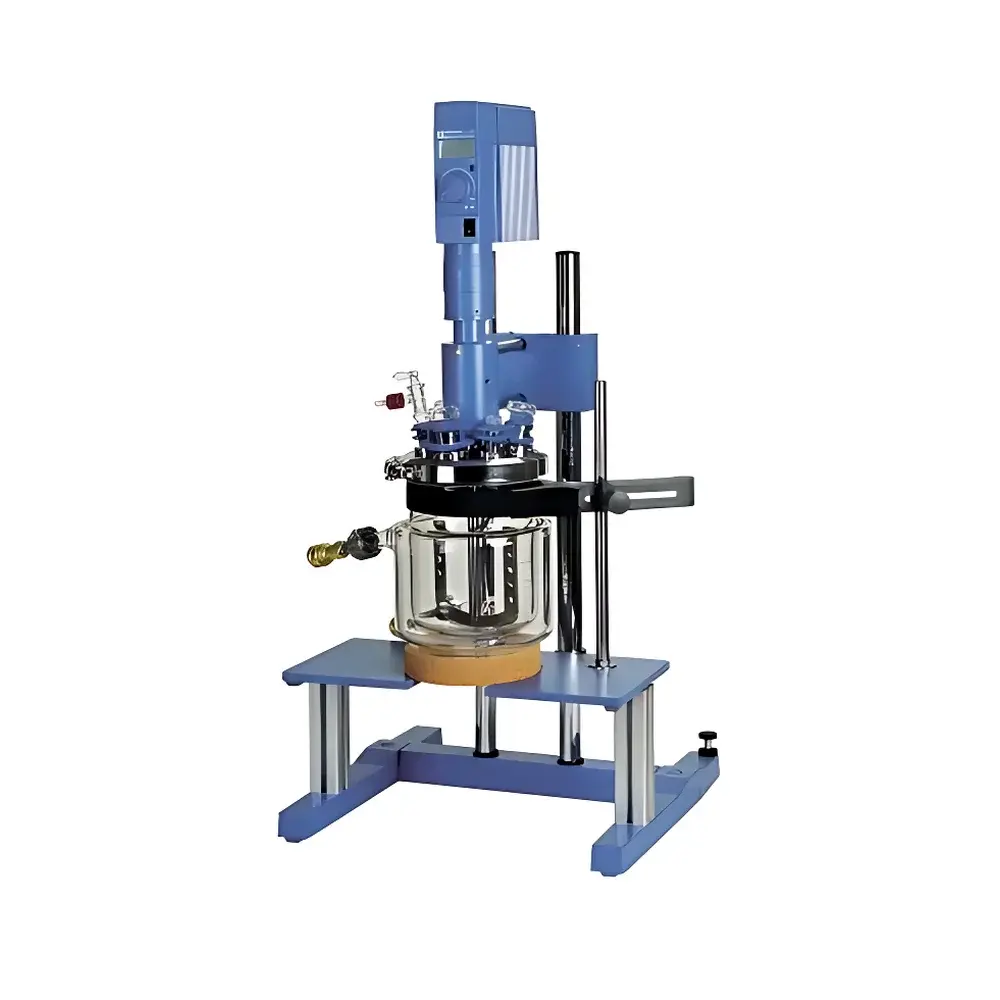
IKA LR-2.ST the High-Performer Modular Laboratory Reactor System
| Brand | IKA |
|---|---|
| Origin | Germany |
| Manufacturer Type | Direct Manufacturer |
| Origin Category | Imported |
| Model | LR-2.ST the High-Performer |
| Instrument Category | Laboratory Reactor |
| Usable Volume | 0.5–2 L |
| Vessel Material | Borosilicate Glass (DIN ISO 3585), Stainless Steel 1.4571 (AISI 316Ti), FFPM & PTFE Seals |
| Operating Pressure Range | Up to 6 bar (gauge), Down to 25 mbar (absolute vacuum) |
| Temperature Range | Ambient to +230 °C |
| Vacuum Capability | ≤25 mbar (absolute) |
| Max. Viscosity Handling | 150,000 mPa·s |
| Speed Range | 8–290 rpm |
| Torque-Controlled Speed Stability | Microprocessor-regulated, load-compensated |
| Vertical Travel of Lifting Column | 390 mm |
| Port Configuration | 3 × NS 29/32, 2 × NS 14/23 |
| Dimensions (W×H×D) | 460 × 1240 × 430 mm |
| Weight | 25 kg |
| Ambient Operating Conditions | 5–40 °C, ≤80 % RH (non-condensing) |
| Power Supply | 115 V, 50/60 Hz |
| Compliance | CE, UL Listed, Designed per EN 61000-6-2 / EN 61000-6-4 |
Overview
The IKA LR-2.ST the High-Performer is a fully modular, benchtop-scale laboratory reactor system engineered for reproducible execution and optimization of chemical synthesis, catalytic reactions, polymerization, crystallization, and high-viscosity mixing under controlled temperature, pressure, and vacuum conditions. Built upon IKA’s long-standing expertise in precision drive technology and process safety, the system integrates a robust EUROSTAR 200 control-type P4 overhead stirrer with enhanced torque transmission—capable of sustaining stable rotational speed even under dynamically increasing viscosity or sudden load changes. Its core architecture follows a Couette-type mixing principle, where shear rate and power input are precisely governed by impeller geometry, rotational velocity, and fluid rheology. The reactor vessel—constructed from DIN-certified borosilicate glass (ISO 3585)—provides optical clarity for real-time reaction monitoring, while all wetted seals employ chemically inert FFPM (perfluoroelastomer) and PTFE, ensuring compatibility with aggressive solvents, strong acids/bases, and elevated temperatures up to 230 °C. Vacuum operation down to 25 mbar absolute enables solvent removal, degassing, and low-boiling-point reaction control without thermal decomposition.
Key Features
- Modular port-based design with five standardized ground-glass joints (3 × NS 29/32, 2 × NS 14/23) for flexible integration of temperature probes, pH electrodes, condensers, dosing units, gas inlets, or ULTRA-TURRAX® dispersing tools
- Microprocessor-controlled speed regulation with active torque compensation—maintains set rpm within ±1 rpm across viscosity ranges from <10 to 150,000 mPa·s
- Motorized lifting column with 390 mm vertical travel and mechanical safety lock—enables precise positioning of stirrer shaft and easy vessel access
- WiCo wireless controller (included) allows full parameter adjustment—including speed, direction, timer, and safety lock status—from outside fume hoods or behind shielding, compliant with lab ergonomics and containment protocols
- Integrated safety interlock system: automatic motor shutdown upon lid removal or pressure/vacuum threshold breach; dual redundant temperature cutoff at 250 °C
- All contact materials conform to USP Class VI and FDA 21 CFR 177.2600 specifications—validated for GMP-aligned process development and QC batch documentation
Sample Compatibility & Compliance
The LR-2.ST accommodates liquid, slurry, and heterogeneous reaction mixtures within its 0.5–2 L usable volume range. Its borosilicate glass vessel exhibits exceptional thermal shock resistance (ΔT = 120 K) and UV transparency for photochemical applications. FFPM gaskets retain sealing integrity across −10 °C to +230 °C and resist swelling in chlorinated hydrocarbons, DMF, DMSO, and concentrated HNO₃/H₂SO₄. The system meets EN 61010-1 (Safety Requirements for Electrical Equipment for Measurement, Control, and Laboratory Use) and carries CE marking under the EU Machinery Directive 2006/42/EC. It supports audit-ready operation under GLP and GMP frameworks via optional data logging modules compatible with 21 CFR Part 11-compliant software platforms.
Software & Data Management
While the base LR-2.ST operates via standalone WiCo interface, it is natively compatible with IKA’s Labworldsoft® v5.0 platform (optional). This validated software enables synchronized acquisition of torque, speed, temperature, and time-stamped event logs—including start/stop commands, safety triggers, and manual interventions. All datasets are exported in CSV and PDF formats with embedded digital signatures, supporting traceability requirements per ISO/IEC 17025 and ASTM E2500-15. Remote monitoring via Ethernet or USB is supported, and alarm thresholds can be configured for out-of-specification deviations during unattended overnight runs.
Applications
- Process development of API intermediates under reflux, hydrogenation, or anhydrous Grignard conditions
- Kinetic profiling of exothermic nitration or epoxidation reactions using real-time torque-derived power consumption trends
- Viscosity-driven endpoint detection in polycondensation (e.g., PET, polycarbonate) and emulsion polymerization
- Solvent-free mechanochemical synthesis using high-shear dispersion attachments
- Crystallization screening under controlled supersaturation via simultaneous cooling and agitation
- Scale-down validation for pilot-plant reactors (1:10 to 1:50 geometric similarity maintained)
FAQ
What is the maximum allowable working pressure for the LR-2.ST reactor vessel?
The standard borosilicate glass vessel is rated for operation up to 0.6 bar(g) at 230 °C. For higher-pressure applications, stainless steel 1.4571 vessels (optional) are available with ASME Section VIII Div. 1 certification up to 10 bar(g).
Can the system be used for moisture-sensitive reactions under inert atmosphere?
Yes—the sealed port configuration supports continuous N₂ or Ar purging via mass flow controller integration; residual O₂ levels <10 ppm are routinely achieved using triple-purge protocols.
Is torque measurement traceable to national standards?
Torque sensing is factory-calibrated against PTB-traceable reference transducers (DAkkS-accredited calibration certificate available upon request).
Does the WiCo controller support multi-user access control?
Not in standalone mode; however, when connected to Labworldsoft®, role-based permissions (operator, supervisor, administrator) and electronic signature workflows comply with 21 CFR Part 11 Annex 11 requirements.
What maintenance intervals are recommended for long-term reliability?
Annual verification of seal compression force, stirrer shaft runout (<0.05 mm), and motor encoder linearity is advised. Full preventive maintenance kits—including FFPM gasket sets and PTFE bushings—are available under IKA part number 3012000.



