
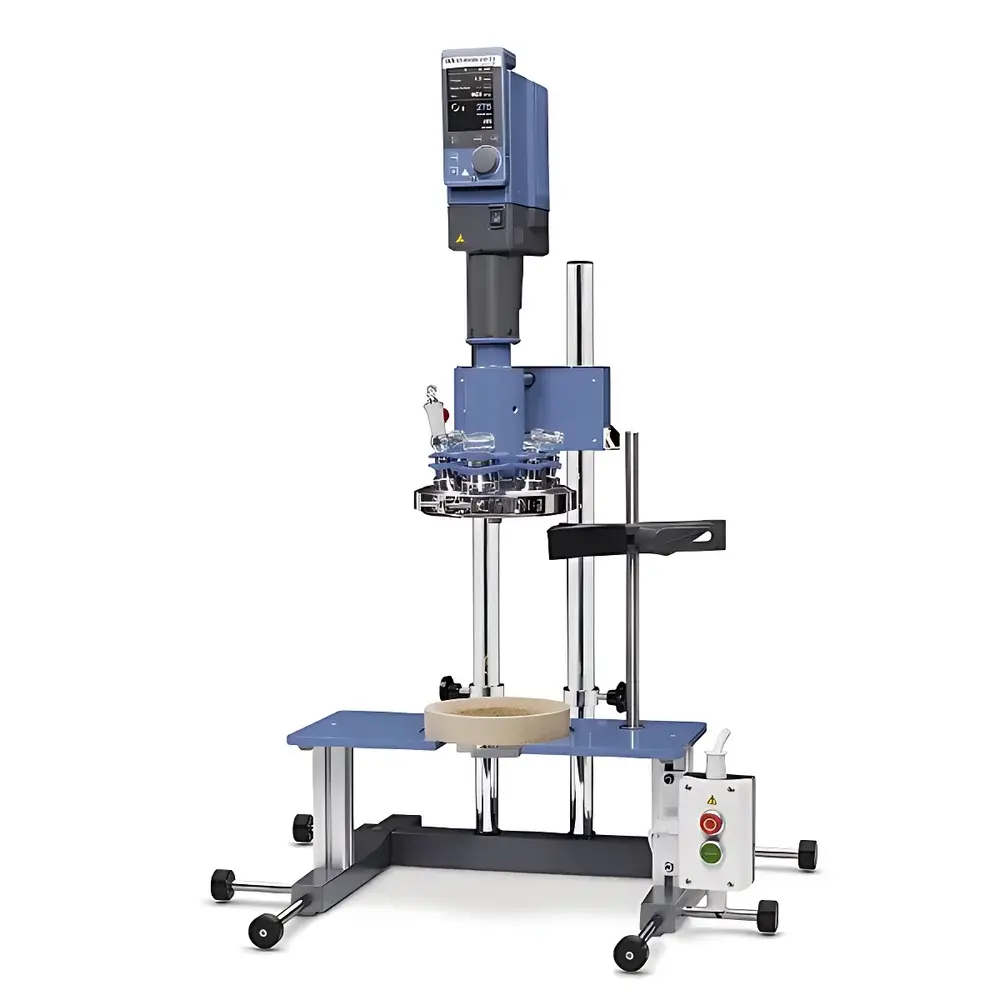
IKA LR-2.ST Starvisc 200 Modular Laboratory Reactor with Integrated Torque-Based Viscosity Monitoring
| Brand | IKA |
|---|---|
| Origin | Germany |
| Model | LR-2.ST Starvisc 200 |
| Working Volume | 500–2000 mL |
| Temperature Range | Ambient to 230 °C |
| Vacuum Capability | Down to 25 mbar |
| Max. Viscosity | 100,000 mPa·s |
| Min. Agitation Speed | 6 rpm |
| Lift Stroke | 390 mm |
| Stirring Shaft Max. Torque | 200 N·cm |
| Wetted Materials | Borosilicate Glass (DIN ISO 3585), FFPM, PTFE, Stainless Steel 1.4571 |
| Reactor Opening Configuration | 3× NS 29/32 + 2× NS 14/23 |
| Dimensions (W×H×D) | 460 × 1240 × 430 mm |
| Weight | 25 kg |
| Ambient Operating Conditions | 5–40 °C, ≤80 % RH |
Overview
The IKA LR-2.ST Starvisc 200 is a modular, benchtop laboratory reactor engineered for precise control and real-time monitoring of high-viscosity chemical reactions, polymerizations, emulsification, and suspension processes. Unlike conventional stirred reactors, the LR-2.ST integrates a dedicated Starvisc 200-2.5control torque measurement system directly into the drive head—enabling continuous, load-independent quantification of dynamic torque during operation. Since viscosity (η) in rotational systems is linearly proportional to torque (τ) under defined geometry and shear rate (γ̇), the instrument computes and displays real-time apparent viscosity (in mPa·s) using calibrated hydrodynamic models aligned with ISO 2555 and ASTM D2196 principles. This architecture eliminates reliance on external viscometers or post-hoc rheological analysis, making it particularly valuable for kinetic studies where viscosity evolution correlates directly with reaction progress (e.g., epoxy curing, polycondensation, or solvent-free resin synthesis).
Key Features
- Integrated Starvisc 200-2.5control torque sensor providing direct, high-resolution torque measurement (0.1–200 N·cm) and derived viscosity output (1–100,000 mPa·s) with <±2% full-scale accuracy under steady-state conditions
- Modular reactor head accommodating up to five standardized ground-glass ports (3× NS 29/32, 2× NS 14/23) for simultaneous integration of temperature probes, reflux condensers, dosing units, pH electrodes, or T25 high-shear dispersers
- Motor-driven vertical lift mechanism with 390 mm stroke and position memory, enabling reproducible vessel access and safe handling of hot or vacuum-loaded vessels
- Chemically inert wetted path comprising borosilicate glass 3.3 (DIN ISO 3585), perfluoroelastomer (FFPM) sealing gaskets rated to 230 °C and resistant to aggressive solvents (e.g., chlorinated hydrocarbons, strong acids/bases), and electropolished stainless steel 1.4571 (AISI 316L equivalent) components
- Microprocessor-controlled speed regulation (6–250 rpm, 0.1 rpm resolution) with automatic load compensation to maintain setpoint stability across viscosity jumps exceeding two orders of magnitude
- Wireless WiCo controller supporting remote operation outside fume hoods, with configurable alarm thresholds for torque overload, temperature deviation, or lift limit breach
Sample Compatibility & Compliance
The LR-2.ST Starvisc 200 supports heterogeneous, non-Newtonian, and thermally sensitive systems—including organometallic catalyst slurries, silicone prepolymers, lithium battery electrode pastes, and pharmaceutical suspensions. Its sealed, vacuum-rated design (25 mbar ultimate pressure) enables solvent removal, inert-atmosphere reactions (N₂/Ar), and low-boiling-point reagent additions. All materials comply with USP Class VI and FDA 21 CFR 177.2600 for indirect food contact; FFPM gaskets meet ASTM D1418 classification for fluorocarbon elastomers. The system architecture supports GLP-compliant data integrity when paired with IKA Labworldsoft v5.x, including electronic signatures, audit trails, and user-level access control per 21 CFR Part 11 requirements.
Software & Data Management
Labworldsoft v5.x (included) provides synchronized acquisition of torque, temperature, speed, lift position, and time-stamped event markers (e.g., “dosing started”, “cooling initiated”). Raw torque vs. time datasets are exportable in CSV and .xlsx formats; viscosity curves may be overlaid with thermal profiles to identify gel points, vitrification events, or exotherm onset. The software supports automated method templates—reducing operator variability in multi-step protocols—and generates PDF reports compliant with internal SOPs or external regulatory submissions. Data encryption at rest and role-based permissions ensure traceability in QA/QC environments.
Applications
- Development and scale-up of high-viscosity polymer synthesis (polyurethanes, silicones, acrylics)
- In-process monitoring of curing kinetics in thermoset resins and composites
- Optimization of nanoparticle dispersion stability in non-aqueous media
- Controlled precipitation and crystallization under reduced pressure
- Batch consistency validation for pharmaceutical ointments and topical gels
- Reaction calorimetry proxy via torque-derived power input (when combined with calibrated jacket temperature profiles)
FAQ
Can the Starvisc 200 measure absolute viscosity without calibration against a reference fluid?
No. While the system delivers highly reproducible relative torque trends, absolute viscosity values require geometric calibration using Newtonian standards (e.g., silicone oils traceable to NIST SRM 2490) per ISO 16520 Annex A.
Is the reactor compatible with corrosive halogenated solvents such as chloroform or carbon tetrachloride?
Yes—FFPM gaskets and borosilicate glass provide resistance to these solvents; however, prolonged exposure to liquid bromine or anhydrous HF is not recommended.
Does the lift mechanism support automated sequencing in unattended runs?
The lift is manually triggered or controlled via WiCo; programmable lift automation requires optional Labworldsoft Advanced Sequencing Module.
What is the maximum allowable pressure differential across the reactor lid during vacuum operation?
The standard glass vessel and FFPM seal assembly are rated for ≤0.1 bar overpressure and ≤0.975 bar vacuum (25 mbar abs), consistent with DIN 28120 Class I safety classification.
How frequently should torque sensor zeroing be performed?
Zero calibration is recommended before each experimental series and after ambient temperature shifts >5 °C; the procedure is guided within Labworldsoft and takes <30 seconds.
Related Products



