
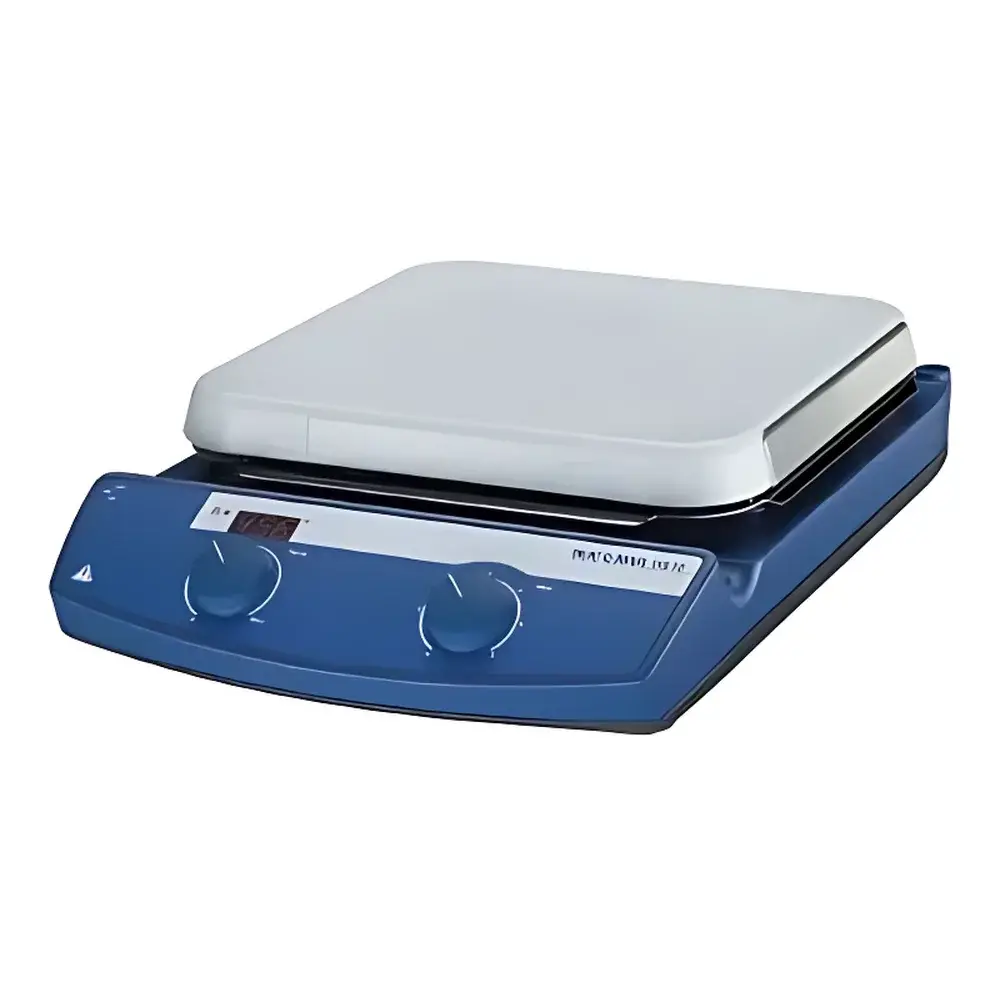
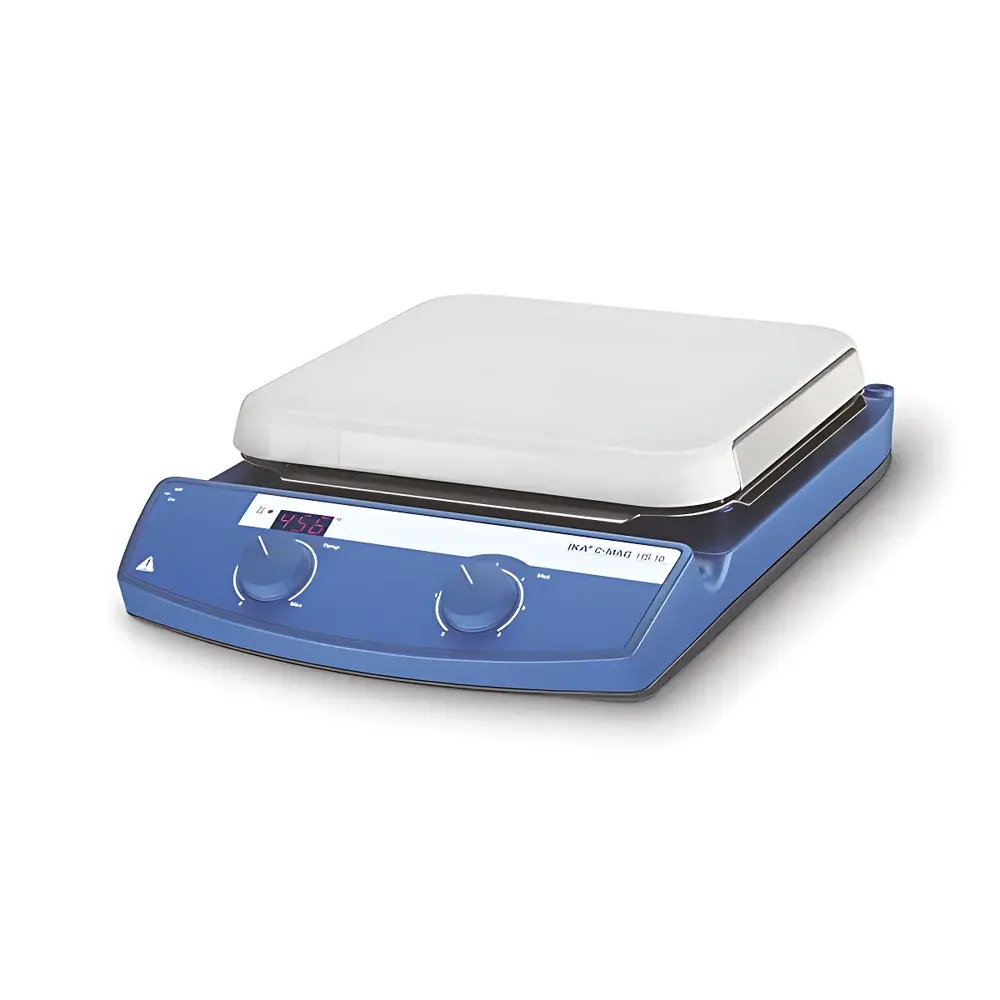
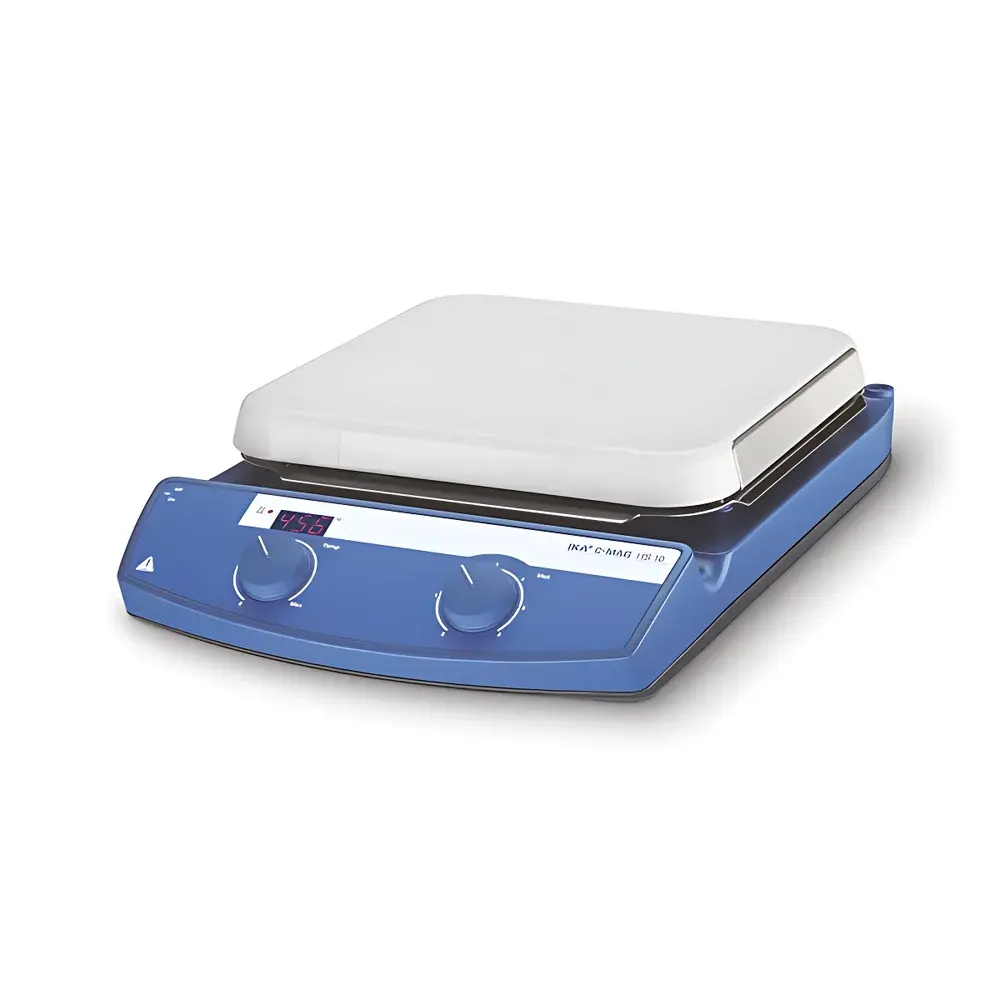
IKA C-MAG HS 10 Magnetic Stirrer with Hotplate
| Brand | IKA |
|---|---|
| Origin | Germany |
| Manufacturer | IKA-Werke GmbH & Co. KG |
| Model | C-MAG HS 10 |
| Stirrer Type | Magnetic Stirrer |
| Max. Stirring Volume (H₂O) | 15 L |
| Speed Range | 100–1500 rpm |
| Heating Temperature Range | 50–500 °C |
| Heating Power | 1500 W |
| Plate Material | Ceramic |
| Plate Dimensions | 260 × 260 mm |
| Safety Cut-off | 550 °C |
| IP Rating | IP21 |
| Input Voltage | 230/120/100 V, 50/60 Hz |
| Weight | 6 kg |
| Ambient Operating Conditions | 5–40 °C, ≤80 % RH |
Overview
The IKA C-MAG HS 10 is a high-performance magnetic stirrer and hotplate system engineered for precision thermal mixing in research laboratories, quality control environments, and industrial R&D settings. Combining robust heating capability with digitally regulated stirring, the unit operates on the principle of electromagnetic induction to drive PTFE- or glass-coated stir bars within vessels—enabling homogeneous temperature distribution and consistent shear delivery without mechanical shaft penetration. Its ceramic heating plate provides rapid thermal response and exceptional resistance to chemical degradation, while the microprocessor-controlled feedback loop continuously monitors both motor speed and surface temperature to maintain setpoint stability under variable load conditions. Designed for reproducible method execution, the C-MAG HS 10 supports GLP-compliant workflows through stable parameter retention and intrinsic safety features including overtemperature cutoff and visual thermal status indication.
Key Features
- Ceramic heating plate (260 × 260 mm) with seamless construction for superior chemical resistance and long-term thermal uniformity
- Digital speed control (100–1500 rpm) with analog dial interface and real-time rpm display for repeatable agitation protocols
- Heating range from 50 °C to 500 °C with ±10 K accuracy; heating rate of ~5 K/min for 1 L water (in standard H15 vessel)
- Integrated safety circuit terminating heating at 550 °C to prevent thermal runaway or plate damage
- Elevated control panel design minimizing liquid splash exposure and improving ergonomics during operation
- Microprocessor-based regulation ensuring constant rotational speed regardless of viscosity changes or load fluctuations
- Compatibility with external temperature sensors (e.g., ETS-D5 contact probe) for solution-phase temperature feedback control (optional accessory)
- IP21 ingress protection rating for safe use in standard laboratory environments with moderate humidity and particulate exposure
Sample Compatibility & Compliance
The C-MAG HS 10 accommodates standard laboratory glassware including beakers, flasks, and crystallization dishes up to 15 L volume (water-equivalent), supporting stir bar lengths up to 80 mm. Its chemically inert ceramic surface resists attack from common solvents, acids, and bases—making it suitable for applications involving organic synthesis, buffer preparation, dissolution testing, and catalyst activation. The device conforms to DIN EN 60529 (IP21), IEC 61010-1 (safety requirements for electrical equipment), and EU Directive 2014/30/EU (EMC). While not intrinsically certified for hazardous area use, its design aligns with general laboratory safety best practices recommended by ISO/IEC 17025-accredited facilities. No built-in audit trail or electronic signature functionality is provided; however, manual parameter logging satisfies basic GLP documentation requirements when paired with standardized SOPs.
Software & Data Management
The C-MAG HS 10 operates as a standalone instrument with no embedded software, network interface, or data export capability. All operational parameters—including speed setting, target temperature, and real-time status indicators—are managed via front-panel controls and LED displays. For traceable temperature monitoring, users may connect an optional ETS-D5 electronic contact thermometer (sold separately) to enable closed-loop solution temperature regulation. This analog feedback integration does not generate electronic records but allows improved thermal consistency across replicate experiments. Laboratories requiring 21 CFR Part 11 compliance must implement external data capture systems (e.g., validated chart recorders or SCADA interfaces) if digital archiving is mandated by internal QA policy or regulatory jurisdiction.
Applications
- Precise heating and homogenization during synthesis of polymers, nanoparticles, and metal-organic frameworks (MOFs)
- Dissolution studies per USP using calibrated vessels and defined stir bar geometry
- Buffer equilibration and reagent warming prior to chromatographic or spectroscopic analysis
- Cell culture media preparation under controlled thermal conditions to preserve growth factor integrity
- Viscosity-dependent reaction kinetics where consistent shear input is critical to pathway selectivity
- Calibration of temperature-sensitive sensors and reference standards in metrology labs
FAQ
Can the C-MAG HS 10 be used with non-magnetic or oversized vessels?
No—the unit requires ferromagnetic or magnetically responsive stir bars placed within diamagnetic containers (e.g., borosilicate glass, PP, PTFE). Vessels with thick walls or metallic shielding will impair coupling efficiency.
Is external temperature control possible without the ETS-D5 probe?
Only surface temperature is actively regulated. Solution-phase temperature control requires the optional ETS-D5 or compatible Pt100 sensor connected via the rear-mounted analog input port.
What maintenance is required for long-term reliability?
Routine cleaning of the ceramic plate with non-abrasive, pH-neutral cleaners; periodic inspection of stir bar integrity; and verification of calibration against NIST-traceable references every 6–12 months per lab quality protocol.
Does the unit support programmable ramp-soak profiles?
No—this model lacks time-based programming. It maintains only static setpoints for speed and temperature.
How does the safety cut-off interact with external probe control?
The 550 °C hardware limit remains active regardless of sensor input; it functions independently as a fail-safe mechanism overriding all control logic.
Related Products



