
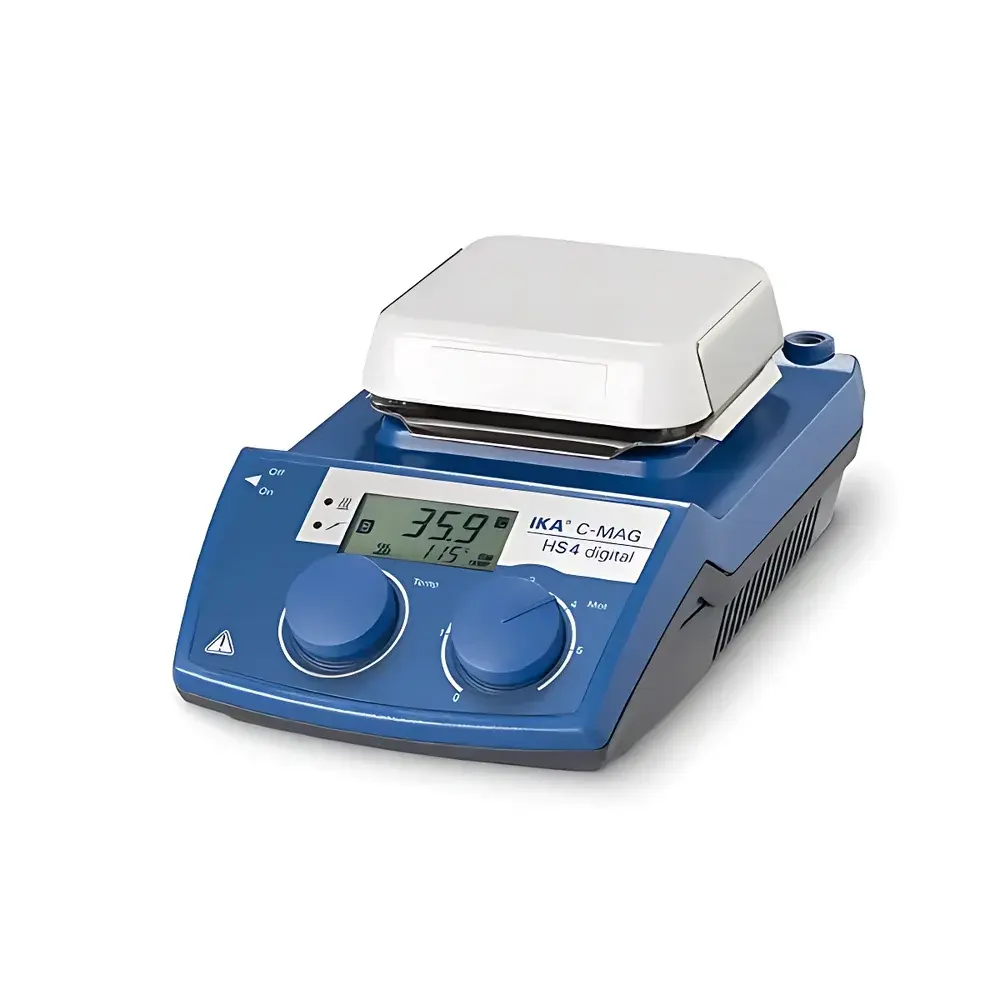
IKA C-MAG HS 4 digital Magnetic Stirrer
| Brand | IKA |
|---|---|
| Origin | Germany |
| Model | C-MAG HS 4 digital |
| Max. Stirring Volume (H₂O) | 5 L |
| Motor Output Power | 1.5 W |
| Rotation Direction | Counter-Clockwise |
| Speed Control | 6-step dial |
| Speed Range | 100–1500 rpm |
| Max. Stir Bar Length | 30 mm |
| Heating Power | 250 W |
| Heating Temperature Range | 50–500 °C |
| Heating Rate | 2.5 K/min |
| Plate Temperature Setting Accuracy | ±5 K |
| External Temperature Sensor Interface | PT1000 |
| Fixed Safety Cut-off Temperature | 550 °C |
| Working Plate Material | Ceramic |
| Plate Dimensions | 100 × 100 mm |
| Overall Dimensions | 150 × 105 × 260 mm |
| Weight | 3.566 kg |
| Ambient Operating Temperature | 5–40 °C |
| Relative Humidity Limit | 80 % |
| Protection Class | IP21 (DIN EN 60529) |
| Voltage | 230 V |
| Frequency | 50/60 Hz |
| Total Input Power | 270 W |
| Temperature Display | Dual LCD (setpoint & actual) |
| Media Temperature Accuracy (with PT1000) | ±0.5 K |
| Media Temperature Resolution (with PT1000) | 0.1 K |
| Operating Modes | Standard / Safety / Lock |
Overview
The IKA C-MAG HS 4 digital is a high-performance, digitally controlled magnetic stirrer with integrated heating functionality, engineered for precision, safety, and long-term reliability in demanding laboratory environments. Designed around a robust ceramic heating plate and a thermally optimized permanent magnet drive system, it operates on the principle of magnetic coupling—where rotation of an internal rotating magnet induces torque in a ferromagnetic stir bar immersed in the sample. This non-contact mixing mechanism eliminates mechanical wear and ensures contamination-free operation. The unit features independent thermal regulation via a built-in ceramic heating element and supports external feedback control using a PT1000 resistance temperature detector (RTD), enabling direct monitoring and regulation of the sample’s actual temperature—not just the plate surface. Its compact footprint, sealed ceramic surface (chemically inert to most organic solvents, acids, and bases), and compliance with DIN EN 60529 (IP21) make it suitable for routine QC testing, synthetic chemistry workflows, buffer preparation, and stability studies under GLP-aligned conditions.
Key Features
- Seamless ceramic heating plate offering exceptional chemical resistance and thermal stability—resistant to scratches, corrosion, and thermal shock
- Dual LCD display showing both setpoint and real-time temperature simultaneously, with 0.1 K resolution when paired with PT1000 sensor
- Three configurable operating modes: Standard (full parameter access), Safety (prevents accidental setting changes), and Lock (panel input disabled during operation)
- Integrated fixed-temperature safety cut-off at 550 °C, independent of sensor input, providing hardware-level thermal protection
- Elevated control panel design minimizes risk of liquid ingress during vigorous stirring or spill events
- Visual thermal warning system: LED indicator blinks during active heating to alert users of elevated plate surface temperature
- Error code diagnostics displayed numerically on the LCD for rapid troubleshooting (e.g., sensor fault, overtemperature, motor stall)
- Optimized motor architecture delivering consistent torque up to 1500 rpm—even at maximum load (5 L H₂O) and elevated temperatures
Sample Compatibility & Compliance
The C-MAG HS 4 digital accommodates standard laboratory glassware (e.g., beakers, flasks, reaction vessels) up to 5 L volume, provided appropriate stir bar geometry (≤30 mm length) and viscosity range are observed. Its ceramic plate is compatible with aqueous solutions, alcohols, acetone, dilute mineral acids (e.g., HCl, HNO₃), and common organic solvents. It is not recommended for use with hydrofluoric acid or molten alkali metals. From a regulatory standpoint, the instrument meets CE marking requirements and conforms to DIN EN 61010-1 (Safety Requirements for Electrical Equipment for Measurement, Control, and Laboratory Use). While not inherently 21 CFR Part 11 compliant, its digital interface supports integration into validated systems when used with audit-trail-capable LIMS or ELN platforms. Temperature logging with external PT1000 enables traceable calibration per ISO/IEC 17025 guidelines.
Software & Data Management
This model operates as a standalone instrument without embedded firmware-based data export or PC connectivity. However, its analog-compatible PT1000 interface allows connection to third-party data acquisition systems (e.g., LabVIEW, MATLAB, or PLC-based controllers) for continuous temperature logging and process documentation. When deployed in regulated environments, users may implement procedural controls—including written SOPs for calibration frequency (recommended annually), verification of temperature uniformity across the plate (using NIST-traceable thermocouples), and documented verification of safety cut-off function. The device retains no internal memory or user history, aligning with minimal-data-retention principles in GxP settings.
Applications
- Precise temperature-controlled dissolution and homogenization in pharmaceutical formulation development
- Heating and mixing during titration reagent preparation and standard solution conditioning
- Controlled synthesis reactions requiring stable thermal profiles and consistent agitation (e.g., esterification, condensation)
- Cell culture media warming and buffer equilibration prior to sterile filtration
- Accelerated stability testing where defined ramp-and-hold thermal cycles are applied to samples
- Environmental testing labs performing EPA-compliant digestion protocols (e.g., TCLP extraction)
FAQ
Does the C-MAG HS 4 digital support RS232 or USB communication?
No—this is a stand-alone analog/digital hybrid instrument without serial or digital communication ports.
Can the PT1000 sensor be calibrated independently?
Yes—the sensor must be calibrated separately using a reference thermometer traceable to national standards; IKA provides calibration certificates upon request.
What is the maximum viscosity this stirrer can handle at 1500 rpm?
Performance depends on stir bar geometry and vessel shape; for Newtonian fluids, typical upper limit is ~500 mPa·s at full speed and 5 L volume.
Is the ceramic plate resistant to sodium hydroxide solutions?
Yes—standard 1–5 M NaOH solutions do not degrade the plate over short-term exposure (<2 hours); prolonged contact above 80 °C is not advised.
How often should the safety cut-off function be verified?
Per IKA recommendations, functional verification should occur before each new experimental series involving >300 °C setpoints or extended heating cycles.



