
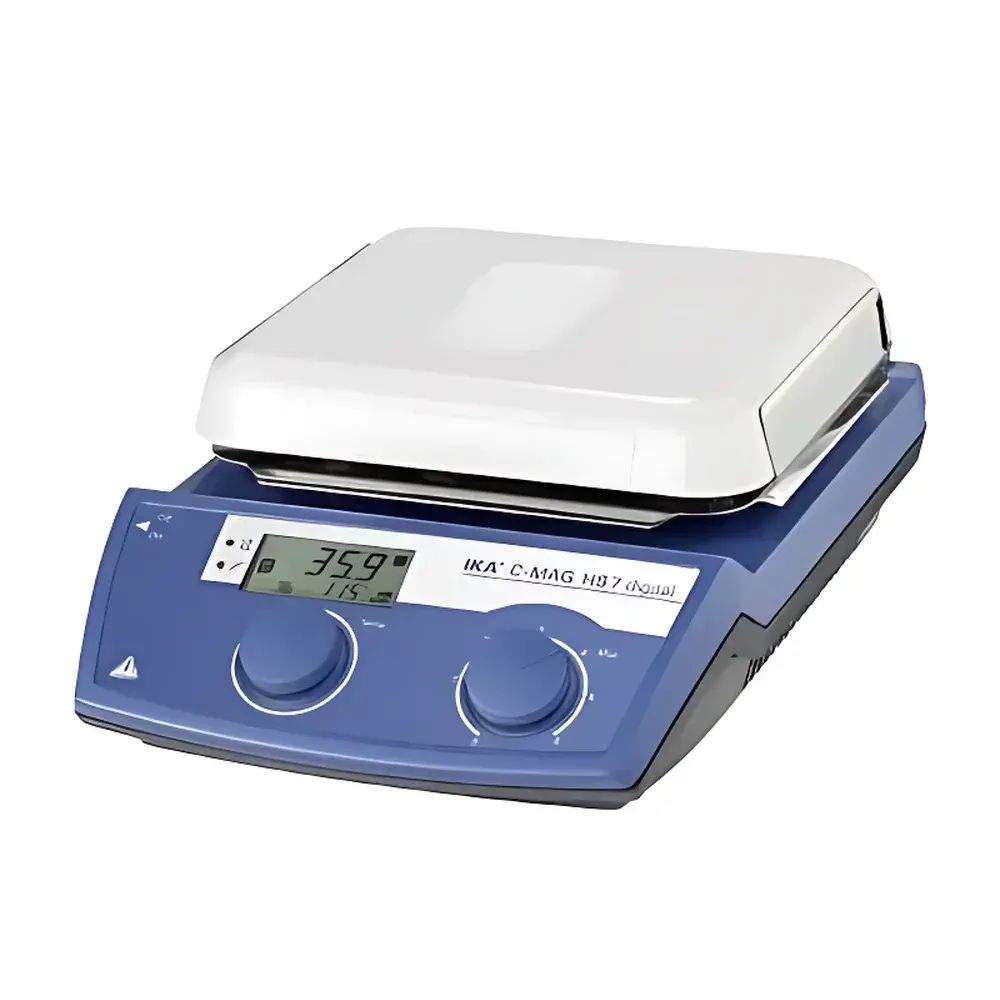
IKA C-MAG HS 7 Digital Magnetic Hotplate Stirrer
| Brand | IKA |
|---|---|
| Origin | Germany |
| Manufacturer | IKA-Werke GmbH & Co. KG |
| Product Type | Digital Magnetic Hotplate Stirrer |
| Model | C-MAG HS 7 digital |
| Maximum Stirring Volume (H₂O) | 10 L |
| Speed Range | 100–1500 rpm |
| Heating Temperature Range | 50–500 °C |
| Heating Power | 1000 W |
| Motor Output Power | 1.5 W |
| Plate Material | Seamless Ceramic |
| Plate Dimensions | 180 × 180 mm |
| Safety Cut-off Temperature | 550 °C |
| External Temperature Sensor Interface | ETS-D5 compatible |
| IP Rating | IP21 |
| Input Voltage | 230 / 120 / 100 V, 50/60 Hz |
| Power Consumption | 1020 W |
| Net Weight | 5 kg |
| Operating Ambient | 5–40 °C, ≤80% RH |
Overview
The IKA C-MAG HS 7 Digital Magnetic Hotplate Stirrer is an integrated laboratory heating and stirring system engineered for precision, repeatability, and operational safety in demanding routine and research applications. Based on the proven Couette flow principle, it employs a rotating magnetic field generated beneath a chemically inert ceramic plate to drive PTFE- or glass-coated stir bars within vessels—enabling homogeneous mixing without mechanical shaft penetration. Simultaneously, resistive heating elements embedded in the plate deliver stable thermal energy across the full 50–500 °C range, with microprocessor-regulated feedback control ensuring minimal temperature deviation over time. Designed and manufactured in Staufen, Germany, the unit complies with IEC 61010-1 for electrical safety and conforms to DIN EN 60529 (IP21) for protection against solid objects and vertically dripping water—making it suitable for standard analytical, synthetic, and quality control laboratories operating under GLP or ISO/IEC 17025 frameworks.
Key Features
- Seamless one-piece ceramic working surface offering exceptional resistance to acids, alkalis, solvents, and thermal shock—eliminating crevices where reagents could accumulate or degrade performance.
- Dual independent digital control loops: one for precise speed regulation (100–1500 rpm, resolution ±10 rpm), and another for heating (50–500 °C, resolution ±1 °C), both governed by real-time sensor feedback.
- Integrated safety architecture including hardware-based thermal cut-off at 550 °C, visual LED warning indicators during active heating, and elevated control panel design to minimize liquid ingress risk from splashes.
- High-torque brushless motor delivering consistent rotational force even with viscous media (e.g., polymer solutions, cell culture media, or concentrated suspensions), supporting reliable stirring of up to 10 L of water-equivalent volume.
- External temperature probe interface (ETS-D5 compatible) enables closed-loop solution temperature control—critical for reaction kinetics studies, crystallization protocols, or USP compounding environments requiring strict thermal validation.
- Compact footprint (220 × 105 × 330 mm) and low mass (5 kg) facilitate benchtop deployment in fume hoods, cleanrooms, or modular lab setups without compromising stability or heat dissipation efficiency.
Sample Compatibility & Compliance
The C-MAG HS 7 accommodates standard round-bottom flasks, beakers, and jacketed reactors ranging from 50 mL to 10 L capacity. Stir bar compatibility extends to lengths up to 80 mm, supporting both standard cross-shaped and elliptical geometries for optimal vortex formation. Its ceramic plate surface remains inert toward common laboratory reagents including concentrated HNO₃, NaOH (up to 40%), and organic solvents such as acetone, ethanol, and chloroform—validated per ISO 8502-1 corrosion resistance testing. The device meets CE marking requirements and adheres to essential health and safety provisions outlined in the EU Machinery Directive 2006/42/EC. For regulated environments, its fixed safety temperature limit and non-volatile memory settings support audit readiness under FDA 21 CFR Part 11 when used in conjunction with validated procedural documentation.
Software & Data Management
While the C-MAG HS 7 operates as a standalone instrument with no built-in data logging or PC connectivity, its analog/digital hybrid architecture ensures deterministic behavior under continuous operation—ideal for SOP-driven workflows where parameter reproducibility is prioritized over telemetry. Settings are retained after power cycling, and the LED display provides unambiguous real-time readouts of setpoint and actual values for both speed and plate temperature. When paired with the optional ETS-D5 electronic contact thermometer, users achieve traceable solution temperature control compliant with ASTM E2465 and ISO 17025 clause 5.8.1 for measurement uncertainty management. All calibration procedures—including speed verification using certified tachometers and thermal mapping via PT100 probes—follow manufacturer-recommended intervals and can be documented within internal QA systems.
Applications
- Controlled heating and homogenization of aqueous and organic reaction mixtures in synthetic organic chemistry.
- Buffer preparation and pH adjustment in molecular biology workflows requiring thermal stability during titration.
- Dissolution testing of pharmaceutical dosage forms per USP , particularly when combined with external temperature monitoring.
- Preparation of calibration standards and reference materials in environmental and food testing labs accredited to ISO/IEC 17025.
- Cell culture media warming and suspension maintenance prior to inoculation in microbiology and bioprocessing labs.
- Viscosity assessment pre-conditioning steps where sample thermal history must be tightly controlled before rheometric analysis.
FAQ
Is the C-MAG HS 7 compatible with non-IKA stir bars?
Yes—the unit generates a strong, uniform magnetic field optimized for standard PTFE- or glass-coated stir bars up to 80 mm in length; however, optimal torque transfer is achieved with IKA-certified bars due to precise magnetic moment alignment.
Can the heating plate temperature be calibrated independently of the solution temperature?
Yes—plate temperature calibration follows IKA’s recommended procedure using a traceable surface-contact thermometer; solution temperature calibration requires integration of the ETS-D5 probe and separate validation against a reference standard.
Does the device support programmable ramp-soak profiles?
No—the C-MAG HS 7 features manual setpoint control only; for automated thermal profiling, consider the IKA RCT basic or IKA HS 7 control series with RS232/USB interfaces.
What maintenance is required to ensure long-term accuracy?
Annual verification of speed accuracy using an optical tachometer and thermal uniformity mapping across the plate surface using a grid of calibrated PT100 sensors is recommended per IKA Service Bulletin SB-2022-04.
Is the ceramic plate repairable if chipped or cracked?
No—the plate is a monolithic component; physical damage compromises chemical resistance and thermal integrity, necessitating full replacement through authorized IKA service centers.



