
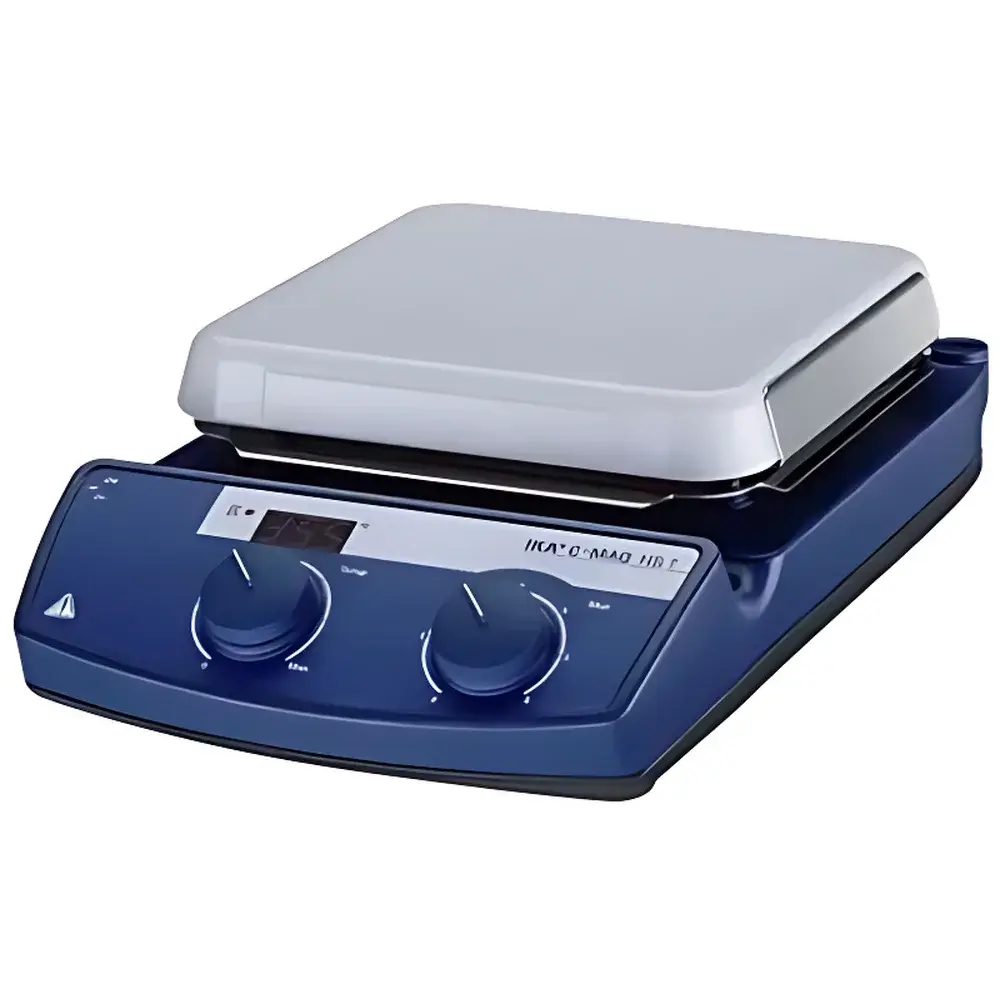
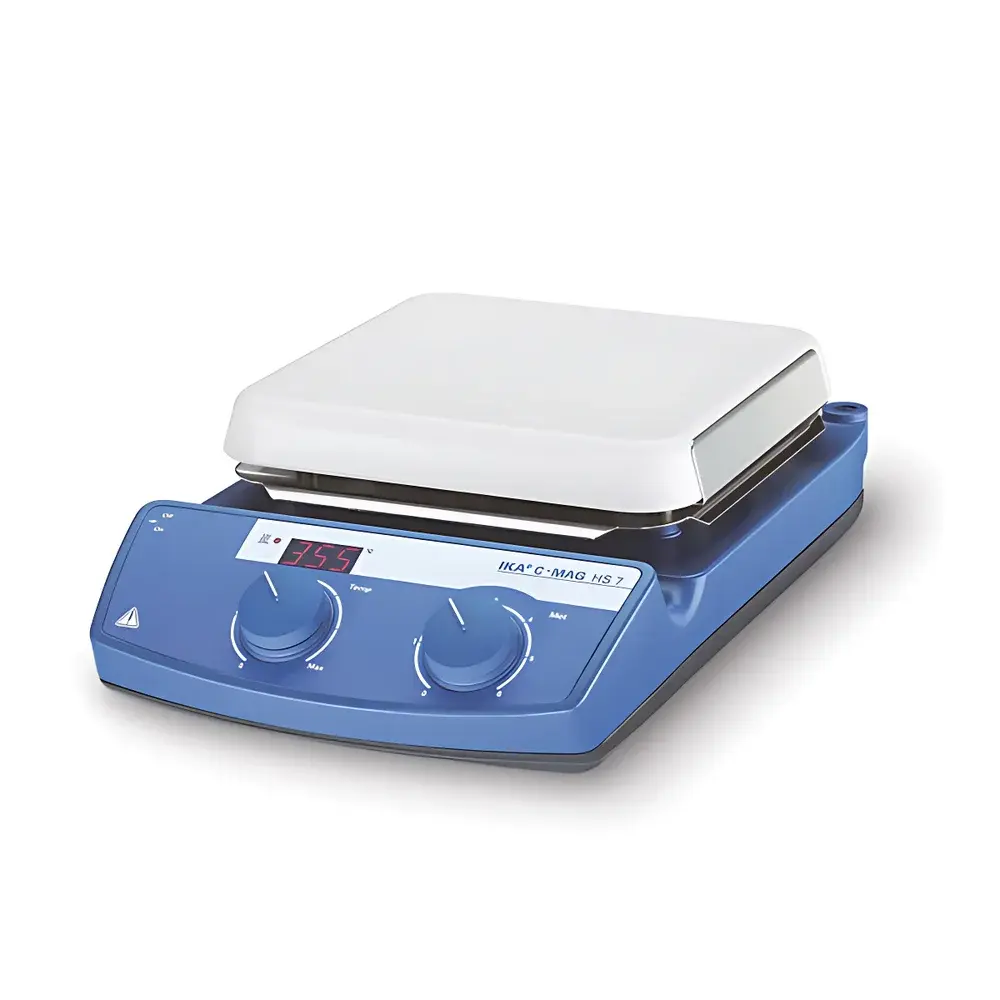
IKA C-MAG HS 7 Magnetic Stirrer
| Brand | IKA |
|---|---|
| Origin | Germany |
| Manufacturer | IKA-Werke GmbH & Co. KG |
| Model | C-MAG HS 7 |
| Instrument Type | Magnetic Stirrer |
| Max. Stirring Volume (H₂O) | 10 L |
| Speed Range | 100–1500 rpm |
| Heating Temperature Range | 50–500 °C |
| Heating Power | 1000 W |
| Plate Material | Ceramic |
| Plate Dimensions | 180 × 180 mm |
| Safety Cut-off | 550 °C |
| External Temperature Sensor Interface | ETS-D5 |
| IP Rating | IP21 |
| Input Voltage | 230 / 120 / 100 V, 50/60 Hz |
| Power Consumption | 1020 W |
| Weight | 5 kg |
| Operating Ambient | 5–40 °C, ≤80 % RH |
Overview
The IKA C-MAG HS 7 is a high-performance magnetic stirrer with integrated heating, engineered for precision, safety, and reproducibility in demanding laboratory environments. Utilizing a robust ceramic heating plate and a microprocessor-controlled DC motor, it delivers consistent rotational torque across its full speed range (100–1500 rpm) while maintaining stable thermal output from 50 to 500 °C. Its design follows the fundamental principles of magnetic coupling—where a rotating permanent magnet beneath the plate induces synchronous rotation of a magnetic stirring bar immersed in the sample—enabling contactless agitation ideal for sealed or sterile systems. The unit is intended for routine and method-critical applications in analytical chemistry, pharmaceutical development, materials synthesis, and quality control laboratories where thermal stability, chemical resistance, and operator safety are non-negotiable.
Key Features
- Ceramic heating plate: Seamless, one-piece construction with exceptional resistance to acids, alkalis, and organic solvents—eliminating crevices where reagents could accumulate or degrade.
- Microprocessor-based dual-loop control: Independently regulates motor speed and heating power using real-time feedback from internal sensors, ensuring setpoint fidelity under variable load conditions.
- Elevated control panel: Positioned above the heating surface to minimize risk of liquid ingress and improve ergonomics during parameter readout and adjustment.
- Fixed overtemperature protection: Hardware-enforced cut-off at 550 °C prevents thermal runaway regardless of controller status—compliant with EN 61000-6-2 and IEC 61010-1 safety standards.
- Visual thermal warning system: Pulsing LED indicator alerts users to active heating mode and elevated plate temperature, reducing accidental contact risk.
- Digital display with rotary encoder: Enables precise, repeatable entry of both speed (rpm) and temperature (°C), supporting SOP-driven workflows and audit-ready documentation.
- Integrated interface for external temperature monitoring: Compatible with IKA’s ETS-D5 contact probe, allowing closed-loop solution temperature regulation—critical for kinetic studies and exothermic reaction control.
Sample Compatibility & Compliance
The C-MAG HS 7 accommodates standard laboratory glassware (e.g., beakers, flasks, crystallization dishes) up to 10 L volume when using appropriately sized stirring bars (max. 80 mm length). Its ceramic surface withstands exposure to concentrated HCl, HNO₃, NaOH, acetone, and chlorinated solvents without etching or delamination. The device conforms to DIN EN 60529 (IP21 rating), IEC 61010-1 (Safety Requirements for Electrical Equipment for Measurement, Control, and Laboratory Use), and EU Directive 2014/30/EU (EMC Directive). It supports GLP-compliant operation when paired with traceable calibration records and validated ETS-D5 sensor integration.
Software & Data Management
While the C-MAG HS 7 operates as a standalone instrument without proprietary software, its analog/digital hybrid interface enables seamless integration into lab-wide data ecosystems. The ETS-D5 temperature probe provides a calibrated analog output compatible with third-party data loggers (e.g., Omega OM-DAQPRO, LabVIEW DAQ modules) for time-stamped temperature profiling. All parameter settings—including speed ramp profiles, hold times, and thermal setpoints—are manually entered and retained via non-volatile memory. For regulated environments, the absence of network connectivity simplifies 21 CFR Part 11 compliance by eliminating electronic signature requirements; however, handwritten logs linked to instrument ID and user initials satisfy audit trail expectations per FDA guidance on legacy equipment.
Applications
- Controlled heating and homogenization of viscous polymer solutions prior to rheological testing.
- Preparation of buffer solutions and culture media requiring precise thermal equilibration before sterilization.
- Facilitation of solid-phase synthesis reactions where inert atmosphere and consistent agitation are essential.
- Accelerated solvent evaporation in open-vessel setups under regulated thermal input.
- Standardization of dissolution media temperature in USP Apparatus II (paddle) validation protocols.
- Long-duration stability studies involving temperature-dependent degradation kinetics.
FAQ
Is the C-MAG HS 7 suitable for use with corrosive solvents such as hydrofluoric acid?
No. While the ceramic plate resists most common laboratory acids and bases, HF attacks silicon-based ceramics and must be handled exclusively in PTFE- or quartz-lined systems.
Can the unit maintain ±0.5 °C temperature accuracy across its full 50–500 °C range?
Accuracy depends on sensor placement and thermal mass. With ETS-D5 immersed directly in the solution, typical deviation is ±1.0 °C at 100 °C and ±2.5 °C at 450 °C under steady-state conditions.
Does the device support programmable multi-step heating/stirring sequences?
No. The C-MAG HS 7 features manual setpoint control only; programmable ramps require external controllers or higher-tier models like the RCT basic series.
What is the maximum recommended viscosity for reliable stirring at 1500 rpm?
For water-like fluids (500 mPa·s (e.g., glycerol), optimal performance is observed below 2 L volume and 800 rpm.
How frequently should the unit undergo preventive maintenance?
Annual verification of thermal calibration (using NIST-traceable thermometer) and visual inspection of ceramic plate integrity are recommended. No scheduled lubrication or motor servicing is required due to brushless DC architecture.
Related Products



