
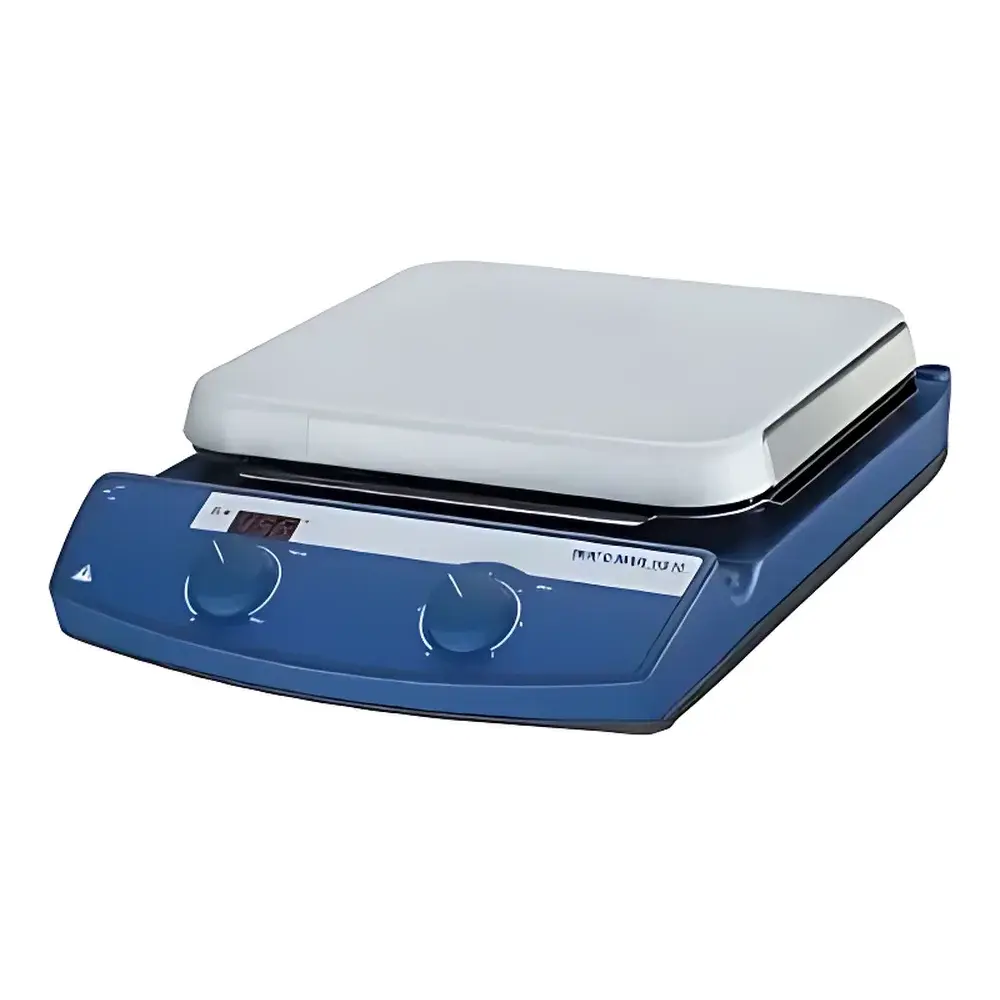
IKA C-MAG HS10 IKAMAG® Magnetic Stirrer with Heating
| Brand | IKA |
|---|---|
| Origin | Germany |
| Model | C-MAG HS10 |
| Instrument Type | Magnetic Stirrer |
| Max. Stirring Volume | 15 L (H₂O) |
| Speed Range | 100–1500 rpm |
| Heating Temperature Range | 50–500 °C |
| Heating Power | 1500 W |
| Plate Material | Ceramic |
| Plate Dimensions | 260 × 260 mm |
| Safety Cut-off | 550 °C |
| External Temp. Sensor Interface | DIN 12878 (compatible with ETS-D5) |
| Temp. Control Accuracy (with external probe) | ±3 K |
| Media Temperature Stability | ±3 K |
| IP Rating | IP21 |
| Input Voltage | 230 V, 50/60 Hz |
Overview
The IKA C-MAG HS10 IKAMAG® is a high-performance benchtop magnetic stirrer with integrated heating, engineered for precision, safety, and long-term reliability in regulated laboratory environments. It operates on the principle of electromagnetic coupling: a rotating magnetic field generated beneath a chemically inert ceramic plate induces synchronous rotation of a PTFE- or glass-coated magnetic stirring bar immersed in the sample vessel. Simultaneously, resistive heating elements embedded within the ceramic plate deliver uniform thermal energy across the entire surface. This dual-function architecture enables simultaneous temperature-controlled mixing—critical for applications requiring reproducible reaction kinetics, dissolution profiling, buffer equilibration, or sample homogenization prior to downstream analysis. Designed and manufactured in Staufen, Germany, the unit complies with IEC 61010-1 for electrical safety and conforms to DIN EN 60529 (IP21) for protection against vertically falling solid objects and limited ingress of moisture.
Key Features
- Ceramic working surface (260 × 260 mm) — seamless, scratch-resistant, and resistant to strong acids, alkalis, and organic solvents; facilitates rapid cleaning and prevents cross-contamination.
- Digital LED display for both set temperature and real-time plate temperature — enabling immediate verification of thermal status without external instrumentation.
- Integrated safety circuit with fixed overtemperature cut-off at 550 °C — independent of user settings, providing hardware-level protection against thermal runaway.
- Elevated control panel design — minimizes risk of liquid ingress during accidental splashing or condensation buildup.
- DIN 12878-compliant sensor port — supports connection of IKA ETS-D5 or other compatible contact thermometers for closed-loop media temperature feedback, improving thermal accuracy to ±3 K (vs. ±10 K using plate-sensing alone).
- Robust motor drive delivering consistent torque up to 1500 rpm — optimized for viscous aqueous solutions and low-viscosity organic media alike, with stable operation even under load variations typical in multi-vessel workflows.
- Error code diagnostics displayed numerically — streamlines troubleshooting and supports GLP-compliant maintenance logging.
Sample Compatibility & Compliance
The C-MAG HS10 accommodates standard laboratory glassware including beakers (up to 2 L), cylindrical vessels, and jacketed reactors. Its 15 L maximum stirring capacity (in water) is validated per ISO 8573-1 methodology using standardized magnetic stir bars (max. 80 mm length). The ceramic plate’s thermal uniformity (< ±5 K across surface at 300 °C) ensures minimal radial gradient effects during extended heating cycles. The device meets essential requirements of ISO/IEC 17025 for equipment used in accredited testing laboratories and supports audit readiness for FDA 21 CFR Part 11 when paired with validated electronic lab notebook (ELN) systems that capture timestamped parameter logs. All materials contacting the plate surface comply with USP Class VI biocompatibility standards.
Software & Data Management
While the C-MAG HS10 operates as a standalone analog-digital hybrid instrument, its DIN 12878 interface enables integration into centralized monitoring networks via optional IKA Labworldsoft® or third-party SCADA platforms supporting Modbus RTU or analog 4–20 mA output (with external signal conditioner). When used with an ETS-D5 probe, temperature and speed data can be logged externally with time-stamped metadata, satisfying traceability requirements under GMP Annex 11 and EU GMP Chapter 4. The unit does not feature built-in Wi-Fi or Ethernet; however, its deterministic response time (< 2 s from setpoint change to stabilized output) and repeatable ramp profiles make it suitable for SOP-driven manual operations in QC labs conducting compendial tests (e.g., USP Dissolution, EP 2.9.36).
Applications
- Buffer preparation and pH adjustment in molecular biology workflows.
- Heating and homogenization of culture media prior to sterilization.
- Controlled dissolution testing of pharmaceutical tablets under USP Apparatus II conditions.
- Precipitation reactions requiring precise thermal ramping and mixing synergy.
- Pre-analytical sample conditioning for ICP-MS, HPLC, or titration assays where matrix homogeneity directly impacts measurement uncertainty.
- Calibration of reference thermometers using stirred oil baths (ASTM E77).
FAQ
What is the maximum recommended viscosity for reliable stirring at 1500 rpm?
For continuous operation at full speed, aqueous solutions up to 50 mPa·s are supported; higher viscosities require reduced rpm and use of extended-length stir bars.
Can the unit maintain temperature stability during open-vessel evaporation?
Yes—when used with an external ETS-D5 probe immersed in the solution, media temperature stability remains within ±3 K even under moderate solvent loss rates (e.g., ethanol at 60 °C).
Is the ceramic plate resistant to hydrofluoric acid exposure?
No—HF etches silica-based ceramics; alternative PTFE-coated hotplates or glass-lined reactors are recommended for HF-containing systems.
Does the device support programmable temperature ramps?
No—the C-MAG HS10 features only manual setpoint control; programmable ramping requires integration with external controllers or IKA’s RH basic series.
How often should the unit undergo calibration verification?
Per ISO/IEC 17025, verify temperature accuracy (plate and media) and speed consistency annually—or after any impact event or repair—using NIST-traceable references.



