
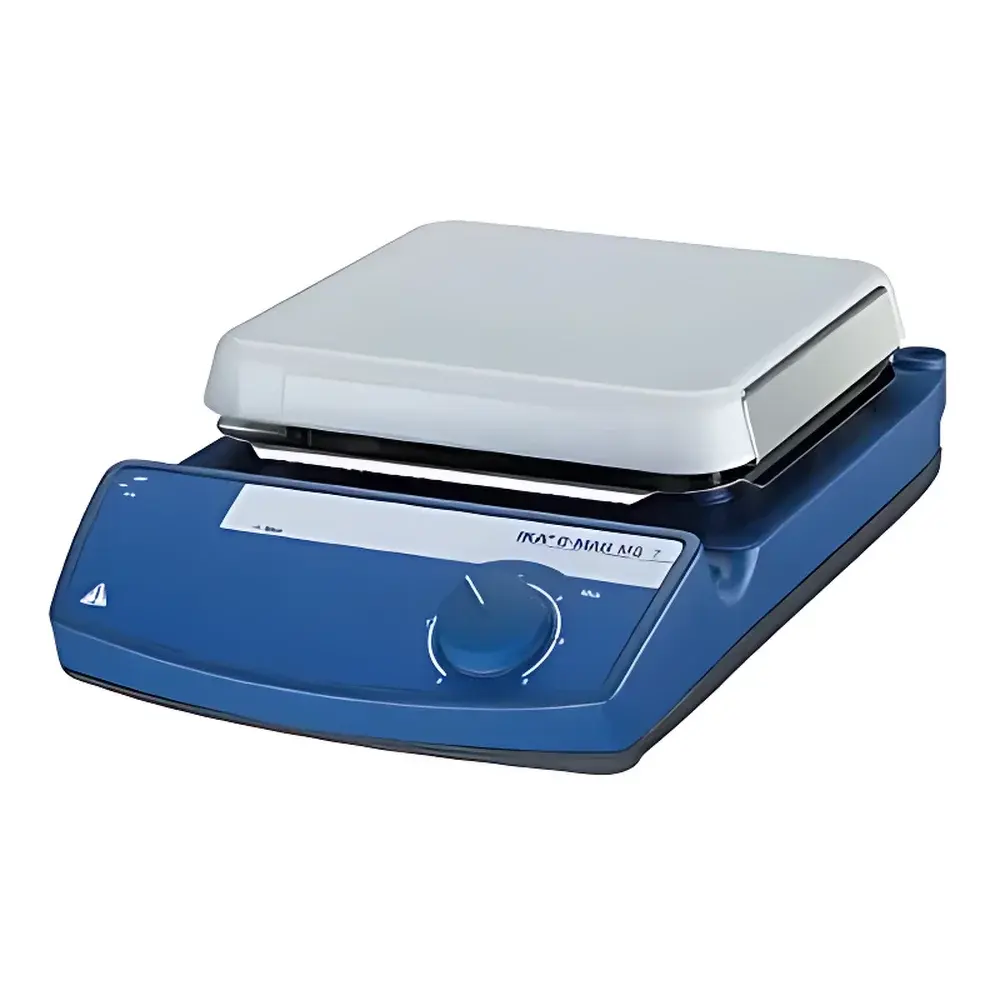
IKA C-MAG MS 7 Magnetic Stirrer
| Brand | IKA |
|---|---|
| Origin | Germany |
| Manufacturer | IKA Werke GmbH & Co. KG |
| Type | Magnetic Stirrer |
| Model | C-MAG MS 7 |
| Maximum Stirring Volume (H₂O) | 10 L |
| Speed Range | 100–1500 rpm |
| Motor Output Power | 1.5 W |
| Plate Material | Ceramic |
| Plate Dimensions | 180 × 180 mm |
| Overall Dimensions | 220 × 105 × 330 mm |
| Weight | 5 kg |
| Operating Temperature Range | 5–40 °C |
| Relative Humidity Limit | ≤80 % RH |
| Protection Class | IP21 (per DIN EN 60529) |
| Voltage | 230 / 120 / 100 V |
| Frequency | 50/60 Hz |
| Input Power | 30 W |
| Max. Stir Bar Length | 80 mm |
| Rotation Direction | Clockwise only |
| Control Method | Analog dial (0–6 scale) |
| Panel Height | Elevated for splash resistance and readability |
Overview
The IKA C-MAG MS 7 is a precision-engineered magnetic stirrer designed for consistent, reliable mixing in demanding laboratory environments. Utilizing a permanent magnet drive system with high-torque coupling, it operates on the principle of rotating magnetic fields to induce motion in ferromagnetic stir bars immersed in liquid samples. Its robust brushless DC motor delivers stable rotational output across the full speed range—critical for applications requiring reproducible shear profiles or gradual viscosity-dependent ramping. Unlike hotplate stirrers, the C-MAG MS 7 is a non-heating unit, making it ideal for temperature-sensitive protocols where thermal interference must be excluded. The device is calibrated for aqueous media up to 10 L at standard ambient conditions, with performance validated under ISO/IEC 17025-aligned internal quality control procedures.
Key Features
- High-strength neodymium magnet assembly ensures secure coupling with stir bars—even under high-viscosity or low-volume conditions—minimizing “jumping” or decoupling during operation.
- Ceramic work surface: seamless, one-piece construction offering exceptional resistance to acids, alkalis, solvents, and thermal shock; complies with DIN 12878 chemical resistance classification.
- Elevated control panel design reduces risk of liquid ingress during vigorous stirring or accidental splashing; digital speed readout remains clearly visible without repositioning.
- Analog speed dial (0–6) with fine-grained mechanical feedback enables intuitive, repeatable setting recall—particularly valuable in GLP-compliant workflows where instrument parameter logging is required.
- IP21-rated enclosure provides protection against vertically falling drips and solid objects ≥12.5 mm, supporting safe use in shared lab spaces per IEC 61000-6-3 EMC standards.
- Multi-voltage compatibility (100 / 120 / 230 V) and dual-frequency support (50/60 Hz) enable global deployment without hardware modification or external transformers.
Sample Compatibility & Compliance
The C-MAG MS 7 accommodates standard PTFE- or glass-coated stir bars up to 80 mm in length and is compatible with a wide range of container geometries—including beakers, Erlenmeyer flasks, and cylindrical reaction vessels—provided minimum depth and diameter allow effective magnetic coupling. It supports mixing of aqueous solutions, organic solvents, suspensions, and low-to-medium viscosity polymer solutions (e.g., <500 mPa·s at 25 °C). No heating function eliminates thermal artifacts in kinetic studies, enzymatic assays, or buffer equilibration. The unit conforms to DIN EN 61326-1 (electromagnetic compatibility for laboratory equipment) and meets essential safety requirements under Directive 2014/30/EU (EMC) and 2014/35/EU (LVD). While not certified for cleanroom use, its sealed ceramic surface facilitates ISO 14644-1 Class 8-compatible cleaning protocols.
Software & Data Management
As a stand-alone analog instrument, the C-MAG MS 7 does not feature digital connectivity, firmware updates, or data export capabilities. Its design prioritizes operational simplicity, mechanical reliability, and audit-trail transparency: all speed settings are manually selected and visually confirmed via the front-panel scale, eliminating software-mediated interpretation layers. This architecture aligns with FDA 21 CFR Part 11 Annex A guidance for “non-electronic record” devices—where manual entry into lab notebooks constitutes the primary record. For laboratories implementing electronic lab notebooks (ELNs), users may document speed settings, duration, and sample identifiers directly within their validated systems without interface validation overhead.
Applications
- Preparation of homogeneous calibration standards and reference solutions in analytical chemistry labs (e.g., ICP-MS, HPLC mobile phase blending).
- Mixing of reagent cocktails for ELISA, PCR master mixes, and cell culture media—where temperature stability and absence of localized heating are essential.
- Stirring during titration setups, dissolution testing (USP ), and pH adjustment protocols requiring steady agitation without introducing thermal gradients.
- Supporting solvent exchange steps in sample preparation workflows for GC-MS or LC-MS, particularly when volatile or heat-labile analytes are present.
- Routine use in QC/QA environments performing ASTM D445 (kinematic viscosity) pre-mixing or ISO 8502-6 (surface cleanliness) extraction procedures.
FAQ
Does the C-MAG MS 7 include a heating function?
No. It is a dedicated magnetic stirrer without integrated temperature control or hotplate capability.
What is the maximum recommended viscosity for stable operation?
For optimal coupling and speed consistency, use with liquids up to approximately 500 mPa·s at 25 °C; higher viscosities may require larger-diameter or longer stir bars (up to 80 mm) and reduced speed settings.
Is the ceramic plate resistant to hydrofluoric acid (HF)?
No. While highly resistant to most common laboratory chemicals, standard IKA ceramic plates are not HF-resistant; alternative PTFE-coated or quartz platforms are recommended for HF-based etching or digestion protocols.
Can this unit be used inside a fume hood?
Yes—its IP21 rating, low electromagnetic emissions, and absence of exposed electronics make it suitable for installation in ventilated enclosures, provided ambient temperature remains within 5–40 °C.
How often should preventive maintenance be performed?
IKA recommends visual inspection of the ceramic surface and stir bar coupling integrity before each use; annual verification of motor torque response and dial calibration by authorized service centers is advised for GMP-regulated environments.



