
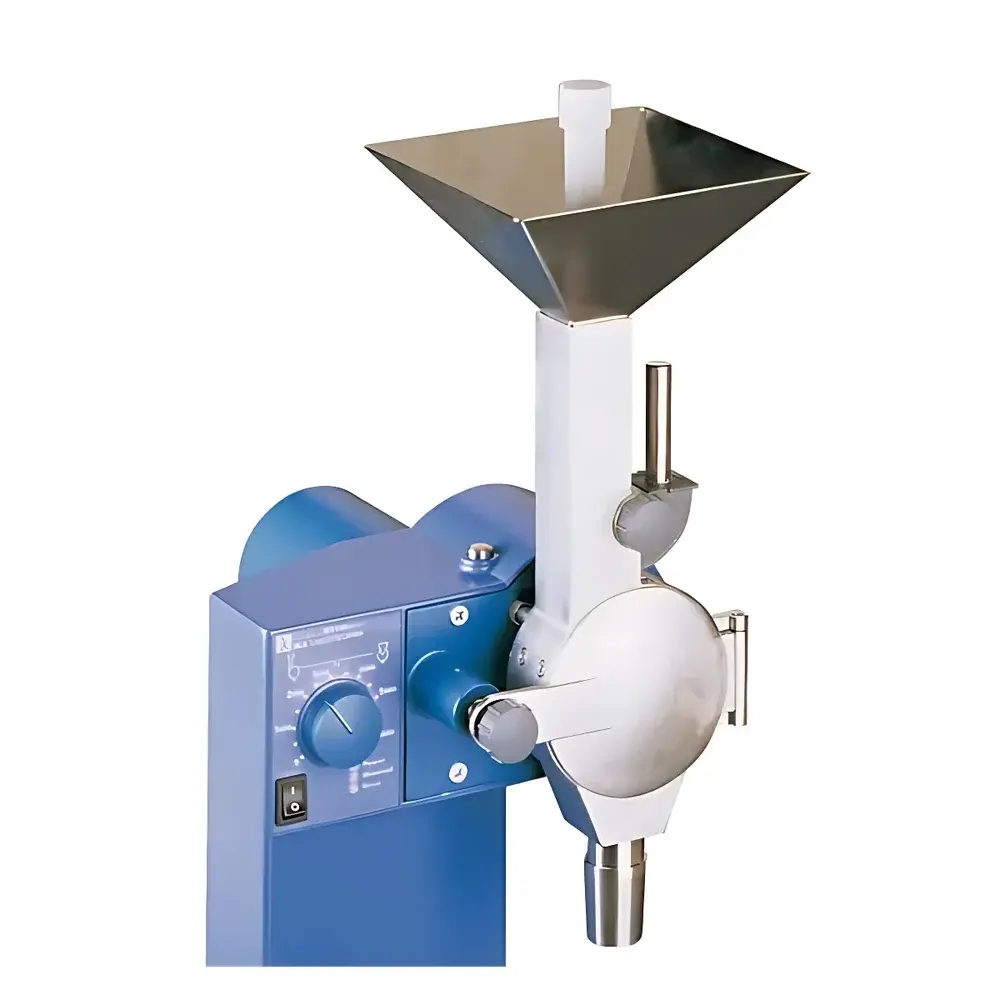
IKA MF 10.1 Cutting-Grinding Head for Laboratory Sample Preparation
| Brand | IKA |
|---|---|
| Origin | Germany |
| Model | MF 10.1 |
| Maximum Peripheral Speed | 24.5 m/s |
| Maximum Feed Particle Size | 15 mm |
| Grinding Chamber Material | Stainless Steel 1.4308 (AISI 304 equivalent) |
| Cooling Capability | Dry Ice Integration in Grinding Chamber |
| Dimensions (W × D × H) | 320 × 560 × 300 mm |
| Weight | 2.633 kg |
| Sieve Compatibility | Interchangeable stainless steel sieves (optional, not included) |
| Collection Vessel | Standard NS 29 threaded container |
Overview
The IKA MF 10.1 Cutting-Grinding Head is a precision-engineered laboratory grinding module designed for reproducible size reduction of soft, fibrous, and low-density materials. Unlike high-energy impact or ball-mill systems, the MF 10.1 employs a controlled rotary cutting-grinding mechanism—comprising a fixed counter-knife and a high-speed rotating knife—to achieve consistent particle size distribution through shearing and compression forces. Its operational principle aligns with ASTM D7263-22 (Standard Test Methods for Laboratory Determination of Particle Size Distribution of Soils) for preparatory homogenization steps and supports GLP-compliant sample conditioning prior to downstream analysis (e.g., elemental analysis, polymer characterization, or botanical extraction). The unit is intended for integration with IKA’s universal drive systems (e.g., RW 20, RW 47, or overhead stirrers with compatible mounting interfaces), enabling modular adaptation across diverse lab workflows.
Key Features
- High-precision cutting-grinding head engineered for low-heat generation during operation, with dry ice cooling capability directly integrated into the grinding chamber to preserve thermolabile compounds
- Stainless steel 1.4308 (AISI 304-grade) grinding chamber—corrosion-resistant, non-reactive, and compliant with ISO 8502-9 for surface cleanliness verification prior to analytical use
- Maximum peripheral speed of 24.5 m/s ensures efficient fiber disruption without excessive pulverization—optimized for paper, plant tissues, polymers, foams, and rubber-like matrices
- Interchangeable stainless steel sieve inserts (available separately in nominal aperture sizes: 0.25 mm, 0.5 mm, 1.0 mm, and 2.0 mm) allow precise control over output particle size; all sieves conform to ISO 3310-1:2016 tolerances
- NS 29 standard thread interface enables secure coupling with common laboratory collection vessels—including glass, polypropylene, or stainless steel containers—ensuring containment integrity per OSHA Lab Standard 29 CFR 1910.1200
- Compact footprint (320 × 560 × 300 mm) and lightweight design (2.633 kg) facilitate benchtop deployment and easy reconfiguration within fume hoods or glove boxes
Sample Compatibility & Compliance
The MF 10.1 is validated for use with organic fibrous substrates (e.g., cellulose-based papers, leafy botanicals, cereal straws), thermoplastic polymers (LDPE, PP, PS), elastomeric foams, and low-hardness composites. It is not rated for abrasive minerals, metals, or high-density ceramics. All wetted components comply with EU Regulation (EC) No 1935/2004 for food-contact materials and meet USP requirements for pharmaceutical-grade polymer compatibility when used with approved collection vessels. The unit supports audit-ready documentation under FDA 21 CFR Part 11 when operated in conjunction with IKA’s lab software platforms featuring electronic signature and change-control logs.
Software & Data Management
While the MF 10.1 itself is a mechanical module without embedded electronics, it is fully compatible with IKA’s Labworldsoft® and iControl® software suites when mounted on digitally controlled drives. These platforms enable RPM logging, torque profiling, runtime tracking, and export of timestamped grinding parameters (speed, duration, ambient temperature) in CSV or PDF formats—supporting traceability for ISO/IEC 17025:2017 accredited laboratories. Audit trails are retained for ≥36 months and include user ID, parameter modifications, and system error flags.
Applications
- Pre-analytical preparation of plant biomass for lignocellulosic sugar quantification (e.g., NREL LAP-002)
- Homogenization of polymer blends prior to melt-flow index testing (ASTM D1238)
- Size reduction of pharmaceutical excipients (e.g., microcrystalline cellulose) for content uniformity studies
- Fragmentation of recycled paper products for pulp consistency evaluation (TAPPI T 233 cm-22)
- Routine sample subdivision in environmental labs processing soil-organic matter composites
FAQ
Is the MF 10.1 suitable for cryogenic grinding?
Yes—dry ice can be placed directly into the grinding chamber prior to operation to maintain sub-zero temperatures during processing, preserving volatile constituents and inhibiting enzymatic degradation.
What drive units are mechanically compatible with the MF 10.1?
It mounts via standard IKA G-type clamping interface and is certified for use with RW 20, RW 47, RCT basic, and overhead stirrers equipped with ≥10 mm shaft diameter and ≥15 N·cm torque rating.
Are sieve inserts supplied with the unit?
No—sieves are optional accessories; users must specify required aperture size at time of order.
Can the grinding chamber be sterilized in an autoclave?
The stainless steel chamber is autoclavable at 121 °C, 2 bar for 20 minutes; however, repeated cycles may affect gasket integrity—replacement O-rings (Order No. 301250) are recommended after every 10 cycles.
Does the MF 10.1 meet CE marking requirements?
Yes—it carries CE marking under Directive 2006/42/EC (Machinery Directive) and complies with EN 61000-6-2 (EMC immunity) and EN 61000-6-4 (EMC emission) standards.



