
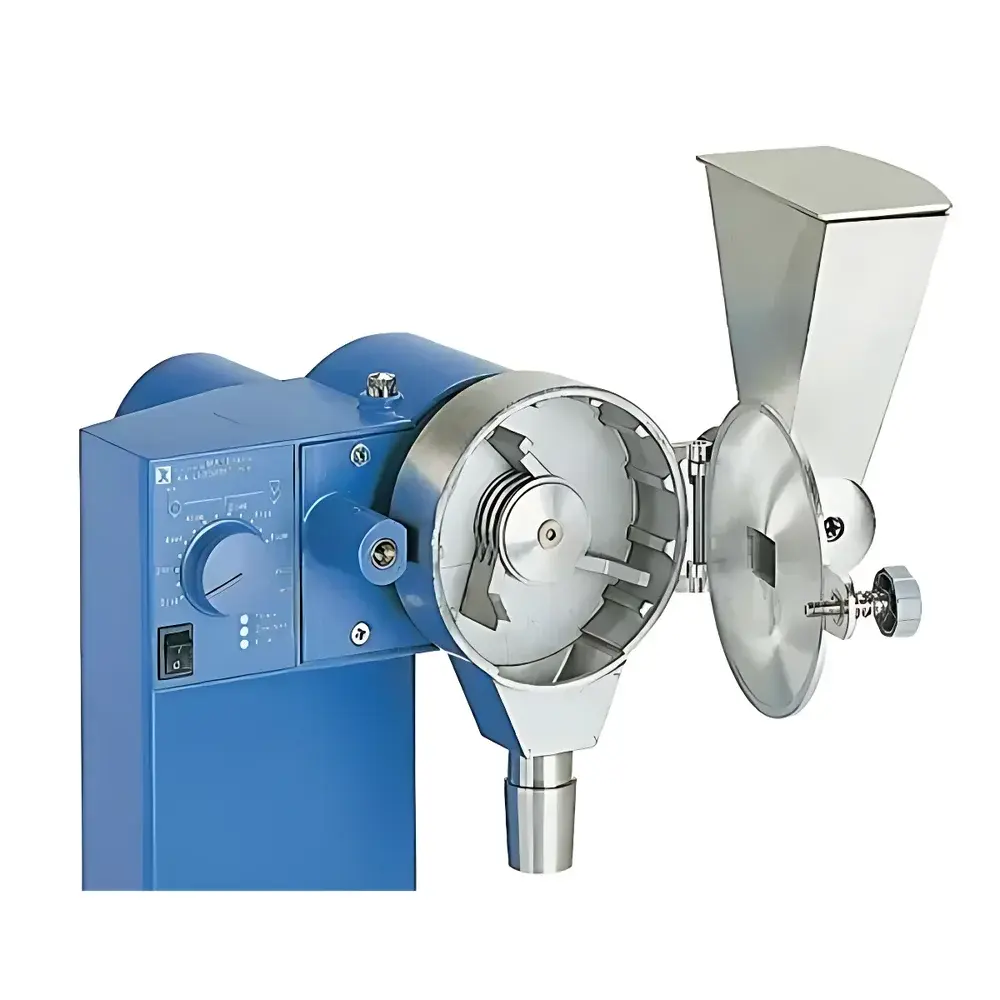
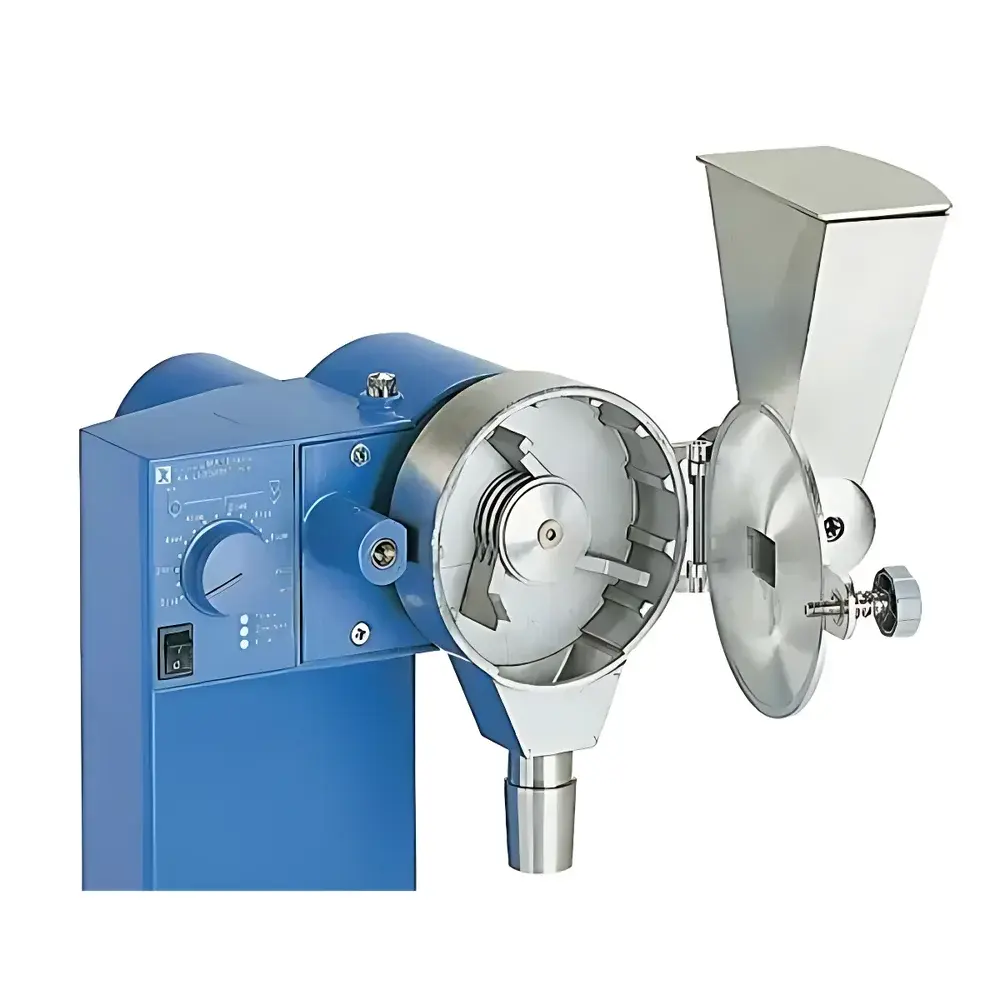
IKA MF 10.2 Impact Grinding Head
| Brand | IKA |
|---|---|
| Origin | Germany |
| Model | MF 10.2 Impact Grinding Head |
| Operating Principle | Impact Milling |
| Maximum Peripheral Speed | 34 m/s |
| Maximum Feed Hardness | 6 Mohs |
| Maximum Feed Particle Size | 10 mm |
| Grinding Chamber Material | Stainless Steel 1.4308 (AISI 304 equivalent) |
| Cooling Option | Dry Ice Insertion in Grinding Chamber |
| Dimensions (W × D × H) | 320 × 450 × 300 mm |
| Weight | 2.942 kg |
| Sieve Compatibility | Interchangeable stainless steel sieves (sold separately) |
| Collection Vessel | Standard NS 29 threaded container |
Overview
The IKA MF 10.2 Impact Grinding Head is a precision-engineered, high-energy impact milling module designed for rapid, reproducible size reduction of brittle and moderately hard solid materials in laboratory environments. It operates on the principle of high-velocity mechanical impact—where feed material is accelerated by a rotating impeller and fractured upon collision with the hardened grinding chamber wall and stationary impact elements. This mechanism ensures efficient comminution without significant heat generation, particularly when combined with optional dry ice cooling directly within the grinding chamber. The unit is not a standalone grinder but a modular head intended for integration with IKA’s MF series base units (e.g., MF 10 basic or MF 10.1), enabling flexible configuration across analytical, quality control, and R&D workflows. Its design adheres to European machinery safety directives (2006/42/EC) and incorporates corrosion-resistant 1.4308 stainless steel construction—ensuring compatibility with routine cleaning, solvent exposure, and regulated sample handling protocols.
Key Features
- High-peripheral-speed rotor delivering up to 34 m/s tip velocity for effective impact-based particle fracture
- Robust grinding chamber fabricated from austenitic stainless steel 1.4308 (EN 10088-1), equivalent to AISI 304, providing excellent resistance to wear and chemical degradation
- Dry ice insertion port integrated into the chamber lid, enabling cryogenic stabilization of thermolabile or hygroscopic samples during grinding
- Modular sieve system accepting interchangeable stainless steel sieves with nominal aperture sizes ranging from 0.25 mm to 4.0 mm (sieves sold separately)
- NS 29 standard thread interface for secure, leak-tight coupling with IKA-certified collection vessels—ensuring containment integrity during operation
- Compact footprint (320 × 450 × 300 mm) and low operational mass (2.942 kg) facilitate benchtop integration and ergonomic handling in ISO Class 5–7 cleanrooms or GLP-compliant laboratories
Sample Compatibility & Compliance
The MF 10.2 Impact Grinding Head is validated for processing non-fibrous, brittle materials with a Mohs hardness ≤ 6—including minerals (e.g., limestone, gypsum, quartzite), construction aggregates, ceramics, pharmaceutical excipients, and certain geological specimens. It is unsuitable for ductile, elastic, or highly abrasive materials exceeding its hardness threshold (e.g., tungsten carbide, silicon carbide). Feed particles must be ≤ 10 mm in maximum dimension to prevent jamming or unbalanced rotor loading. All wetted surfaces comply with FDA 21 CFR §177.1520 for indirect food contact and meet EU Regulation (EC) No. 1935/2004 for materials intended to come into contact with foodstuffs. Documentation packages support audit readiness for ISO/IEC 17025, USP , and ASTM D297–22 grinding consistency validation requirements.
Software & Data Management
As a mechanically actuated, non-electronic grinding head, the MF 10.2 does not incorporate embedded firmware, digital controls, or data logging capabilities. Operational parameters—including run time, feed mass, and sieve selection—are recorded manually or via external laboratory information management systems (LIMS). When paired with an IKA MF 10.1 base unit equipped with the RW 20 control module, users may document rotational speed settings and total grinding duration through the base unit’s analog output interface. For full traceability in GMP-regulated environments, we recommend integrating the MF 10.2 into standardized operating procedures (SOPs) that include pre- and post-grinding visual inspection, sieve calibration logs (per ISO 3310-1), and container lot traceability for NS 29 vessels.
Applications
- Preparation of homogenized mineralogical samples for X-ray fluorescence (XRF) and X-ray diffraction (XRD) analysis
- Routine particle size reduction of construction materials prior to sieve analysis (ASTM C136/C136M) or specific surface area determination (BET)
- Homogenization of pharmaceutical raw materials for content uniformity testing per USP
- Fragmentation of geological core segments for geochemical assay preparation under CLIA- and ISO 15189-aligned workflows
- Standardized grinding of certified reference materials (CRMs) used in interlaboratory proficiency testing schemes
FAQ
Is the MF 10.2 Impact Grinding Head compatible with non-IKA drive units?
No. It requires precise torque transmission and mechanical alignment only achievable with IKA MF-series base units (MF 10 basic, MF 10.1, or MF 10.2 base). Third-party couplings are not supported and void warranty.
Can the grinding chamber be autoclaved?
No. While constructed from autoclavable-grade stainless steel, the sealing gasket material and internal geometry are not validated for steam sterilization cycles. Cleaning is recommended via ethanol wipe-down or ultrasonic bath with neutral detergent.
What sieve sizes are available for this grinding head?
Standard interchangeable sieves range from 0.25 mm to 4.0 mm aperture (nominal), manufactured to ISO 3310-1 tolerances. Custom apertures are available upon request with lead-time verification.
Does IKA provide calibration certificates for the MF 10.2?
No calibration certificate is issued for the grinding head itself, as it contains no metrologically traceable sensors. However, IKA supplies dimensional inspection reports for critical interfaces (NS 29 thread, chamber bore) upon request.
Is dry ice insertion mandatory for operation?
No. Dry ice cooling is optional and application-dependent—primarily used for heat-sensitive organics or polymers prone to thermal softening. Ambient-temperature grinding is fully supported for inorganic, thermally stable samples.



