
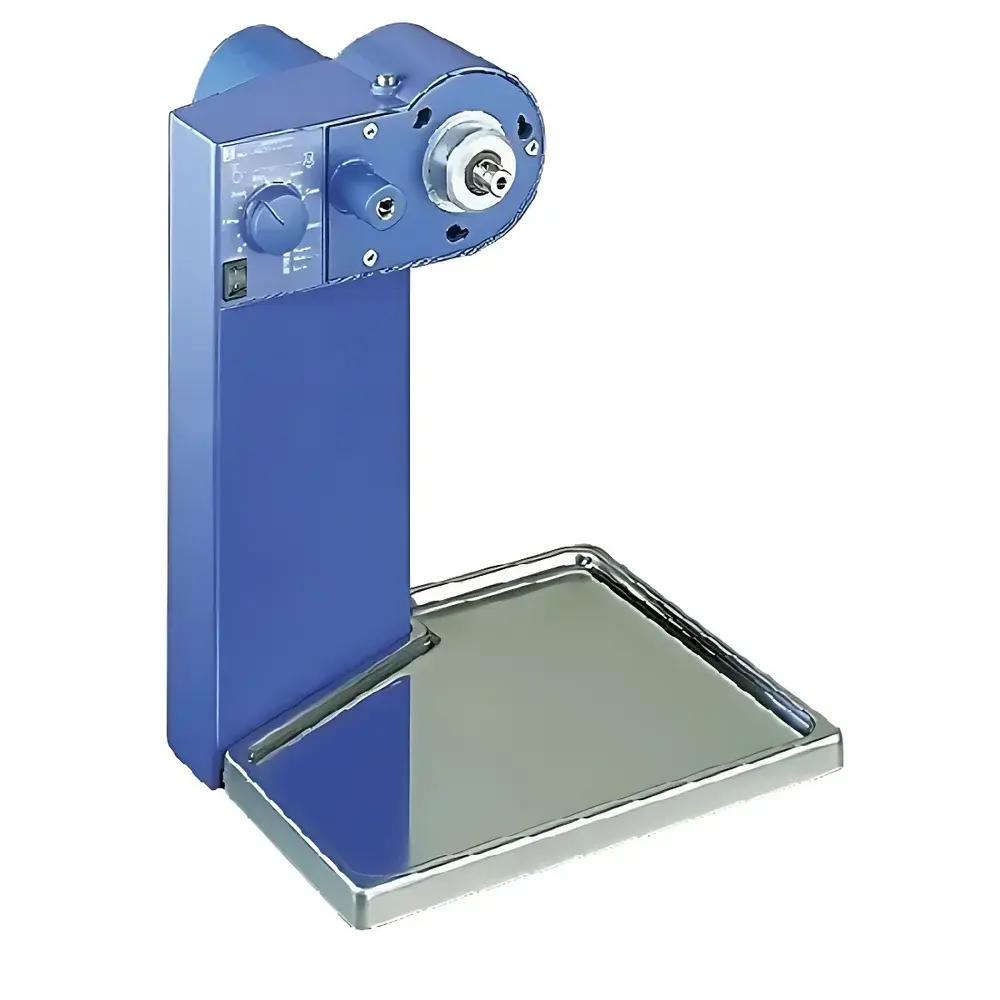
IKA MF 10 basic Microfine Grinder Drive
| Brand | IKA |
|---|---|
| Origin | Germany |
| Model | MF 10 basic Microfine Grinder Drive |
| Motor Input Power | 1000 W |
| Motor Output Power | 500 W |
| Speed Range | 3000 – 6500 rpm |
| Continuous Operation Time | 120 min (ON) / 30 min (OFF) |
| Cooling | Dry ice compatible in grinding chamber |
| Dimensions (W × D × H) | 320 × 380 × 300 mm |
| Weight | 9.7 kg |
| Ambient Temperature Range | 5 – 40 °C |
| Relative Humidity Limit | ≤80 % |
| Protection Class | IP 22 (DIN EN 60529) |
| Voltage | 230 V, 50/60 Hz |
| Optional Voltages | 115 V or 100–115 V |
| Grinding Principle | Shear and Impact |
| Material Contact Surfaces | Stainless Steel |
| Grind Head & Sieve | Sold Separately |
Overview
The IKA MF 10 basic Microfine Grinder Drive is a robust, benchtop laboratory grinder engineered for reproducible particle size reduction of dry, brittle, and moderately fibrous materials. Operating on the principle of high-speed shear and impact, it delivers consistent microfine grinding performance across diverse sample types—including pharmaceutical excipients, botanicals, polymers, minerals, and food ingredients. Its modular architecture centers on a high-torque, brushless motor drive unit that accepts interchangeable grinding heads and sieves (sold separately), enabling method flexibility without requiring full system replacement. Designed and manufactured in Staufen, Germany, the MF 10 basic complies with IEC/EN 61000 electromagnetic compatibility standards and meets essential safety requirements per EN 61010-1 for laboratory electrical equipment. The device is not intended for wet grinding, cryogenic milling below −40 °C, or abrasive materials exceeding Mohs hardness 6.
Key Features
- High-performance drive unit with 500 W continuous output power and variable speed control from 3000 to 6500 rpm—optimized for balancing throughput and particle size distribution.
- Durable stainless-steel grinding chamber and base plate ensure chemical resistance, ease of cleaning, and compliance with Good Manufacturing Practice (GMP) surface requirements.
- Integrated thermal management supports optional dry ice cooling within the grinding chamber, extending operational stability during prolonged runs and minimizing heat-sensitive sample degradation.
- IP 22 ingress protection rating (per DIN EN 60529) provides limited protection against vertically falling drips and solid objects >12.5 mm—suitable for standard laboratory environments with controlled humidity (≤80 % RH) and ambient temperatures between 5 °C and 40 °C.
- Configurable duty cycle: rated for up to 120 minutes of continuous grinding followed by a mandatory 30-minute cooldown period—ensuring motor longevity and thermal safety under routine use.
- Modular design allows rapid interchange of grinding heads (e.g., knife, rotor-stator, or cutting disc configurations) and sieve inserts (mesh sizes from 0.25 mm to 4.0 mm)—supporting method development per ASTM D5630 (plastic ash content) or USP (particle size distribution of drug substances).
Sample Compatibility & Compliance
The MF 10 basic is validated for use with dry, non-oily, low-moisture (<10 % w/w) samples exhibiting moderate hardness and friability. Compatible materials include lactose monohydrate, microcrystalline cellulose, sodium chloride, dried plant leaves, and thermoplastic polymer granules. It is not suitable for metals, ceramics, or highly elastic polymers. All contact surfaces conform to FDA-compliant stainless steel (1.4301/AISI 304) specifications. While the unit itself does not carry CE marking for medical devices or IVD applications, its construction and documentation support integration into ISO 17025-accredited testing laboratories. Routine calibration verification can be performed using NIST-traceable tachometers and certified reference powders per ISO 13320:2020 (laser diffraction particle sizing methodology).
Software & Data Management
The MF 10 basic operates as a stand-alone analog instrument with manual speed selection via rotary dial and mechanical timer. It does not feature digital connectivity, onboard data logging, or USB/RS232 interfaces. However, its repeatable mechanical behavior—verified across ≥50 consecutive runs at fixed speed and load—enables reliable integration into validated workflows governed by 21 CFR Part 11 when paired with external electronic lab notebooks (ELNs) or LIMS systems that record operator ID, batch number, speed setting, duration, and sieve specification. Audit trails must be maintained externally, as the device lacks built-in user authentication or electronic signature capability.
Applications
- Preparation of homogenized reference standards for X-ray fluorescence (XRF) and inductively coupled plasma (ICP) analysis.
- Size reduction of tablet excipients prior to blend uniformity assessment per USP .
- Particle size conditioning of herbal powders for dissolution testing (USP Apparatus II).
- Routine grinding of geological core samples for geochemical assay preparation (ASTM D5158).
- Homogenization of composite polymer pellets prior to melt flow index (MFI) determination (ASTM D1238).
FAQ
Is the MF 10 basic suitable for cryogenic grinding with liquid nitrogen?
No. While dry ice cooling is supported inside the grinding chamber, the unit is not rated for direct liquid nitrogen immersion or operation below −40 °C due to material embrittlement risks and seal integrity limitations.
Are grinding heads and sieves included with the MF 10 basic drive unit?
No. All grinding heads (e.g., Type A knife head, Type B rotor-stator head) and sieve inserts are optional accessories and must be ordered separately based on application requirements.
Can the MF 10 basic be operated continuously beyond 120 minutes?
No. Exceeding the specified 120-minute ON / 30-minute OFF duty cycle voids warranty coverage and increases risk of thermal overload, bearing wear, and inconsistent particle size output.
What voltage variants are available for international deployment?
Standard configuration is 230 V, 50/60 Hz. Optional 115 V and 100–115 V versions are available upon request and require factory configuration—do not attempt field voltage modification.
Does IKA provide IQ/OQ documentation for this model?
Yes. Installation Qualification (IQ) and Operational Qualification (OQ) protocols—including torque verification, speed accuracy testing, and temperature rise measurement—are available through IKA’s Application Support team upon purchase confirmation.



