
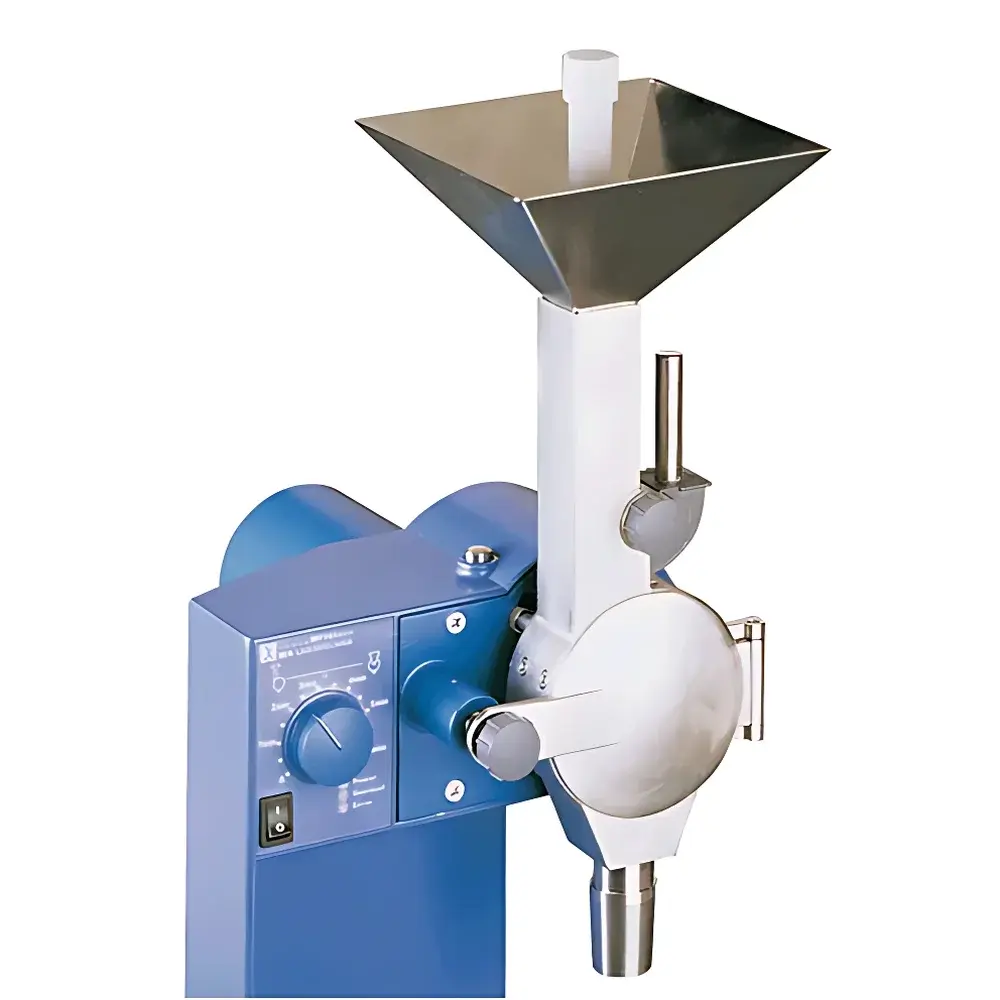
IKA MF10.1 Cutting-Grinding Head
| Brand | IKA |
|---|---|
| Origin | Germany |
| Manufacturer Type | Original Equipment Manufacturer (OEM) |
| Origin Category | Imported |
| Model | MF 10.1 Cutting-Grinding Head |
| Instrument Type | Laboratory Grinder |
| Sample Applicability | Rigid, fibrous, and low-density materials (e.g., paper, vegetables, plastics) |
| Feed Particle Size | <15 mm |
| Discharge Particle Size | 0.01–0.5 mm (adjustable via interchangeable sieves) |
| Final Output Particle Size | <0.25 mm |
| Grinding Chamber Material | Stainless Steel 1.4308 (AISI 304 equivalent) |
| Maximum Peripheral Speed | 24.5 m/s |
| Cooling Option | Dry ice cooling compatible in grinding chamber |
| Dimensions (W×H×D) | 320 × 560 × 300 mm |
| Weight | 2.633 kg |
Overview
The IKA MF10.1 Cutting-Grinding Head is a precision-engineered, modular grinding module designed for integration with IKA’s laboratory-scale dispersing and homogenizing systems—most commonly the ULTRA-TURRAX® T10 basic or T18 digital drive units. Unlike conventional rotor-stator grinders optimized for liquid suspensions, the MF10.1 employs a high-speed cutting-grinding mechanism based on controlled shear and impact forces generated by a rotating stainless-steel blade assembly within a fixed cylindrical grinding chamber. Its operational principle relies on the relative velocity between the rotating cutting edge and the stationary chamber wall, enabling efficient size reduction of structurally resilient, low-moisture, and fibrous solid samples. The device is not a standalone grinder but a purpose-built accessory intended for intermittent, batch-mode dry or semi-dry grinding applications where particle size distribution control, thermal management, and material integrity preservation are critical.
Key Features
- High-precision cutting-grinding geometry engineered for reproducible particle size reduction of rigid and fibrous materials—including cellulose-rich substrates (paper, plant tissues), thermoplastics, and composite fragments.
- Grinding chamber fabricated from corrosion-resistant stainless steel 1.4308 (equivalent to AISI 304), ensuring long-term mechanical stability and compliance with ISO 8502-3 for metallic surface cleanliness in lab environments.
- Maximum peripheral blade tip speed of 24.5 m/s, calibrated to deliver optimal energy input without excessive localized heating—enabling compatibility with cryogenic cooling using dry ice directly inside the chamber.
- Modular sieve system allows post-grinding classification; interchangeable stainless-steel sieves (sold separately) support nominal aperture sizes ranging from 0.01 mm to 0.5 mm, facilitating alignment with ASTM E11 and ISO 3310-1 standards for test sieves.
- Designed for direct coupling to IKA ULTRA-TURRAX® drive units via standardized G25/30 threaded interface; no additional adapters required.
- Compact footprint (320 × 560 × 300 mm) and lightweight construction (2.633 kg) enable seamless integration into fume hoods, glove boxes, or dedicated sample preparation workstations.
Sample Compatibility & Compliance
The MF10.1 is validated for use with non-hazardous, non-explosive, and non-pyrophoric solid samples exhibiting moderate hardness and low bulk density. It is routinely applied in academic and industrial laboratories for pretreatment of botanical matrices prior to elemental analysis (e.g., ICP-OES/MS), polymer characterization (e.g., FTIR, DSC), and pharmaceutical excipient blending studies. While not certified for ATEX or IECEx environments, its all-metal construction and absence of internal electronics render it suitable for inert-atmosphere grinding when used inside nitrogen-purged enclosures. All wetted surfaces comply with USP and EU Pharmacopoeia Chapter 3.1.1 for metallic components in contact with pharmaceutical raw materials. Documentation supports GLP-compliant method validation under OECD 117 and ISO/IEC 17025 frameworks.
Software & Data Management
As a mechanical grinding head, the MF10.1 does not incorporate embedded firmware or digital interfaces. Operational parameters—including rotational speed, duration, and cooling protocol—are controlled externally via the connected ULTRA-TURRAX® drive unit. When paired with IKA’s ROTAVISC or ULTRA-TURRAX® software suite (via RS232 or USB), users may log timestamped speed profiles and torque load curves for audit trails. Full traceability aligns with FDA 21 CFR Part 11 requirements when deployed with validated electronic records systems and user-access controls.
Applications
- Preparation of homogenized reference materials for environmental soil and sediment analysis (EPA Method 3050B).
- Fiber disintegration in pulp and paper quality control testing per TAPPI T204 and ISO 5351.
- Size reduction of biodegradable polymer pellets prior to melt flow index (MFI) determination (ASTM D1238).
- Homogenization of dried herbal matrices for HPLC-based phytochemical profiling (USP ).
- Generation of narrow-distribution particulates for laser diffraction particle sizing calibration (ISO 13320).
FAQ
Is the MF10.1 compatible with non-IKA drive units?
No—it requires precise mechanical coupling and torque transmission specifications unique to IKA ULTRA-TURRAX® T10/T18 platforms. Third-party drives are not supported.
Can the MF10.1 be used for wet grinding?
It is not designed for slurry processing; moisture content above 15% w/w risks clogging and inconsistent particle release. For liquid-phase dispersion, IKA recommends the S10N-10G or S18N-10G dispersing tools.
Are replacement sieves supplied with the MF10.1?
No—sieves are optional accessories available in 0.01 mm, 0.05 mm, 0.1 mm, 0.25 mm, and 0.5 mm apertures (IKA part numbers: 0002000010 through 0002000014).
Does the MF10.1 meet CE or UKCA marking requirements?
Yes—the entire IKA MF10.1 assembly complies with the Machinery Directive 2006/42/EC and Electromagnetic Compatibility Directive 2014/30/EU when operated with CE-marked IKA drive units.



