
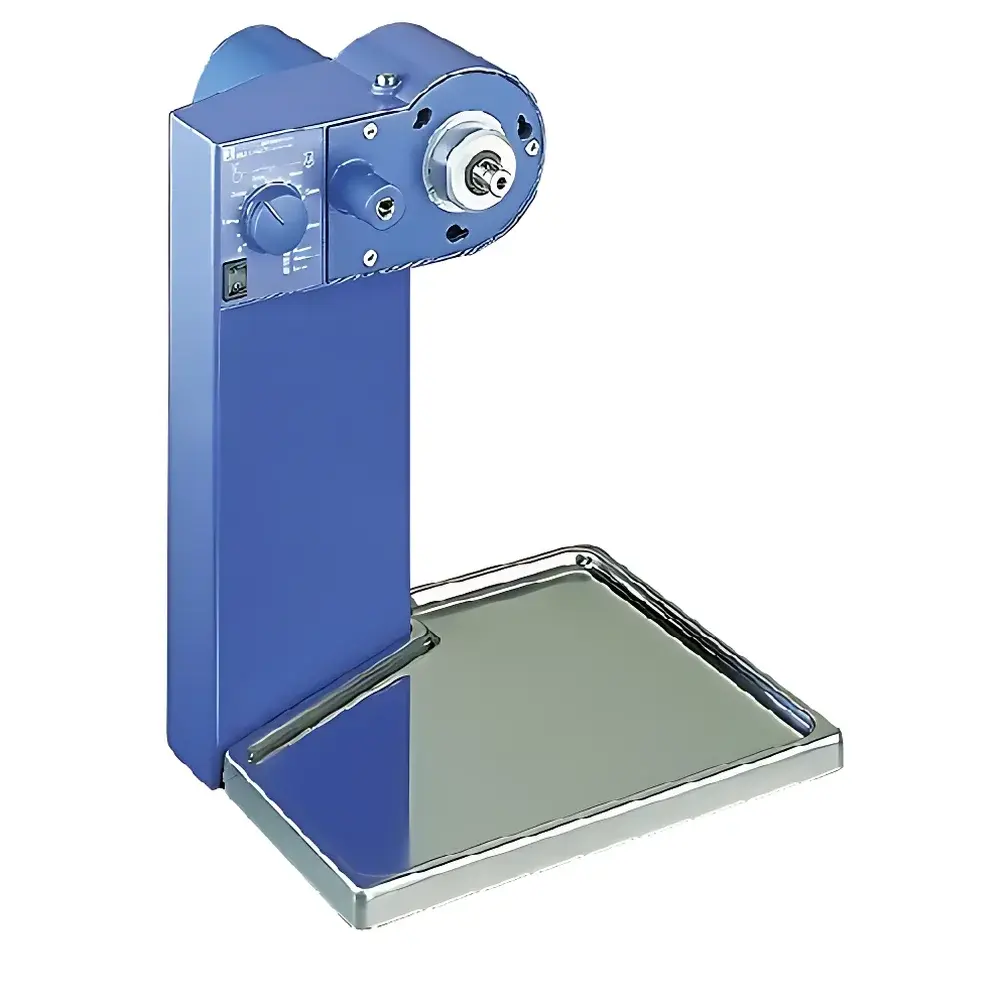
IKA MF10 Basic Grinder Main Unit
| Brand | IKA |
|---|---|
| Origin | Germany |
| Model | MF10 Basic |
| Motor Input Power | 1000 W |
| Motor Output Power | 500 W |
| Speed Range | 3000–6500 rpm |
| Duty Cycle | 120 min ON / 30 min OFF |
| Cooling Options | Dry Ice (Yes), Water (No), Liquid Nitrogen (No) |
| Dimensions (W×D×H) | 320 × 380 × 300 mm |
| Weight | 9.7 kg |
| Ambient Temperature Range | 5–40 °C |
| Relative Humidity Limit | 80 % |
| Protection Rating | IP22 |
| Voltage | 230/115 V |
| Frequency | 50/60 Hz |
Overview
The IKA MF10 Basic Grinder Main Unit is a robust, benchtop high-speed cutting mill engineered for reproducible sample size reduction of soft to medium-hard, fibrous, and brittle materials in academic, industrial, and quality control laboratories. It operates on the principle of high-shear mechanical comminution—combining impact and cutting action via rotating blades against fixed counter-blades within a sealed grinding chamber. Unlike cryogenic or planetary ball mills, the MF10 Basic delivers rapid, scalable particle size reduction without requiring vacuum systems, inert gas purging, or complex milling media. Its design prioritizes operational simplicity, thermal management flexibility, and compliance-ready mechanical architecture—making it suitable for routine preparation of samples prior to elemental analysis (e.g., XRF, ICP-OES), moisture determination, homogenization for microbiological testing, or feedstock conditioning in polymer and pharmaceutical development workflows.
Key Features
- High-performance 1000 W input / 500 W output universal motor delivering consistent torque across the full speed range (3000–6500 rpm)
- Stainless steel grinding chamber and housing—corrosion-resistant, non-porous, and compliant with ISO 8573-1 for cleanability in regulated environments
- Tool-free, ergonomic blade exchange system enabling rapid adaptation between two interchangeable grinding head configurations (standard cutting blade and optional fine-cut blade—ordered separately)
- Duty-cycle optimized for sustained operation: 120 minutes continuous grinding followed by mandatory 30-minute cooling interval to maintain thermal stability and bearing longevity
- Integrated dry ice cooling compatibility—supports temperature-sensitive sample processing (e.g., thermolabile botanicals, enzymatic tissues) without modification to the base unit
- IP22-rated enclosure ensuring protection against vertically falling drips and solid objects ≥12.5 mm—suitable for standard laboratory ambient conditions (5–40 °C, ≤80 % RH)
- Universal dual-voltage capability (230 V / 115 V, 50/60 Hz) with CE, GS, and UL recognition for global deployment
Sample Compatibility & Compliance
The MF10 Basic accepts dry or slightly moist samples up to 500 mL working volume—including plant tissues, grains, plastics, pharmaceutical tablets, foodstuffs, and composite polymers. It excludes highly viscous, oily, or liquid-dominant matrices. Grinding efficiency is validated per ASTM D297–17 (rubber compounding) and ISO 13320:2020 (laser diffraction particle sizing methodology), with typical output particle distributions ranging from 100 µm to 2 mm depending on feedstock hardness, residence time, and blade geometry. The unit meets essential requirements of EU Machinery Directive 2006/42/EC and conforms to EN 61000-6-2 (immunity) and EN 61000-6-4 (emissions). While not intrinsically explosion-proof, its spark-free stainless construction supports safe use with non-hazardous organic powders under standard GLP operating procedures.
Software & Data Management
The MF10 Basic is a stand-alone electromechanical instrument with no embedded microprocessor, digital display, or connectivity interfaces (RS232, USB, Ethernet, or analog outputs are absent). All operational parameters—including speed selection and duty-cycle adherence—are manually controlled via the front-panel rotary switch and mechanical timer. This architecture eliminates firmware dependencies, reduces validation burden in GxP-regulated settings, and ensures long-term operational continuity without software obsolescence. For audit-trail requirements, users may integrate external logging devices (e.g., calibrated tachometers, thermal data loggers) compatible with 21 CFR Part 11-compliant platforms when used in FDA-regulated quality systems.
Applications
- Routine homogenization of herbal raw materials prior to HPLC or GC-MS analysis
- Preparation of representative sub-samples from bulk agricultural commodities for mycotoxin screening
- Size reduction of polymer granules for melt flow index (MFI) testing per ASTM D1238
- Fragmentation of spent catalysts for XRF-based elemental profiling
- Grinding of freeze-dried biological tissues under dry ice cooling for proteomic extraction workflows
- QC sample conditioning in nutraceutical manufacturing per USP Comminuted Dosage Forms
FAQ
Is the MF10 Basic suitable for cryogenic grinding with liquid nitrogen?
No. The grinding chamber is not rated for direct liquid nitrogen immersion or pressurized LN₂ delivery systems. Dry ice cooling is supported; alternative low-temperature solutions require third-party adapters not validated by IKA.
Are grinding blades included with the main unit?
The MF10 Basic is supplied without grinding heads. Two blade types—standard and fine-cut—are available as optional accessories (Order Codes: 30200000 and 30200001, respectively).
Can this grinder be used in a fume hood?
Yes—provided the hood maintains ≥0.5 m/s face velocity and the unit’s rear ventilation grilles remain unobstructed. Ensure grounding continuity is maintained when operating at 115 V in North American hoods.
Does the MF10 Basic comply with ISO/IEC 17025 calibration requirements?
As a Class I mechanical device without programmable logic or traceable sensor outputs, it falls outside mandatory calibration scope. However, speed verification using an NIST-traceable optical tachometer is recommended annually per laboratory quality manual protocols.



