
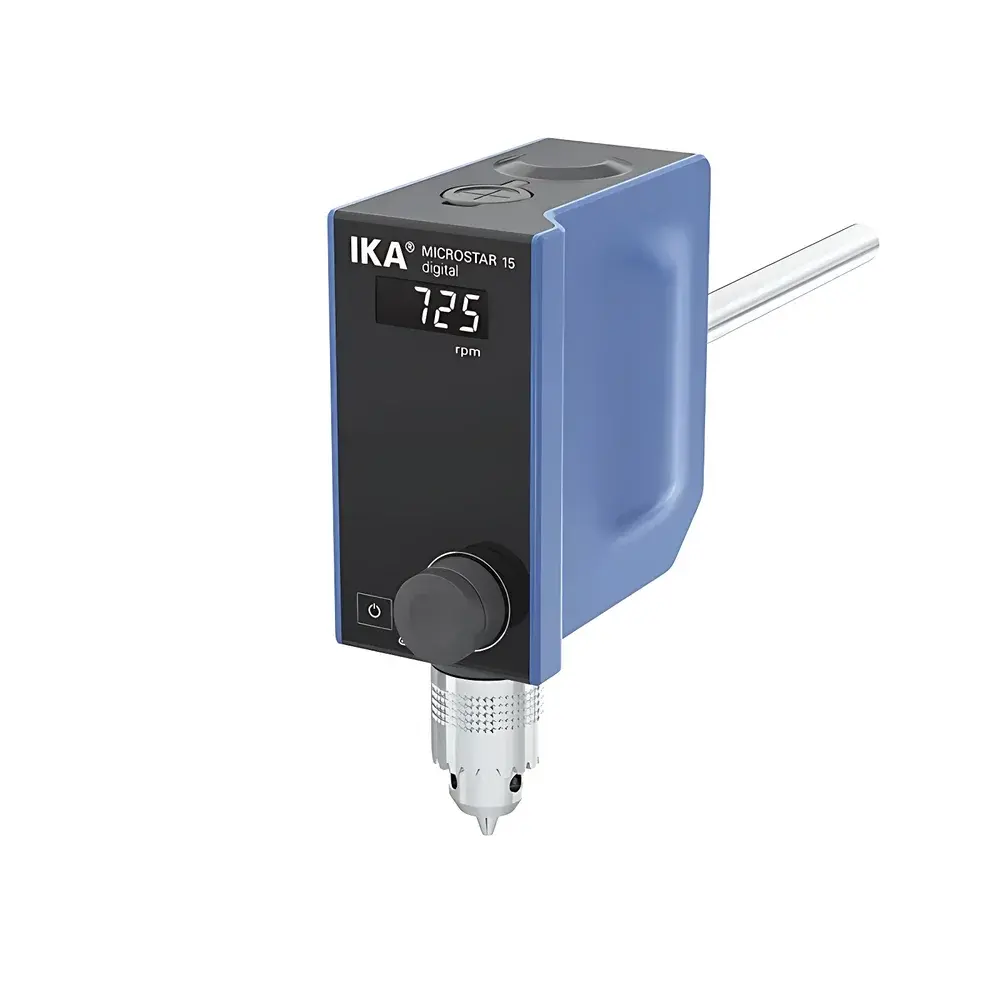
IKA MICROSTAR 15 digital Overhead Stirrer
| Brand | IKA |
|---|---|
| Origin | Germany |
| Model | MICROSTAR 15 digital |
| Max. Stirring Volume (H₂O) | 10 L |
| Motor Input Power | 32 W |
| Motor Output Power | 22 W |
| Drive Type | Brushless DC Motor |
| Speed Display | LED |
| Speed Range | 0/50–1000 rpm |
| Max. Viscosity | 8000 mPa·s |
| Max. Output Power (Stirring Shaft) | 15.7 W |
| Continuous Duty Cycle | 100 % |
| Max. Torque (Shaft) | 15 N·cm |
| Speed Control | Analog Knob |
| Speed Setting Accuracy | ±1 rpm |
| Speed Measurement Deviation | ±1 % (n > 300 rpm), ±3 rpm (n < 300 rpm) |
| Clamp Type | Fixed Chuck |
| Chuck Diameter Range | 0.5–8.2 mm |
| Hollow Shaft ID | 8.5 mm |
| Hollow Shaft Insertion (at standstill) | Yes |
| Extension Arm Diameter | 13 mm |
| Extension Arm Length | 160 mm |
| Rated Torque | 0.15 N·m |
| Timer Display | None |
| Housing Material | Die-cast aluminum with thermoplastic polymer coating |
| Dimensions (W × H × D) | 60 × 173 × 126 mm |
| Weight | 1.26 kg |
| Ambient Temperature Range | 5–40 °C |
| Relative Humidity Limit | 80 % |
| Ingress Protection | IP54 (per DIN EN 60529) |
| USB Interface | Yes |
| Input Voltage | 100–240 V AC |
| Frequency | 50/60 Hz |
| Standby Power Consumption | 0.3 W |
| DC Supply | 24 V = |
| Current Draw | 1300 mA |
Overview
The IKA MICROSTAR 15 digital is a compact, high-precision overhead stirrer engineered for routine and demanding laboratory mixing applications. Designed around a brushless DC motor architecture, it eliminates carbon brush wear—ensuring long-term speed stability, low maintenance, and consistent torque delivery across its full operational range (50–1000 rpm). Its core measurement principle relies on closed-loop electronic speed regulation, where real-time feedback from the motor encoder enables dynamic correction of rotational velocity under variable load conditions—including viscous media up to 8000 mPa·s. The device operates as a standalone unit with no external controller required, making it ideal for integration into fume hoods, gloveboxes, or modular lab workstations. With an IP54-rated housing (DIN EN 60529), it withstands incidental splashes and dust ingress—supporting robust operation in QC labs, academic research settings, and pilot-scale formulation environments.
Key Features
- Brushless DC motor technology ensures zero brush degradation, extended service life, and repeatable performance over thousands of operating hours.
- LED-based digital speed display provides immediate, glare-free readout with ±1 rpm setting resolution and traceable calibration behavior per ISO/IEC 17025-compliant usage protocols.
- Hollow shaft design (8.5 mm internal diameter) allows insertion of temperature probes, pH electrodes, or sampling needles without interrupting agitation—enabling real-time process monitoring during reaction or dissolution studies.
- Fixed chuck system accommodates standard stirring rods from 0.5 mm to 8.2 mm diameter; quick-release mechanism simplifies tool changes while maintaining concentricity and runout control (< 0.15 mm).
- Integrated USB interface supports firmware updates and future software enhancements—ensuring compatibility with evolving laboratory informatics infrastructure and audit-ready configuration management.
- Energy-efficient operation: draws only 0.3 W in standby mode and complies with IEC 62301 ed.3 for low-power standby consumption, supporting sustainability-focused lab certification frameworks (e.g., LEED EBOM, Green Lab Certification).
Sample Compatibility & Compliance
The MICROSTAR 15 digital handles aqueous, organic, and semi-viscous samples up to 10 L volume (water-equivalent), including polymer solutions, suspensions, emulsions, and cell culture media. Its torque output (15 N·cm peak) and thermal management allow uninterrupted operation at maximum rated speed—even under sustained high-viscosity loads. The unit conforms to essential safety and electromagnetic compatibility standards: EN 61000-6-2 (immunity), EN 61000-6-4 (emission), and EN 61010-1 (safety requirements for electrical equipment for measurement, control, and laboratory use). While not intrinsically rated for hazardous areas, its IP54 enclosure permits safe deployment in non-classified wet laboratories compliant with ISO 15190 and CLSI GP26-A4 guidelines.
Software & Data Management
Though operating as a dedicated hardware instrument without onboard data logging, the MICROSTAR 15 digital’s USB port enables direct connection to host PCs for firmware revision tracking and version-controlled updates. When integrated with third-party lab information systems (LIMS) or electronic lab notebooks (ELN), users may record operational parameters—including speed setpoint, duration, and ambient conditions—via manual entry or API-linked metadata ingestion. The device supports 21 CFR Part 11-aligned workflows when used in conjunction with validated software platforms that enforce user authentication, audit trails, and electronic signatures for critical mixing steps in pharmaceutical development or quality control testing.
Applications
- Preparation of homogeneous buffer solutions and reagent stocks in molecular biology and clinical diagnostics labs.
- Controlled dissolution testing per USP and Ph. Eur. 2.9.3, particularly for extended-release formulations requiring constant shear input.
- Mixing of catalyst slurries and heterogeneous reaction mixtures in synthetic chemistry and materials science.
- Cell suspension maintenance in bioreactor seed train operations and stem cell expansion protocols.
- Viscosity-dependent homogenization of cosmetic emulsions and food-grade suspensions during R&D scale-up.
FAQ
Does the MICROSTAR 15 digital support external speed control via analog voltage or RS232?
No—speed is adjusted exclusively via the front-panel rotary knob; no analog or serial remote interface is provided.
Can the hollow shaft accommodate PT100 temperature sensors with standard sheath diameters?
Yes—its 8.5 mm internal diameter accepts common 6 mm OD stainless steel-sheathed PT100 probes without mechanical interference.
Is the unit suitable for continuous operation over 8-hour shifts?
Yes—rated for 100% duty cycle at all speeds within specified ambient conditions (5–40 °C, ≤80% RH).
What is the maximum recommended vessel diameter for optimal vortex control with this stirrer?
For stable operation and minimal splashing, use vessels with internal diameters between 60 mm and 250 mm—consistent with ISO 8573-1 guidance for mechanical agitation geometry.
Does IKA provide calibration certificates traceable to national standards?
Factory calibration is performed per internal SOP; optional UKAS-accredited calibration services are available through authorized IKA service centers upon request.



