
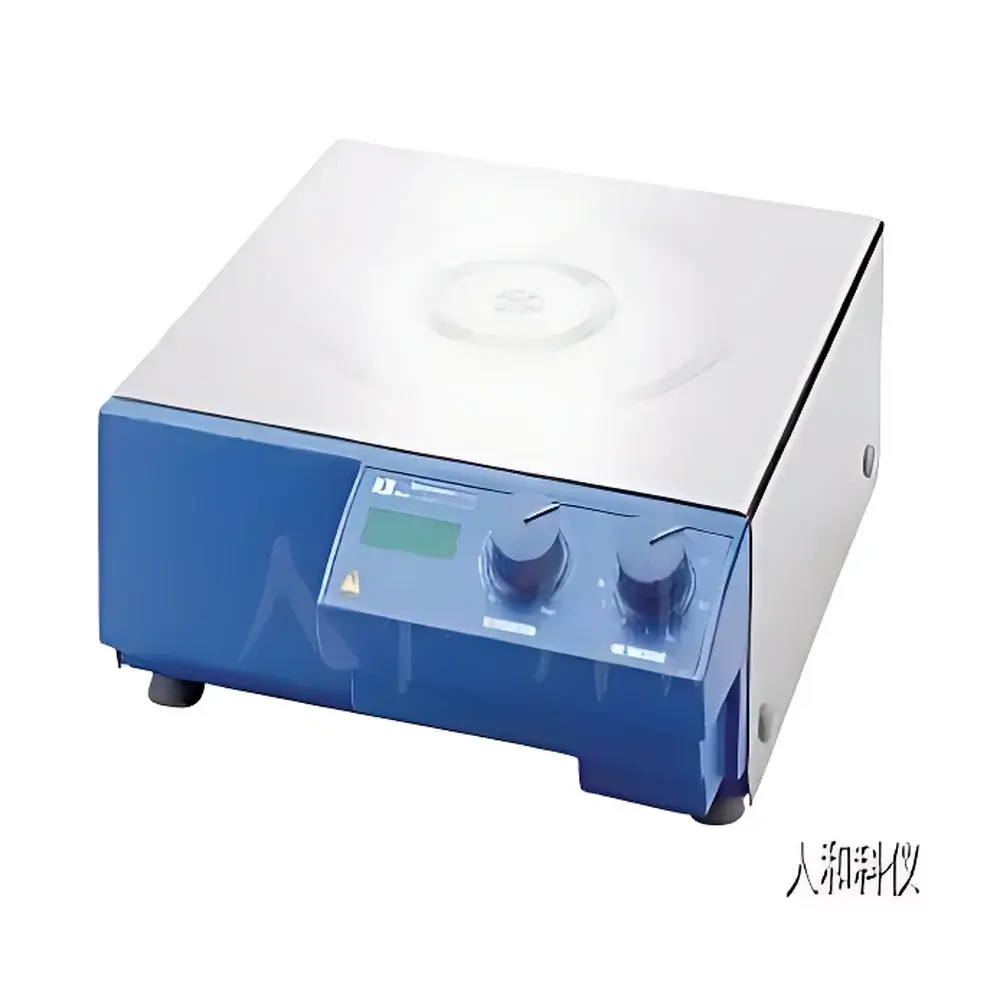
IKA Midi MR 1 digital Magnetic Stirrer
| Brand | IKA |
|---|---|
| Origin | Germany |
| Model | Midi MR 1 digital |
| Instrument Type | Magnetic Stirrer |
| Maximum Stirring Volume (H₂O) | 50 L |
| Speed Range | 0–1000 rpm |
| Motor Output Power | 19 W |
| Drive Interface | RS232 & USB |
| Timer Range | 0–56 min |
| Stir Bar Max Length | 80 mm |
| Working Plate Material | Stainless Steel 1.4301 |
| Plate Dimensions | 350 × 350 mm |
| Device Dimensions (W × H × D) | 360 × 110 × 430 mm |
| Weight | 10.7 kg |
| Ambient Temperature Range | 5–40 °C |
| Relative Humidity Limit | ≤80 % |
| Protection Class | IP21 (DIN EN 60529) |
| Input Voltage | 100–120 V / 230 V, 50/60 Hz |
| Input Power | 70 W |
Overview
The IKA Midi MR 1 digital is a high-torque, non-heating magnetic stirrer engineered for robust, long-duration mixing of low- to medium-viscosity liquids in research laboratories, quality control environments, and industrial R&D settings. Designed around a precision-controlled brushless DC motor and optimized magnetic coupling architecture, it delivers stable rotational motion across its full speed range (0–1000 rpm) with minimal thermal drift or mechanical vibration. Unlike hotplate stirrers, the Midi MR 1 digital separates mixing functionality from thermal control—making it ideal for applications requiring strict temperature independence, such as pH-sensitive buffer preparation, enzymatic reactions, or solvent-based homogenization where exothermic heating must be avoided. Its rigid stainless steel (1.4301) top plate ensures dimensional stability under load and resists corrosion from common laboratory reagents, while the compact yet ergonomic footprint supports integration into fume hoods, laminar flow cabinets, or multi-instrument benchtop configurations.
Key Features
- High-output 19 W brushless motor delivering consistent torque up to 50 L (H₂O), enabling reliable stirring of viscous solutions without stalling
- Digital LED display with real-time rpm readout and intuitive push-button interface for precise speed selection and timer activation
- Programmable timer function (0–56 minutes) with automatic shut-off or continuous operation mode for unattended batch processing
- Dual serial interfaces (RS232 and USB) supporting direct connection to PCs for remote parameter control, data logging, and instrument integration into LIMS or ELN systems
- IP21-rated enclosure compliant with DIN EN 60529, providing protection against vertically falling drips and solid objects >12.5 mm—suitable for general laboratory use under controlled environmental conditions (5–40 °C, ≤80 % RH)
- Stainless steel 1.4301 working surface (350 × 350 mm) offering chemical resistance, flatness tolerance <0.1 mm/m, and compatibility with standard PTFE- or glass-coated stir bars up to 80 mm in length
Sample Compatibility & Compliance
The Midi MR 1 digital is validated for use with aqueous, organic, and mildly aggressive media—including diluted acids, bases, alcohols, and hydrocarbon solvents—provided appropriate stir bar coating (e.g., PTFE, PTFE/glass, or ceramic) is selected. It meets CE marking requirements under the EU Machinery Directive 2006/42/EC and Low Voltage Directive 2014/35/EU. While not classified as a medical device or GMP-grade instrument, its repeatable speed control, audit-ready digital interface, and stable mechanical design support GLP-aligned workflows. The absence of integrated heating eliminates thermal interference in calorimetric assays or temperature-critical dissolution testing—making it suitable for method development per USP & Ph. Eur. general chapters on agitation uniformity.
Software & Data Management
Via the included IKA Labworldsoft™ communication software (or third-party serial terminal applications), users can configure speed profiles, initiate timed runs, and export timestamped rpm logs in CSV format. Both RS232 and USB virtual COM port protocols support command-line instruction sets (e.g., “SPEED=850”, “TIMER=3000”) for scripting in Python, LabVIEW, or MATLAB environments. All interface transactions are non-volatile and retain configuration after power cycling. For regulated environments, the system supports 21 CFR Part 11-compliant audit trails when deployed with validated software layers and user access controls—though native electronic signature capability requires external LIMS integration.
Applications
- Preparation of large-volume buffers and culture media in microbiology and cell biology labs
- Mixing of polymer solutions, paint formulations, and colloidal suspensions during materials science characterization
- Homogenization of extraction solvents in analytical sample preparation prior to HPLC or GC analysis
- Controlled agitation in stability studies (ICH Q1A–Q5C) where thermal input must remain below ambient baseline
- Supporting ASTM D1298 (density of crude oil) and ISO 3104 (kinematic viscosity) test methods requiring standardized mechanical agitation
FAQ
Does the Midi MR 1 digital include a heating function?
No. This model is a dedicated magnetic stirrer without integrated heating. For combined heating and stirring, consider the IKA RCT basic or HS series.
What is the maximum recommended viscosity for stable operation at 50 L volume?
Optimal performance is maintained for Newtonian fluids up to ~500 mPa·s (e.g., 1% CMC solution). For higher viscosities, reduce volume or select a high-torque model such as the IKA RW 20 digital.
Is calibration required before first use?
No factory calibration is needed—the speed control system is factory-trimmed and traceable to internal reference oscillators. Optional periodic verification using an external tachometer is recommended per ISO/IEC 17025 internal quality procedures.
Can the device be mounted in a vertical orientation?
No. The unit must be operated horizontally on a stable, level surface to ensure proper magnetic coupling and prevent bearing stress or rotor misalignment.
What stir bar dimensions are optimal for 50 L mixing?
A dual-cross or octagonal PTFE-coated stir bar measuring 60–80 mm in length and 12–15 mm in diameter provides optimal vortex formation and torque transfer in cylindrical vessels ≥300 mm in diameter.



