
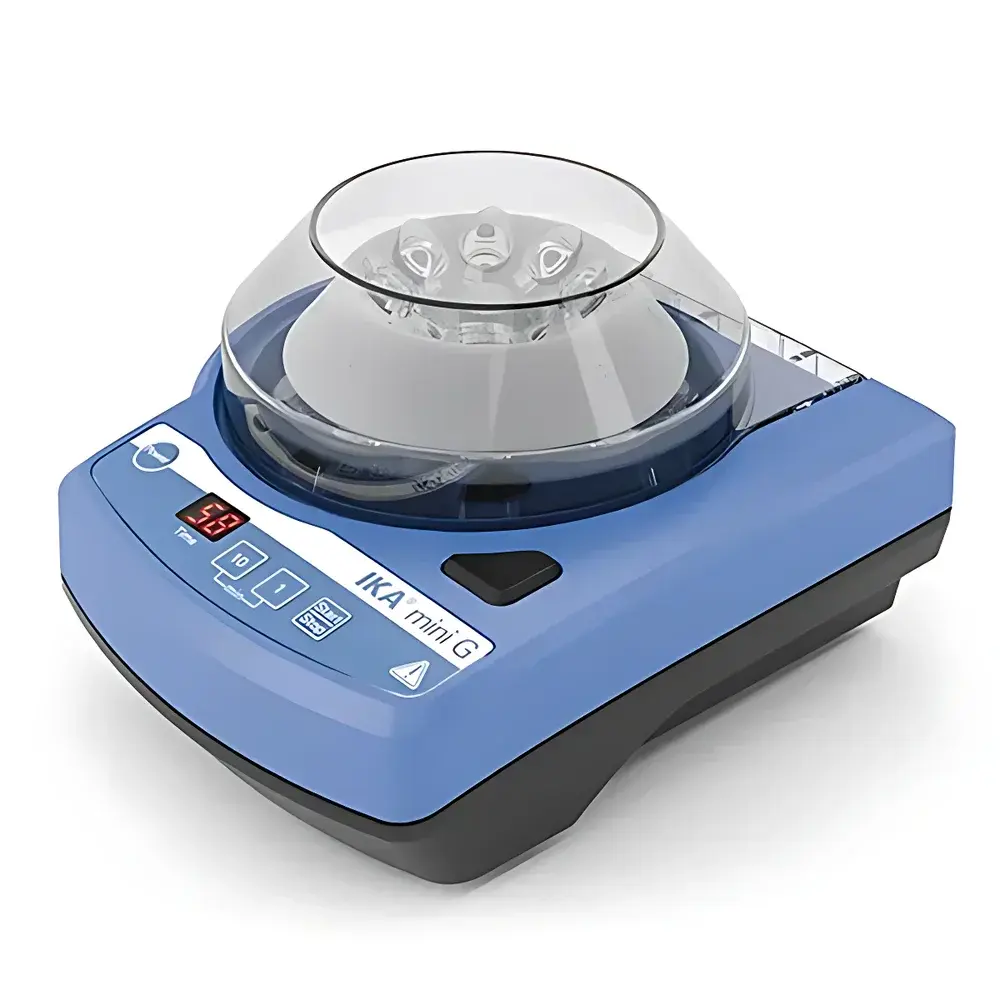
IKA mini G Compact Centrifuge
| Brand | IKA |
|---|---|
| Origin | Germany |
| Model | IKA mini G |
| Maximum Rotor Speed | 6000 rpm |
| Relative Centrifugal Force (RCF) | 2000 × g |
| Capacity | 8 × 2.0 mL tubes |
| Max. Kinetic Energy | 20 N·m |
| Motor Input Power | 12 W |
| Motor Output Power | 8 W |
| Speed Accuracy | ±0.05% of set speed |
| Timer Range | 1–99 min (LED display) |
| Continuous Operation | Yes |
| Quick-Stop Function | Yes |
| Automatic Rotor Lock Release on Lid Opening | Yes |
| Safety Lid Lock | Yes |
| Noise Level | 48 dB(A) |
| Dimensions (W×D×H) | 155 × 105 × 175 mm |
| Weight | 1.4 kg |
| Operating Ambient Temperature | 5–40 °C |
| Max. Relative Humidity | 80% RH (non-condensing) |
| Ingress Protection | IP 30 per DIN EN 60529 |
| Voltage Supply | 100–240 V AC, 50/60 Hz |
| DC Internal Supply | 24 V = |
| Current Draw | 500 mA |
| Rotor Compatibility | Fixed-angle rotor for 2.0 mL microtubes only |
| Density Limit for Samples | ≤1.2 kg/dm³ |
Overview
The IKA mini G is a compact, benchtop centrifuge engineered for precision and reliability in routine laboratory workflows requiring rapid, low-volume sample sedimentation. Designed around a brushless DC motor and fixed-angle rotor architecture, it operates on the principle of centrifugal force generation—accelerating samples radially outward to separate components based on density differentials. With a maximum rotational speed of 6000 rpm and an RCF of 2000 × g, the mini G delivers consistent sedimentation performance for microcentrifuge tubes (2.0 mL), making it ideal for applications such as nucleic acid pelleting, cell harvesting, reagent clarification, and small-scale protein precipitation. Its compact footprint (155 × 105 × 175 mm) and lightweight construction (1.4 kg) enable seamless integration into biosafety cabinets, laminar flow hoods, or crowded benchtop environments without compromising mechanical stability or thermal management.
Key Features
- Fixed-speed operation at 6000 rpm — optimized for reproducible microtube processing with minimal speed variability (±0.05% deviation from setpoint).
- Programmable digital timer — adjustable from 1 to 99 minutes with LED seven-segment display for real-time monitoring and repeatable run durations.
- Intelligent quick-stop deceleration — halts rotation within seconds upon lid opening or emergency stop activation, enhancing operator safety and workflow efficiency.
- Tool-free rotor exchange — integrated mechanical latch allows secure rotor installation and removal without auxiliary tools, minimizing cross-contamination risk and downtime.
- Acoustically optimized housing — engineered vibration-damping structure and balanced rotor assembly limit operational noise to 48 dB(A), supporting quiet operation in shared lab spaces.
- Integrated safety interlocks — motor inhibition until lid is fully closed and locked; automatic rotor brake engagement when lid opens during operation.
- Universal power compatibility — auto-ranging 100–240 V AC input with internal 24 V DC conversion ensures stable performance across global laboratory power infrastructures.
Sample Compatibility & Compliance
The IKA mini G accepts standard 2.0 mL conical-bottom microcentrifuge tubes (e.g., Eppendorf-type) in its single, non-interchangeable fixed-angle rotor. Sample density must not exceed 1.2 kg/dm³ to maintain mechanical integrity and RCF accuracy. The device complies with IEC 61010-1 (Safety Requirements for Electrical Equipment for Measurement, Control, and Laboratory Use) and carries CE marking under the EU Machinery Directive. Its IP 30 rating per DIN EN 60529 indicates protection against solid objects ≥2.5 mm but no ingress protection against water—consistent with typical dry-lab centrifuge deployment. While not certified for GLP/GMP-regulated environments out-of-the-box, its deterministic timer behavior, absence of software-based control logic, and mechanical repeatability support audit-ready documentation in quality-controlled academic or industrial labs.
Software & Data Management
The IKA mini G operates without embedded firmware or external software dependencies. All parameters—including runtime and speed—are controlled via tactile membrane keys and displayed on a dedicated LED module. No data logging, USB connectivity, or PC interface is provided. This design prioritizes simplicity, electromagnetic compatibility (EMC), and long-term functional consistency—eliminating potential failure modes associated with microprocessor-based systems. For laboratories requiring traceability, manual logbook entries synchronized with timer output satisfy basic ALCOA+ principles (Attributable, Legible, Contemporaneous, Original, Accurate) when paired with standardized SOPs.
Applications
- Routine pelleting of bacterial or mammalian cells from suspension cultures (e.g., post-transfection or post-harvest wash steps).
- Clarification of lysates prior to chromatography or electrophoresis.
- Concentration of dilute DNA/RNA solutions using ethanol precipitation protocols.
- Removal of insoluble aggregates from antibody or enzyme preparations.
- Preparatory spin-down of PCR/qPCR reaction mixtures before thermal cycling.
- Quality control checks in diagnostic reagent manufacturing where rapid, discrete batch processing is required.
FAQ
Is the IKA mini G suitable for use with hazardous or biohazardous samples?
Yes—when used with sealed tube caps and appropriate PPE, and operated inside a certified biosafety cabinet for containment-sensitive work.
Can the rotor be autoclaved?
No—the fixed-angle rotor is not autoclavable; cleaning is recommended with 70% ethanol or mild detergent and air drying.
Does the device support variable speed settings?
No—it operates exclusively at 6000 rpm; speed is not adjustable.
What maintenance is required?
Routine wiping of housing and rotor chamber; periodic visual inspection of rotor threads and lid seal integrity; no scheduled lubrication or calibration is specified by IKA.
Is the IKA mini G compliant with FDA 21 CFR Part 11?
No—its standalone, non-networked design lacks electronic records, audit trails, or user authentication features required for Part 11 compliance.



