
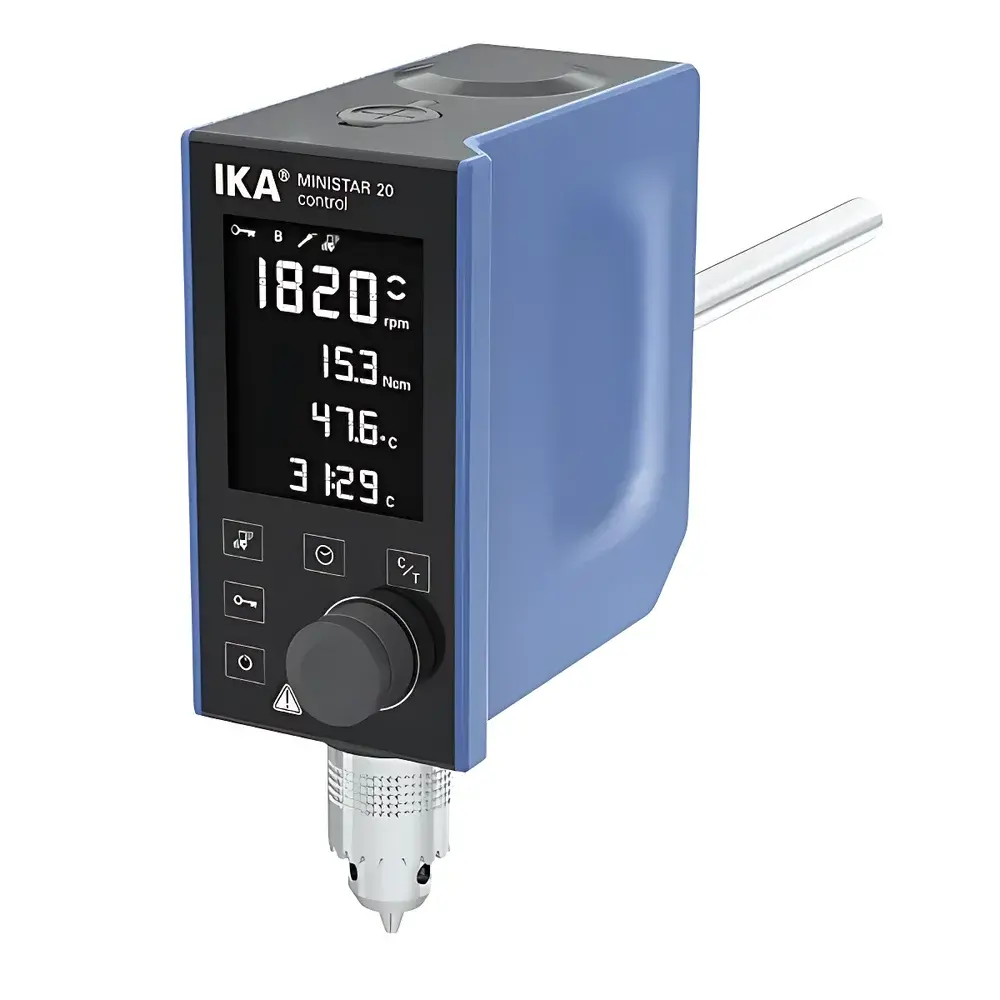
IKA MINISTAR 20 control Overhead Stirrer
| Brand | IKA |
|---|---|
| Origin | Germany |
| Model | MINISTAR 20 control |
| Motor Input Power | 60 W |
| Motor Output Power | 46 W |
| Speed Range | 0/50–2000 rpm |
| Max. Viscosity | 10,000 mPa·s |
| Max. Volume (H₂O) | 15 L |
| Torque | 20 N·cm |
| Speed Setting Accuracy | ±1 rpm |
| Speed Measurement Deviation | ±3 % (at n > 300 rpm) |
| Temperature Range (with PT1000) | −10 to 350 °C |
| Temp. Measurement Accuracy | ±0.5 K (DIN EN 60751 Class A) |
| Temp. Sensor Limiting Error | ≤ ±(0.15 + 0.002× |
| Display | LCD (speed, torque, time, temp.) |
| Timer Range | 0–6000 min |
| Housing Material | Cast aluminum with thermoplastic polymer coating |
| IP Rating | IP54 |
| Dimensions (W×H×D) | 70 × 193 × 154 mm |
| Weight | 1.56 kg |
| Ambient Operating Conditions | 5–40 °C, ≤80 % RH |
| Power Supply | 100–240 V AC, 50/60 Hz |
| USB Interface | Yes |
| Bluetooth | Yes |
| Continuous Duty Cycle | 100 % |
| Shaft Clamp Range | 0.5–8.2 mm |
| Hollow Shaft ID | 8.5 mm |
| Vibration Detection | Yes (auto-shutdown) |
| Key Lock Function | Yes |
| Remote Control Range | Up to 150 m (building-dependent) |
Overview
The IKA MINISTAR 20 control is a precision-engineered overhead stirrer designed for demanding laboratory mixing and dispersion applications requiring high reproducibility, real-time parameter monitoring, and long-term operational stability. Utilizing a brushless DC motor architecture, it delivers consistent torque output across its full speed range (0/50–2000 rpm), eliminating carbon wear and enabling maintenance-free continuous operation under load. Its microprocessor-based control system ensures stable rotational speed even during viscosity fluctuations—critical for non-Newtonian fluid processing, polymer dissolution, or suspension homogenization. The device integrates direct torque measurement (0–20 N·cm), real-time temperature monitoring via PT1000 sensor interface, and programmable timing functions, making it suitable for GLP-compliant workflows where traceability and parameter logging are essential.
Key Features
- Brushless DC motor with 46 W nominal output power and 42 W shaft power delivery—engineered for thermal efficiency and extended service life
- High-resolution LCD display showing simultaneous readouts of speed, torque, elapsed time, and temperature (when PT1000 probe connected)
- Precision speed control via analog rotary dial with ±1 rpm setting resolution and ±3 % measurement deviation above 300 rpm
- Hollow stainless steel stirring shaft (ID 8.5 mm) allows in-situ insertion of temperature probes or pH electrodes without interrupting agitation
- Vibration detection system automatically halts operation upon detecting mechanical instability—protecting both sample integrity and drive unit
- Integrated key lock function prevents accidental parameter changes during unattended runs
- USB and Bluetooth interfaces support firmware updates, data export (CSV), and remote configuration via IKA’s labworldsoft® software platform
- IP54-rated housing constructed from die-cast aluminum with chemical-resistant thermoplastic coating—suitable for use in fume hoods and wet environments
- Programmable timer (0–6000 min) with automatic shutdown and audible alert; supports multi-step protocols when synchronized with external controllers
Sample Compatibility & Compliance
The MINISTAR 20 control accommodates vessels up to 15 L volume (water-equivalent) and handles viscosities up to 10,000 mPa·s using standard anchor, paddle, or propeller impellers. Its clamping system accepts stirring rods from 0.5 to 8.2 mm diameter, including glass, PTFE-coated, or Hastelloy shafts. When paired with certified PT1000 sensors (DIN EN 60751 Class A), temperature measurements meet ISO/IEC 17025 traceability requirements. The unit complies with IEC 61000-6-3 (EMC emission standards), IEC 61000-6-2 (immunity), and carries CE marking per EU Machinery Directive 2006/42/EC. For regulated environments, audit trails generated via labworldsoft® can be configured to satisfy FDA 21 CFR Part 11 electronic record requirements when deployed with appropriate user access controls and electronic signatures.
Software & Data Management
IKA labworldsoft® provides native integration for the MINISTAR 20 control, enabling centralized parameter logging, protocol scheduling, and cross-device synchronization. All measured values—including speed, torque, temperature, and elapsed time—are timestamped and exportable in CSV format for post-processing in MATLAB, Python, or LIMS platforms. Firmware updates are delivered over USB or Bluetooth, ensuring compatibility with evolving cybersecurity and regulatory expectations. The software supports role-based user permissions, session history review, and configurable alarm thresholds—facilitating adherence to internal SOPs and external quality frameworks such as ISO 9001 or GMP Annex 11.
Applications
- Preparation of viscous pharmaceutical suspensions and ointment bases under controlled shear conditions
- Chemical synthesis requiring precise temperature–agitation coupling (e.g., Grignard reactions, emulsion polymerization)
- Materials science workflows involving nanoparticle dispersion in high-viscosity matrices
- Environmental testing of sediment resuspension kinetics in simulated aquatic systems
- Food R&D for texture development in dairy analogs and plant-based formulations
- Academic research in rheology education, where real-time torque vs. speed profiling illustrates yield stress behavior
FAQ
Can the MINISTAR 20 control operate continuously at maximum torque?
Yes—it is rated for 100 % duty cycle under load, provided ambient temperature remains within 5–40 °C and relative humidity does not exceed 80 %.
Is the PT1000 temperature interface compatible with third-party probes?
Only DIN EN 60751 Class A PT1000 sensors are guaranteed for accuracy; deviations may occur with non-certified probes due to impedance mismatch.
Does the vibration detection system require calibration?
No—the algorithm is factory-calibrated and self-adaptive; however, mechanical alignment of the stirrer arm and vessel centering must be verified prior to critical runs.
What data security measures apply to Bluetooth communication?
Bluetooth pairing uses AES-128 encryption; connections are authenticated via device-specific keys stored in secure memory—no credentials are transmitted over the air.
How is compliance with 21 CFR Part 11 achieved?
Through labworldsoft®’s optional Electronic Signature Module, which enforces user authentication, audit trail generation, and immutable record archiving—subject to proper site validation per ALCOA+ principles.



