
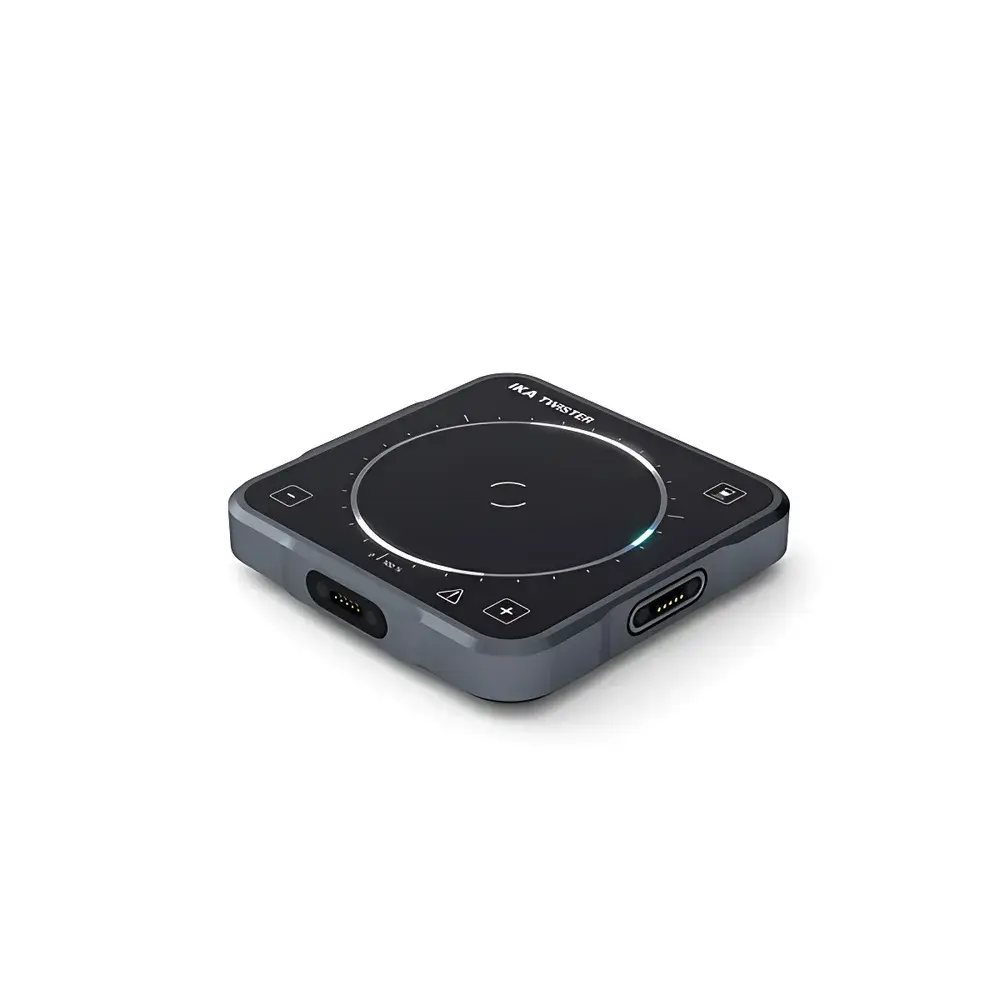
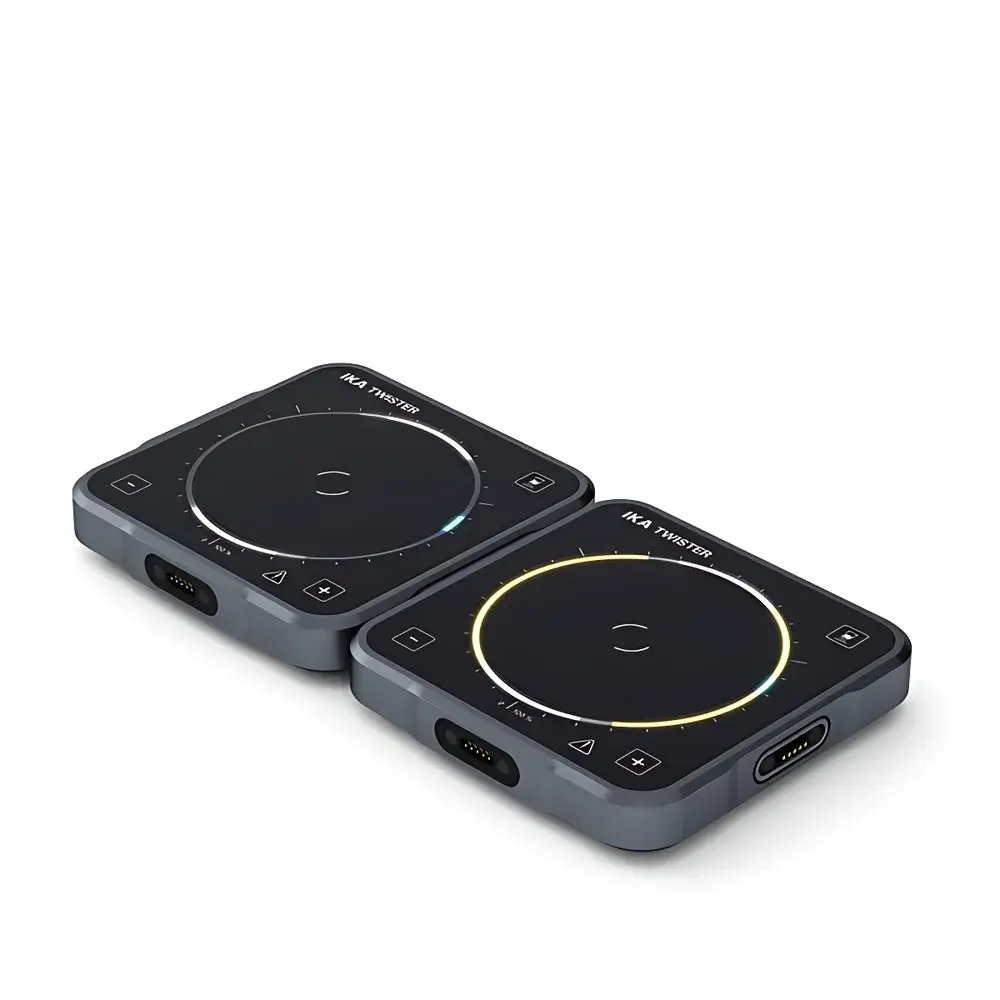
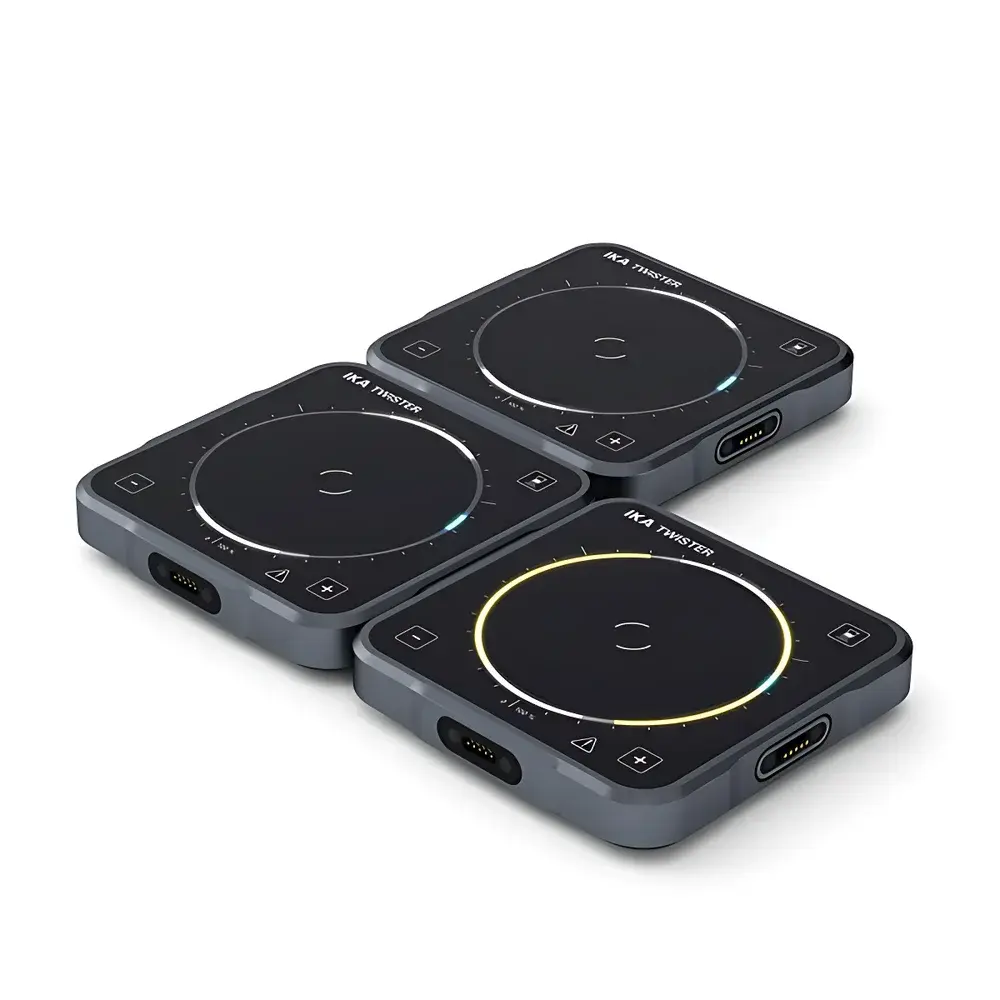
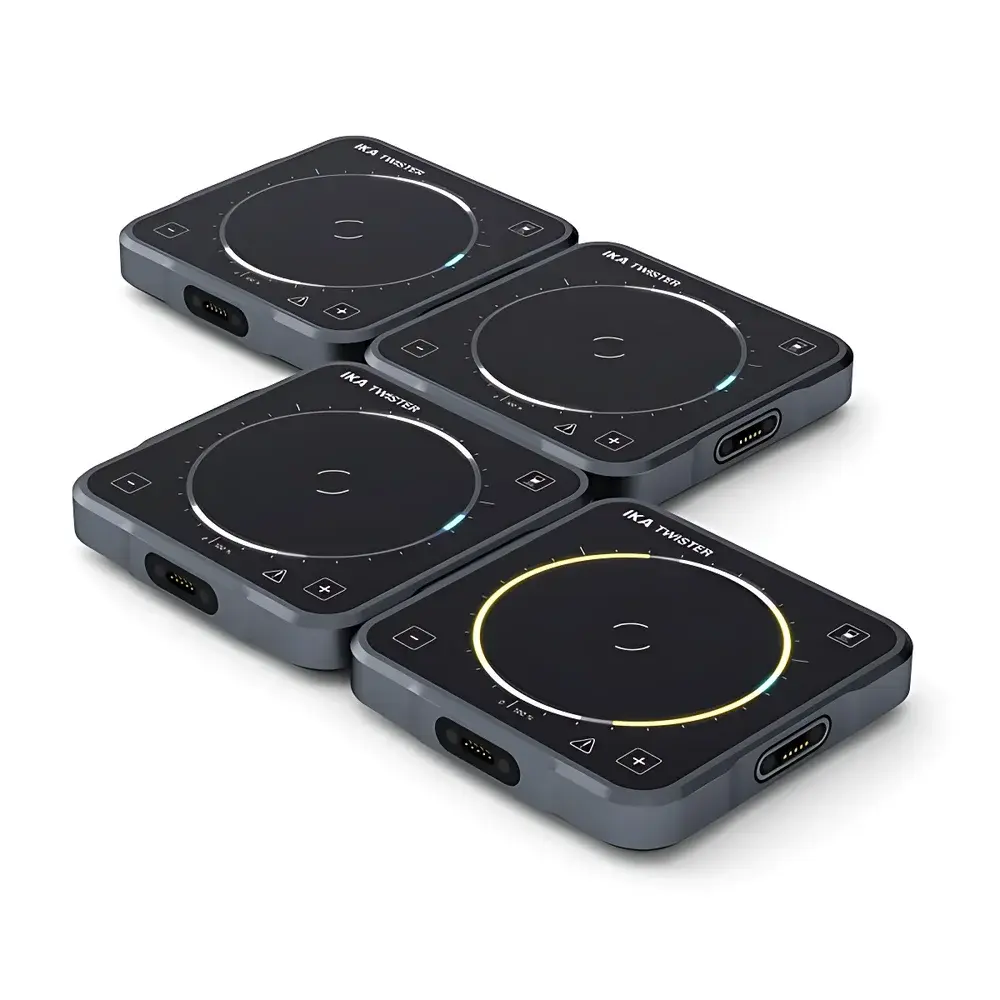
IKA MIXSTER Modular Magnetic Stirrer System
| Brand | IKA |
|---|---|
| Origin | Germany |
| Manufacturer | IKA-Werke GmbH & Co. KG |
| Model | MIXSTER |
| Instrument Type | Modular Magnetic Stirrer & Vortex Shaker |
| Max. Stirring Volume | 5 L (H₂O) |
| Speed Range | 100–3000 rpm |
| Temperature Operation | Ambient (RT), IP66-rated |
| Motor Output | 5 W |
| Dimensions | 135 × 24 × 135 mm |
| Weight | 0.6 kg |
| Power Input | 100–240 V, 50/60 Hz |
| Protection Class | IP66 |
| Interface Options | RS232 / USB / Bluetooth / Wi-Fi (optional) |
| Control | Touch-sensitive capacitive interface with 360° LED ring display |
| Beaker Recognition | Integrated optical detection system |
| Auto-start | Capacitive activation via vessel or accessory contact |
| Programmable Modes | Intermittent operation, reverse rotation, viscosity trend monitoring, jump detection, timer (6 s – 1 min), graphical speed profiles |
| Expandable Configuration | Up to 30 units via HUB (2–16 units standalone |
| Stirring Points | Single-point base unit |
Overview
The IKA MIXSTER is a CE-certified, modular magnetic stirrer system engineered in Staufen, Germany, for high-precision, adaptive liquid handling in regulated laboratory environments. Unlike conventional fixed-function stirrers, the MIXSTER implements a reconfigurable architecture grounded in Couette flow principles—leveraging rotating magnetic fields to drive PTFE- or ceramic-coated stir bars within vessels. Its core innovation lies in functional duality: a single compact unit serves as both a high-torque magnetic stirrer (up to 3000 rpm, 5 L aqueous load) and, via interchangeable accessories, a vortex shaker (TW.VX), multi-position platform (TW.IX, 9 positions), or low-shear macro-mixer (STICKMAX II). This eliminates hardware redundancy while maintaining full traceability and operational integrity—critical for GLP-compliant workflows in pharmaceutical QC, academic synthesis labs, and bioprocess development.
Key Features
- Modular Scalability: Base unit operates standalone or integrates into networks of up to 30 synchronized units via optional HUB controller; supports hierarchical master-follower topology with real-time parameter mirroring or independent task assignment per node.
- Capacitive Touch Activation: No physical buttons—stirring initiates automatically upon hand proximity to vessel or accessory, reducing cross-contamination risk and enabling glove-compatible operation.
- Optical Beaker Recognition: Integrated sensor detects vessel presence and geometry, auto-adjusting speed ramp profiles and engaging safety interlocks before motor start.
- IP66-Rated Enclosure: Fully sealed against high-pressure water jets and dust ingress; validated for continuous operation in incubators (≤40 °C) and wet-lab environments requiring frequent decontamination.
- Dual-Direction & Intermittent Control: Programmable clockwise/counterclockwise alternation and pulse-mode operation support heterogeneous suspension, crystallization kinetics, and enzymatic reaction quenching protocols.
- Real-Time Viscosity Trend Monitoring: Embedded torque sensing enables non-invasive tracking of apparent viscosity changes during polymerization or sol-gel transitions without external rheometers.
Sample Compatibility & Compliance
The MIXSTER accommodates standard laboratory glassware (vials: 0.005–0.5 L; beakers/flasks: 0.5–5 L) using stir bars 10–30 mm in length. Its glass top plate (124 × 124 mm) ensures thermal stability and chemical resistance to common solvents (e.g., ethanol, acetone, dilute acids/bases). All configurations comply with DIN EN 61000-6-3 (EMC), DIN EN 61000-6-2 (immunity), and IEC 61010-1 (safety). Optional interfaces (RS232, USB, Bluetooth, Wi-Fi) support 21 CFR Part 11–compliant audit trails when paired with IKA LabWorld software—enabling electronic signatures, user access control, and immutable log export for FDA-regulated submissions.
Software & Data Management
IKA LabWorld software (Windows/macOS) provides centralized configuration, firmware updates, and remote monitoring of multi-unit arrays. Each MIXSTER logs timestamped events—including speed setpoint, actual RPM, torque deviation, error codes (e.g., “stir bar jump detected”), and environmental temperature—into encrypted CSV or SQL databases. Graphical profile editors allow creation of multi-step programs (e.g., ramp-to-1500-rpm → hold-3-min → reverse-rotate-20-sec → decelerate), with validation reports exportable as PDF for internal QA review. Audit trail metadata includes operator ID, device MAC address, and digital signature hash—fully aligned with ISO/IEC 17025 and EU Annex 11 requirements.
Applications
- Pharmaceutical Development: Dissolution testing of solid dosage forms under USP conditions; buffer preparation for chromatography mobile phases.
- Materials Science: Homogenization of nanoparticle suspensions (e.g., TiO₂ in ethanol) prior to DLS analysis; controlled shear mixing of hydrogels.
- Molecular Biology: Gentle lysis of bacterial cultures using STICKMAX II; vortex-assisted DNA extraction with TW.VX on 96-well plates.
- Environmental Testing: EPA Method 3510C-compliant sample homogenization for nutrient analysis; ASTM D7042 viscosity screening of biodiesel blends.
- Teaching Labs: Student-safe demonstration of Newtonian vs. non-Newtonian fluid behavior via real-time torque feedback.
FAQ
Can the MIXSTER operate inside a CO₂ incubator?
Yes—the IP66-rated housing and ambient-temperature design permit uninterrupted use at ≤40 °C and ≤80% RH, including standard humidified incubators.
Is calibration required for regulatory compliance?
While no routine recalibration is mandated, IKA provides NIST-traceable factory calibration certificates (speed ±2% at 1500 rpm, torque linearity ±3%). Annual verification against reference standards is recommended per ISO/IEC 17025 Clause 6.5.
How does the HUB manage synchronization across >16 units?
The HUB uses deterministic time-sliced CAN bus communication with sub-10-ms latency; all follower units maintain phase coherence within ±15 rpm under dynamic load changes.
Does beaker recognition work with opaque or metal containers?
No—it relies on optical transmission through transparent or translucent materials (glass, PP, PC); stainless steel or aluminum vessels require manual activation.
What happens during a power interruption?
The device retains last-used parameters in non-volatile memory and resumes operation at pre-interruption speed upon restoration—no reconfiguration needed.



